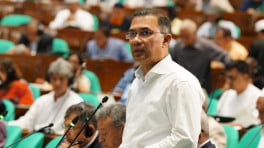
National Citizen Party signs July Charter
The July National Charter 2025 was signed on 17 October 2025, amid the boycott of several political parties, including the National Citizen Party (NCP)

The National Citizen Party (NCP) signed the July National Charter at the chief adviser's residence, Jamuna, this evening (16 February).
NCP Convenor Nahid Islam and Member Secretary Akhtar Hossain signed the charter on behalf of the party in presence of Chief Adviser Muhammad Yunus, the CA's Press Wing said in a statement.
There were no note of dissent from the party.
 Keep updated, follow The Business Standard's Google news channel

NCP Joint Convener Sarwar Tushar, Joint Convener Javed Rasin, Joint Convener Monira Sharmin, and Joint Member Secretary Zahirul Islam Musa were present at the event.
Vice-Chairman of the National Consensus Commission Professor Ali Riaz, commission member Badiul Alam Majumdar, and Special Assistant to the chief adviser Monir Haider were also present.
Addressing attendees, the chief adviser said, "The nation had faith that the NCP would sign this charter. Today that faith has been fulfilled. The July National Charter has been realised. Thank you to the NCP for participating in this historic work."

He urged all involved to ensure that the charter's provisions are implemented at every level, with the goal of building a new Bangladesh rooted in humanity.
He also announced that the oath-taking ceremony for members of the new parliament will be held tomorrow, wishing everyone success in the days ahead.
Nahid Islam said the MPs elected from the NCP will take their oaths tomorrow.
"We are taking two oaths simultaneously. We are committed to fulfilling the trust that the people have placed in us," he said.
He added that, while his party was the last to sign the July Charter, it has been among the most active in working to implement its commitments.
The much-awaited "July National Charter 2025" was signed on 17 October 2025, amid the boycott of several political parties, including the National Citizen Party (NCP).
Chief Adviser Muhammad Yunus, members of National Consensus Commission and leaders of different political parties signed the charter at South Plaza of the Jatiya Sangsad Bhaban in Dhaka.
Besides NCP, the ceremony was also boycotted by the Communist Party of Bangladesh (CPB), the Bangladesh Samajtantrik Dal (Basad), the Bangladesher Samajtantrik Dal (Marxist), and the Bangladesh Jatiya Samajtantrik Dal (Jasad).
Meanwhile, Gonoforum attended the ceremony but didn't sign the charter, according to a Prothom Alo report.
On 25 October, NCP Member Secretary Akhter Hossen said the party will sign the July Charter only after the assurance of its implementation through an order and referendum.

"The signing of the July Charter was merely a formality. Its implementation will only be ensured through the issuance of an order and a referendum. The NCP will sign the charter only after getting such assurance, Akhter said while talking to reporters after a meeting with the National Consensus Commission.
The charter
The 40-page dossier outlines the political history of Bangladesh, covering the British colonial period, the historic Language Movement of 1952, the education movements of 1962, the autonomy movement of 1966, and the mass uprising of 1969.
It also recalls the 1970 general elections, the Liberation War of 1971, and the establishment of a one-party state through constitutional amendments in 1975.
The charter noted that "following various political developments, the country returned to democracy through the parliamentary elections of 1979, initiated by the reintroduction of a multi-party system in 1978. However, that democratic path was short-lived."
It further highlights that between 2009 and 2024, state institutions were dominated by autocratic practices favouring certain individuals, families, and groups.
The charter criticised the three consecutive controversial elections of 2014, 2018, and 2024, saying they undermined the electoral system, politicised the judiciary, law enforcement and public administration and facilitated corruption.
The charter also reflects on the persistent democratic movements of the last 16 years, including the road safety movement in 2018, the anti-quota movement, and the student-led anti-discrimination movement, culminating in the broad-based mass uprising against fascism in July 2024.
Finally, the charter contains a seven-point commitment, urging political party representatives to sign it and uphold the will of the people expressed in the July 2024 uprising, grounded in democratic principles and national consensus.