



Who Will Fund the Future as Foreign Debt Gets Costlier?
As Bangladesh nears its graduation from LDC status, a deepening crisis in banking and capital markets threatens its ability to finance development, exposing long-standing failures of governance and regulation
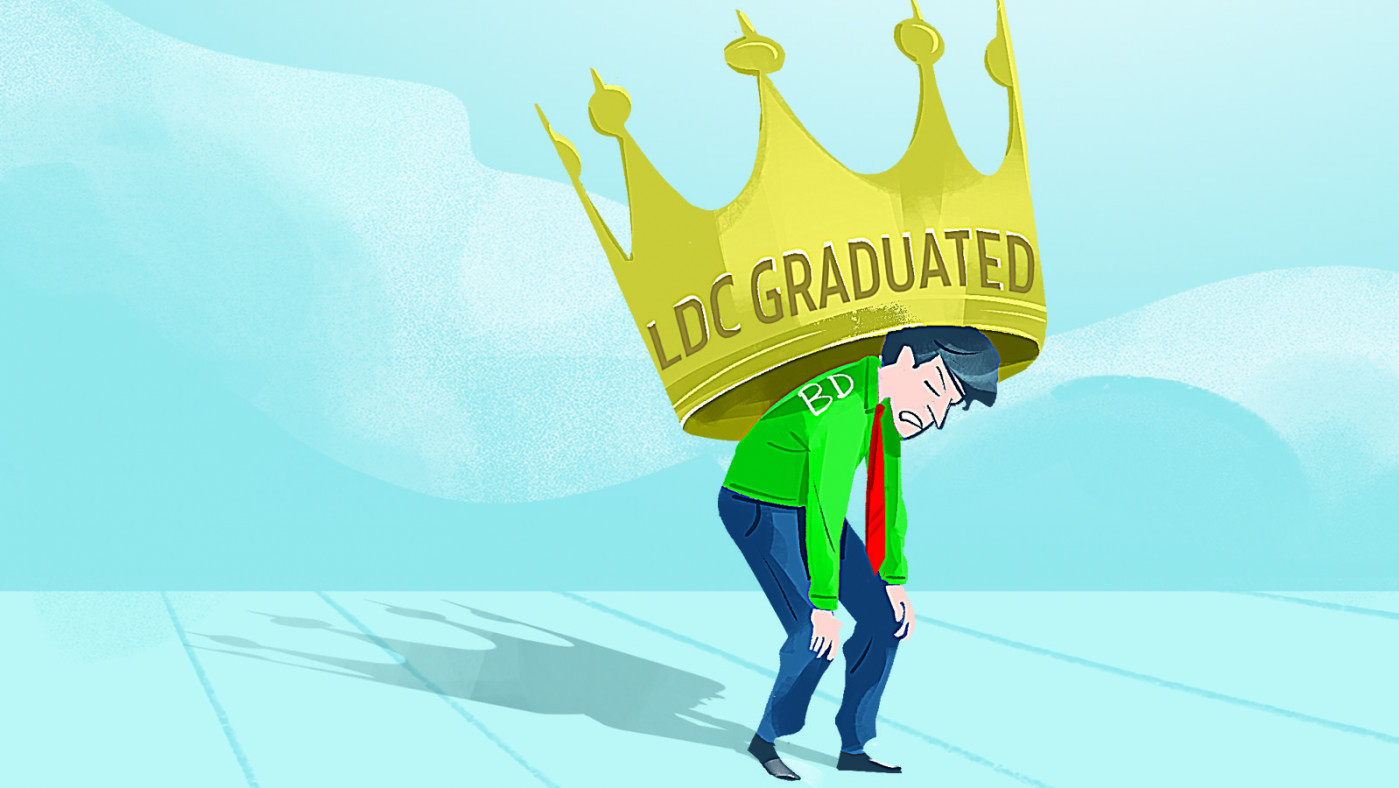
While Bangladesh prepares to graduate from the United Nations' list of Least Developed Countries in November 2026, the country is confronting a serious funding dilemma. After fifty long years of development, Bangladesh will attain this status, a milestone that will inevitably increase the cost of foreign borrowing.
To sustain its development momentum in the near future and to act as a responsible global citizen, the country will therefore need to tap domestic sources of funding. At present, however, both the banking system and the Dhaka Stock Exchange are suffering from a profound crisis of confidence.
The gravity of the situation can be gauged from staggering and unprecedented figures. As of mid-2025, non-performing loans (NPLs) in Bangladesh had reached a record high, topping Tk 4.20 trillion, or Tk4.2 lakh crore, by March 2025.
This represents 24.13% of total outstanding loans, although some reports place the figure as high as 34.6%—the highest since 2000—equivalent to roughly Tk 5.99 trillion in defaulted loans. More alarmingly, over 80% of these classified loans are reportedly unrecoverable, signalling a severe haemorrhaging of funds from the financial sector.
 Keep updated, follow The Business Standard's Google news channel
The newly formed Sammilito Islami Bank PLC, created through the amalgamation of five ailing Islamic banks, was a drastic, surgical measure intended to cure a deeply troubled institution. Ironically, the amalgamation itself stands as testimony to the vulnerability of the system that allowed such weaknesses to fester. The process, while necessary, is unlikely to be a definitive remedy for the structural malaise embedded within the banking sector.
The root causes driving the country towards this crisis are persistent and symptomatic of governance failure. Irregular lending practices, widespread lack of due diligence, and political interference have all been identified as major contributors to the surge in NPLs.
The problem is particularly acute in public commercial banks, where 44.6% of loans are classified as non-performing. This reflects a culture of impunity for major loan defaulters and chronic weaknesses in governance, which have eroded the foundations of public financial institutions.
These problems are compounded by structural deficiencies, including the absence of a public or centralised register of beneficial ownership and limited autonomy of the Bangladesh Bank. Experts argue that because the central bank is not adequately shielded from political and business pressures, it cannot function as a neutral regulator capable of enforcing rules and penalising large defaulters. As a result, the NPL crisis continues to spiral.
Parallel governance failures have also undermined confidence in the capital market, placing additional strain on the country's finances. The Dhaka Stock Exchange (DSE), intended to be a reliable vehicle for capital mobilisation, is instead plagued by instability driven by manipulation and insider trading. The principal regulator, the Securities and Exchange Commission (SEC), is widely viewed as ill-equipped and ineffective in curbing such practices.
The consequences have been severe, most notably in the collapse of investor confidence. Market indicators reflect this stagnation: net foreign investment in listed stocks stood at minus $66 million during the July–October period of fiscal year 2025–26, underscoring the lack of confidence among international portfolio investors. For domestic retail investors—who should form the backbone of the market—participation has increasingly resembled a game of chance rather than informed investment.
The combined impact of crises in both banking and capital markets has become a significant drag on the national economy. Private investment has remained stuck at around 23–24% of GDP for nearly a decade, well below the level required to propel Bangladesh towards upper-middle-income status.
The Dhaka Stock Exchange, meant to mobilise capital, is plagued by manipulation and insider trading, while the Securities and Exchange Commission struggles to curb these abuses.
Record-high NPLs undermine bank liquidity, constrain credit to productive sectors, and pose systemic risks to financial stability, creating a lose-lose environment for entrepreneurs and savers alike. As LDC graduation approaches and foreign borrowing becomes more expensive, the inability to mobilise and protect domestic resources threatens to erect a formidable barrier to continued development financing.
A long-discussed reform agenda has thus become a matter of urgent national survival. First, the Bangladesh Bank must be granted legal and operational autonomy—if not full independence—to enable fearless enforcement and recovery of bad loans, even from powerful interests.
Second, stronger legislation is required to criminalise financial malfeasance, establish a public beneficial ownership registry, and grant regulators genuine punitive authority. Third, the SEC and broader market infrastructure must undergo a comprehensive overhaul to restore integrity and attract both domestic and foreign investment.
One enduring strength of Bangladesh's economy, however, has been its remarkable capacity for resilience. Whether the next chapter in this story—sustained growth after graduation—can be written will depend on a single decisive choice: embracing the difficult transition to a rule-based financial system or persisting with a culture of impunity that will ultimately suffocate investment. With NPLs at historic highs and the countdown to graduation underway, the era of rhetoric has ended. The time for hard, uncompromising decisions has arrived.

Md Deen Islam is an Associate Professor of Economics at the University of Dhaka and Research Director of Research and Policy Integration for Development (RAPID)
Disclaimer: The views and opinions expressed in this article are those of the author and do not necessarily reflect the opinions and views of The Business Standard


