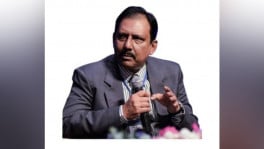
Budget has allocations for all despite resource constraints: Khosru
No class, profession, religion or community is outside this budget. This is everyone's budget, says Finance Minister Amir Khosru Mahmud Chowdhury
Finance Minister Amir Khosru Mahmud Chowdhury today (12 June) described the proposed national budget as a budget for all citizens, saying it was prepared under the principle of "Bangladesh first, Bangladesh for all" and combines regulatory reforms with expanded social protection to promote inclusive economic growth.

Speaking at a post-budget press conference at the Osmani Memorial Auditorium in Dhaka, Khosru said the government had sought to bring all sections of society into the budget framework despite resource constraints, while pursuing deregulation to lower business costs, attract investment and eventually reduce inflation.
"We have tried to bring everyone into the budget framework. No class, profession, religion or community is outside this budget. This is everyone's budget," he said.
The minister said the budget prioritises deregulation and administrative reforms alongside increased spending on social protection, education and healthcare. However, he cautioned that the full impact of the measures would take several years to materialise, adding that a broader economic turnaround is expected in the fourth or fifth year of implementation.
 Keep updated, follow The Business Standard's Google news channel
"The government won't limit itself to presenting deregulation proposals in the budget alone. All policies will be implemented within set timelines. No leniency would be shown if any ministry or official is found negligent," said the minister.
Khosru also said the budget preparation process had been completed in a short period, expressing hope that the public would recognise the effort and sacrifice involved.
He said the budget was not designed for any political party and there was no intention to create a party budget. "In the financial sector, we will not appoint party-affiliated people."
He said the government had distributed 37,000 family cards this year without involving any BNP activists or supporters, stressing that no group had been excluded from state benefits.
'Deregulation will play key role'
The finance minister has said deregulation will play a key role in attracting investment and containing inflation, adding that reforms are aimed at reducing the cost of doing business.
"We are trying to reduce the cost of doing business through reforms. This cost is added to prices and contributes to inflation. If it comes down, inflation will also ease," he said.
The minister said business approvals previously took six months to a year, often requiring multiple visits to different offices and additional informal costs. He added that inefficiencies across taxation, port operations, and logistics had significantly increased business expenses.
He acknowledged that inflation driven by external factors is difficult to control directly, but said supply chain management would be improved. Plans include maintaining a three-month stockpile of fuel and increasing reserves of food and fertiliser.
He said price control through police or other enforcement agencies would not be pursued. "We will not do that. Inflation will be managed through policy implementation," he said.
'Revising payscale would reduce corruption'
Khosru argued that a revised public-sector pay structure could help reduce corruption by easing financial pressure on government employees.
"When people are in hardship, corruption tends to increase. If a new pay structure is implemented, corruption will certainly decline," he said.
That government employees have remained under the same pay scale for 11 years despite rising inflation, while the private sector adjusts wages more frequently, he said.
Govt borrowing, tax
Khrosru said the government was shifting away from excessive reliance on domestic bank borrowing, which had previously crowded out the private sector. Next year, borrowing is expected to be reduced by Tk4,000-5,000 crore, with further reductions planned over time.
Expressing confidence in revenue targets, he said reforms in the NBR would be implemented, including separation of tax policy and collection functions.
He added that shops and restaurants across the country would be brought under the tax network, while digitalisation of the NBR would help reduce corruption.
Social investment
The minister said social investment had not been prioritised in the past, but the current budget allocates significantly more resources to social protection, education, and health to improve living standards and enhance employability at home and abroad.
He said investments are being directed towards reducing poverty, supporting low-income workers in transitioning to higher-skilled jobs, and addressing educated unemployment. A shift towards a creative economy is also expected to improve livelihoods.
Taskforce to monitor regulatory reforms
The finance minister said a high-level taskforce will monitor regulatory reforms. He said bureaucratic delays or negligence would not be tolerated.
A dedicated taskforce has been formed, alongside a website where citizens can lodge complaints over delayed services, triggering immediate action.
A seven-day deadline has been set for issuing licences. "If it takes eight days instead of seven, the responsible person will be identified. No leniency will be given," he said.
He added that no policy decision of the BNP government would remain stalled and all measures would be implemented. He also said that even 80% implementation would be enough to transform the country and take it to a new level.
No scope for whitening black money once mouza values updated: NBR chairman
Speaking at the event, NBR Chairman Abdur Rahman Khan said no new provision has been introduced this year to allow whitening of black money.
He said underreporting of property prices creates complications, where land sold for Tk5 crore is registered at Tk1 crore, leaving Tk4 crore as undisclosed but legitimate income.
He said sellers can declare such amounts by paying tax in the current fiscal year, while buyers will get a similar facility next year.
The finance minister said mouza rates remain far below market prices and a committee has been formed to update them nationwide.
He added that once mouza values reflect real market rates, scope for whitening black money through property transactions would end.
Legal steps being initiated against power contracts: Tuku
Also present at the event, Energy and Power Minister Iqbal Hassan Mahmud Tuku said legal steps are being taken over power purchase agreements signed during the Awami League tenure, particularly those linked to capacity charges and sovereign guarantees.
He said the power ministry has sought legal opinion from the law ministry, after which action will be taken on capacity charge-related deals.
To cut costs, he said duties and taxes on imported solar equipment, including batteries, have been withdrawn under a plan to generate 5,000MW of solar power by 2030. He added the benefits would take about two to two-and-a-half years to materialise.
He said despite securing maritime territory, no effective offshore gas extraction was pursued, unlike other countries that have developed and exported such resources.
Tuku said Bapex is being strengthened with five new drilling rigs. Foreign firms have been invited through tenders for offshore exploration support. He said Bangladesh will remain import-dependent until offshore gas production begins.
Referring to global disruptions, he said $2.5 billion worth of fuel was imported to ensure supply stability after tensions linked to the Iran conflict, adding that Bangladesh avoided shortages seen in places like Florida, US