Can Dhaka and Delhi find a path around key stumbling blocks?
Relations between Dhaka and Delhi have never depended on individual diplomats. But even then, the arrival of Dinesh Hiralal Trivedi creates an opportunity to refresh, if not reset relations

The new Indian high commissioner-designate has arrived in Bangladesh. Now, the question is will this herald a new beginning in the two countries' relations? The short answer is, no.
Relations between Dhaka and Delhi have never depended on individual diplomats. But even then, the arrival of Dinesh Hiralal Trivedi creates an opportunity to refresh, if not reset relations.
What distinguishes Trivedi from his predecessors is the fact that he is not a career bureaucrat. He is a politician with links to the three parties that are key to Bangladeshi interests in relation to India (although, it has to be said, the "three" parties may soon become "two" parties, as Trinamool Congress continues to unravel after their election drubbing.)
 Keep updated, follow The Business Standard's Google news channel
Trivedi was a minister in the Congress-led coalition government headed by Dr. Manmohan Singh. He was a member of parliament from Trinamool Congress, representing Barrackpore constituency in West Bengal for 10 years.
The trick, for both Trivedi and his hosts in Dhaka, would be to navigate a path around the Hasina question, address migration as a humanitarian rather than security issue and rebuild relations on matters which promise greater convergence of mutual interest.
More recently, he served in the upper house, Rajya Sabha, and joined Bharatiya Janata Party, the ruling power.
Perhaps in an attempt to demonstrate the proximity between the two countries, Trivedi chose to travel to Bangladesh by car, crossing the Petrapole border in West Bengal on foot, before being welcomed by high commission officials at Benapole on the Bangladesh side.
Crossing the border on foot may also have been designed to be symbolic, alluding to the dispute over allegations of illegal border crossings.
Push-back and push-in
Perhaps Trivedi's choice of a land crossing was more than symbolic, as that's exactly where a new crisis is seemingly brewing.
A new incoming high commissioner could have done without such a crisis but, given his political credentials, Trivedi may just be the right man at the right time.
Since the BJP's landslide win in the West Bengal assembly polls, the border issue has been threatening to boil over into a full-blown crisis. The dispute is not over land— which was settled years ago.
The current dispute is over people - who belongs where, who crossed the border illegally or not.
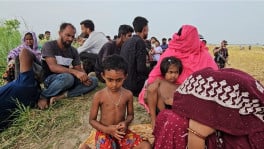
The new chief minister of West Bengal, Suvendu Adhikari has already claimed that several thousand undocumented Bangladeshis have been 'pushed back' into Bangladesh. Dhaka's border guards are claiming they have prevented 'push-ins' here and there.
These claims and counter-claims have a history dating back to the early 1990s, when the BJP and its spiritual fountain head, the Rashtriya Swayamsevak Sangh or RSS, turned an illegal migration issue into one of national security.
The RSS and BJP claimed millions of Bangladeshis were illegally living in India. But instead of calling it migration they called it "infiltration." This framing gave migration, albeit illegal, by poor people a sinister look.
From there on, the presence of these undocumented Bangladeshis were painted as a 'national security threat.'
'National security threat'
Over the years, police in far-flung states of India such as Gujarat and Maharashtra as well the capital Delhi have rounded up allegedly undocumented Bangladeshis and taken them to the border to be "pushed back."
In the process, Bengali speaking Indian Muslims were also often taken to the border, which was then resisted by Bangladeshi border forces.
Successive state governments in West Bengal have been reluctant to participate in this campaign, but no longer.
The BJP in power in Kolkata means local police are being mobilised to round up alleged Bangladeshis. For some, this is the BJP delivering on its election promise. For others, it is in response to public demand. Either way, this crisis is not going away any time soon.
Mass deportations have become a thing around the world lately. The United States caused an uproar by rounding-up undocumented migrants and deporting them in chains. Pakistan deported millions of Afghans living there for decades.
Even South Africa, once called the 'Rainbow Nation,' is currently busy throwing out thousands of migrants from other African countries.
So the problem here is not India's desire to deport undocumented foreigners. But the "Push Back" strategy of the 1990s circumvents due process of law and delivers summary punishment.
Bangladeshis would argue, this is not expected from a friendly neighbour.
In addition, to frame Bangladeshis who may have gone to India illegally in search of livelihood, as a 'national security threat,' is to put those migrants' lives in danger. It demonises them and denies them agency as human beings looking for a better life.
Modi's overtures
For Bangladesh, continued denial about the presence of Bangladeshi migrants in India is not a sound strategy. Most of the people being pushed back (or pushed in) are turning out to be Bangladeshi.
Just as it is undeniable that Bangladeshis are regularly trying to enter Europe illegally - and dying in the Mediterranean in the process, so is the case with India.
However, while migration is the immediate stumbling block Trivedi will face, it is by no means the only one.
Trivedi will need all his political guile and experience to restore bilateral relations to anything resembling 'friendly.' At the moment, things are not as rosy as Delhi might have expected when the interim government headed by Muhammad Yunus departed the scene.
It is now acknowledged on both sides of the border that the attempts to restore friendly relations immediately after the February 12 elections, which returned the Bangladesh Nationalist Party to power, have evidently stalled without any significant achievement.
The overtures were more prominent from the Indian side than the Bangladesh side, which demonstrated a more cautious approach from the BNP government.
Indian prime minister Narendra Modi was the first to congratulate Rahman on his election victory.
He was also quick to invite Prime Minister Tarique Rahman along with his wife Zubaida and daughter Zaima,to visit India.
Clearly, there was hope in Delhi that Rahman would choose India for his first foreign trip, and begin the process of repairing a relationship that was badly damaged by mistrust and acrimony on both sides.
Tarique Rahman's compulsion
Even though the new foreign minister of Bangladesh, Khalilur Rahman made his first foreign trip to Delhi, plans for a summit between Modi and Tarique Rahman in India have clearly been put on the back-burner, at least for the time being .
It is now pretty much certain that Tarique Rahman's first foreign trip would be to Malaysia, a major destination for Bangladeshi migrant labour. This would be followed by a visit to China, a major source of investment and imports.
It is possible that despite Modi's overtures, it was politically infeasible for Rahman to choose Delhi as his first port of call. Even though the elected government has dialled down much of the anti-India rhetoric of its unelected, interim predecessor, the political sphere is still dominated by parties which maintain a tougher stance towards India.
During Khalilur Rahman's visit to Delhi in April, the foreign minister chose his public words carefully, alluding mostly to areas of cooperation between the two countries such as energy, which had become critical with the onset of war in the Persian Gulf. But there was the thorny issue of Sheikh Hasina, who is currently living in Delhi.
The read-out from Bangladesh's Ministry of Foreign Affairs on April 8 also said that Dhaka had reiterated its request to extradite former prime minister Sheikh Hasina to Dhaka, who is facing the death penalty after being convicted last November on charges of crimes against humanity.
Hasina issue remains
Hasina, not surprisingly, described Dhaka's International Crimes Tribunal which convicted her as a "kangaroo court" and the trial as a "farce."
International organisations such as Amnesty and Human Rights Watch have also raised questions about the "fairness" of the trial.
In short, the issue of Sheikh Hasina would remain a stumbling block in bilateral relations for the foreseeable future. It is highly unlikely that the new Indian high commissioner in Dhaka would be able to make any headway on this issue.
For one thing, parties currently represented in the Jatiya Sangsad - BNP, Jamaat-e-Islami and the National Citizens Party - seem in sync on this issue.
On the other hand, there is a consensus among major political parties in India that Hasina be treated as a friend and a guest, and under no circumstances can she be sent back to face the death penalty.
The trick, for both Trivedi and his hosts in Dhaka, would be to navigate a path around the Hasina question, address migration as a humanitarian rather than security issue and rebuild relations on matters which promise greater convergence of mutual interest.
For instance, regional connectivity is likely to be beneficial to both India and Bangladesh. Similarly, a stable security environment along Bangladesh's eastern border will serve the interests of both Dhaka and Delhi.
An Indo-Bangla summit in Delhi is likely to come later, because Dhaka's relations with a neighbour with which it shares nearly 95 per cent of its land borders, is far too important to be left to rot.
Sabir Mustafa is a journalist and podcaster. He can be contacted by email: sabir.mustafa@gmail.com and his X handle is @Sabir59
Disclaimer: The views and opinions expressed in this article are those of the authors and do not necessarily reflect the opinions and views of The Business Standard.