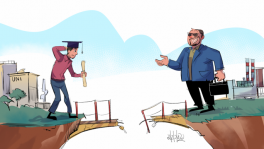
But where's the money?
The government is struggling to meet even basic expenditures; yet against this backdrop, there have been sweeping pay hikes and ambitious election pledges, from higher public sector salaries to expanded jobs, social security and health spending.
Bangladesh's election season is colliding with a hard fiscal reality.
The government is struggling to meet even basic expenditures; yet against this backdrop, sweeping pay hikes and ambitious election pledges, from higher public sector salaries to expanded jobs, social security and health spending.

This raises a single, unavoidable question: where will the money come from?
 Keep updated, follow The Business Standard's Google news channel
Big promises, thin revenues: The fiscal dilemma behind the pay hike plan (Read the full story)
Bangladesh is facing mounting fiscal strain as sluggish public and private investment, weak domestic business activity and slowing export growth weigh on revenue collection, even as debt servicing and interest payments rise sharply. The government is increasingly struggling to cover basic operating expenses.

Against this backdrop, the National Pay Commission has proposed an up to 142% increase in salaries, allowances and pensions for government employees—an expansion that would require an additional Tk1.06 lakh crore annually.
Economists warn that mobilising such a sum is close to impossible under current economic conditions. Even if the proposals were phased over three fiscal years, the government would still need to find roughly Tk35,000 crore a year—equivalent to nearly three and a half months of the country's total revenue—to sustain the higher pay structure.
The fiscal pressure is further compounded by election-year promises.
Low revenue growth, stagnant investment: Can BNP, Jamaat deliver on job creation and social security pledges? (Read the full story)
As Bangladesh heads towards the 2026 national election, the country's two main political parties – the Bangladesh Nationalist Party and Bangladesh Jamaat-e-Islami – have unveiled a range of election pledges, placing the economy, jobs, industrialisation and investment at the centre of their political messaging.

Both parties have placed particular emphasis on job creation, a business-friendly environment, youth empowerment and industrial development.
Party sources from BNP and Jamaat have confirmed that these pledges will feature prominently in their manifestos. Jamaat-e-Islami has already outlined its plans at a policy summit in Dhaka, briefing foreign diplomats, economists and civil society representatives on its economic vision.
Economists and business leaders view the proposals positively in principle. However, they also raised questions about how realistic the plans are, how quickly they can be implemented, how they will be financed, and whether the institutional capacity exists to deliver them.
BNP pledges 5% of GDP to health, Jamaat 6-8%, but experts call for clear roadmaps for funds (Read the full story)
Health has emerged as a central issue in the lead-up to the national election, with political parties placing greater emphasis on public healthcare.

After years of limited investment, both the BNP and Jamaat-e-Islami are promising higher public spending, free treatment, and steps toward universal coverage.
The current budget allocates Tk41,908 crore to health, equivalent to 5.3% of the national budget but just 0.67% of GDP, with full utilisation remaining a recurring challenge.
For years, experts and citizens have called for greater public spending on health, as a very high proportion of costs – around 68-73% – are paid directly by households, leaving nearly three‑quarters of healthcare expenses to out-of-pocket payments.