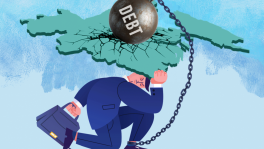
Bangladesh's economic growth set to slow to 3.9% as inflation, banking risks, investment crisis deepen
Private investment growth declined for the first time in 35 years.

Bangladesh's economy is entering one of its most fragile periods in decades, with the World Bank warning that slowing growth, persistent inflation, banking sector weakness and collapsing private investment are converging into a broad macroeconomic crisis.
Real GDP growth is projected to fall to 3.9% in FY2026, marking the third consecutive year of slowdown and a sharp departure from the 7%-plus growth trajectory Bangladesh maintained for much of the previous decade.
The assessment was presented today (18 May) at a dissemination event jointly organised by the Policy Research Institute of Bangladesh and the World Bank titled "Bangladesh Development Update: Special Focus – A Business Environment that Delivers Jobs."
 Keep updated, follow The Business Standard's Google news channel
The event was attended by economists, policymakers, business leaders and development experts. Mahmud Hasan Khan attended as chief guest, while Zaidi Sattar chaired the session.
Private investment contracts for first time in 35 years
The report identified four major structural weaknesses behind the slowdown: high inflation, weak domestic revenue mobilisation, financial sector vulnerabilities and mounting external pressures. Researchers said all four have intensified amid the ongoing war in the Middle East.
One of the most alarming findings was the contraction in private investment growth – the first decline recorded in 35 years. Agricultural growth also slowed sharply, further weakening economic activity.
The report warned that Bangladesh's policy buffers remain extremely limited at a time of growing external uncertainty.
Poverty rising as purchasing power declines
The economic slowdown is already translating into worsening living conditions.
According to the presentation, an estimated 14 lakh additional people fell into poverty in 2025. National poverty is projected to rise from 18.7% in 2022 to 21.4% in 2025, driven by high inflation, weak labour income growth and insufficient productive employment.
The World Bank said the Middle East conflict is expected to further slow poverty reduction by disrupting remittance flows, increasing import costs and squeezing household incomes.
In FY2026, only 0.5 million people are projected to escape poverty, compared with a pre-conflict projection of 1.7 million.
Despite tighter monetary policy, inflation has remained entrenched. Average inflation stood at 8.5% in FY2026 during the July-February period, with both food and non-food inflation remaining persistently high.
Researchers identified supply chain inefficiencies and corruption as key structural drivers of inflation alongside demand-side pressures.
Real wages for low-income and unskilled workers have turned negative across agriculture, industry and service sectors, significantly eroding household purchasing power.
The report cautioned against premature monetary easing and called for both tighter monetary management and structural reforms targeting supply bottlenecks.
Banking sector under severe stress
The country's banking sector emerged as one of the most vulnerable areas highlighted in the report.
System-wide regulatory capital stood at only 4.6% in June 2025, less than half the minimum regulatory requirement of 10%. The report said 22 banks controlling nearly 47% of total banking assets are currently undercapitalised.
Non-performing loans surged following the introduction of stricter loan classification standards and restructuring efforts within several banks after the political transition.
Transparency-focused reforms have exposed deep asset quality problems, particularly among Islamic banks and state-owned commercial banks.
The report estimated a provisioning shortfall of roughly $28.5 billion and warned that growing government borrowing from banks is increasingly crowding out private sector credit.
Private sector credit growth fell to 6% in February FY2026, down from 6.8% a year earlier.
The report called for urgent recapitalisation measures, faster resolution of bad loans, stronger bank supervision and improved restructuring governance to prevent systemic risks from worsening.
Revenue falls to lowest in 15 years
Although the fiscal deficit narrowed slightly to 3.5% of GDP in FY2025 from 3.9% the previous year, the report warned that Bangladesh's fiscal position is weakening beneath the surface.
Tax revenue fell to just 6.9% of GDP in FY2025 – the lowest level in 15 years – sharply reducing the government's fiscal space.
At the same time, rising subsidies and persistent current expenditures have crowded out development spending for the second consecutive year.
Public debt increased to 39.5% of GDP in FY2025, up from 37.6% in FY2024, with researchers warning that the rapid accumulation of domestic debt could create future sustainability risks.
The report recommended comprehensive tax reforms, including phased reductions in tax exemptions, VAT restructuring and stronger tax administration.
Structural weaknesses in labour market worsening crisis
Researchers also highlighted deep structural problems in Bangladesh's labour market.
Job creation has failed to keep pace with the growth of the working-age population over the past decade. Employment growth has increasingly shifted toward low-productivity agriculture while manufacturing and services have lost momentum.
For women, all employment growth since 2016 has come from agriculture, reversing earlier gains in sectors such as ready-made garments.
The report described Bangladesh's private sector as highly distorted, with a small group of export-oriented frontier firms – mainly in the garment industry – dominating revenues and exports while generating relatively limited employment.
According to the findings, the top 10% of productive firms account for 75% of revenues and 70% of exports but only 15% of employment.
Meanwhile, SMEs and informal businesses account for the overwhelming majority of jobs yet receive limited policy support.
Business regulations were also identified as a major obstacle to investment and job creation. Senior managers spend an average of 13% of their time complying with regulations, rising to as high as 60% in Barishal.
Starting a formal business can cost up to $10,000, while Bangladesh ranks among the weakest performers in South Asia in market competition, insolvency and dispute resolution indicators.
Middle East war heightens economic risks
The report warned that prolonged instability in the Middle East could significantly worsen Bangladesh's economic outlook.
Although strong remittance inflows helped narrow the current account deficit, researchers cautioned that this buffer remains vulnerable because of Bangladesh's heavy dependence on migrant workers in Gulf countries.
The conflict is also increasing fuel and transport costs, raising subsidy expenditures and pushing up import prices.
The World Bank warned that prolonged external shocks could place further pressure on inflation, fiscal stability and the external sector at a time when Bangladesh has limited room for policy maneuver.
Reform agenda prioritises stabilisation
The report proposed a two-stage reform strategy focused first on macroeconomic stabilisation and later on long-term job creation.
Short-term priorities include maintaining tight monetary policy, rebuilding foreign exchange reserves, restoring banking sector stability and increasing domestic revenue mobilisation.
Over the medium term, researchers said Bangladesh must address four major structural gaps: infrastructure, business regulation, skills development and gender participation in the labour market.
The report also called for "smart deregulation," greater competition, expanded private capital formation and stronger support for SMEs to ensure that future growth translates into sustainable employment generation.