Credit where it is due
Fifteen months is not fifteen years. Within that window, they kept the ship afloat long enough for the country to breathe again

If we want to judge the interim government fairly, the place to start is not with slogans or selective comparisons but with the data — the data candidly laid out in the State of the Economy report launched by the General Economics Division on 8 December. Read it dispassionately and a simple truth emerges: the record speaks for itself. And it speaks more clearly than the refrain that "we're doing better than Indonesia in 1998 or Sri Lanka in 2022."
It is an attractive line, but one like congratulating yourself for not driving into a ditch when the car was already skidding. Still, credit where it is due. The interim government did manage things that matter — and matter deeply — even if they don't fit neatly into a triumphalist narrative.
The IG's report card
Take the political transition. Many observers quietly doubted whether the country could be steered toward a February 2026 election without the usual theatrics. Yet the interim administration coaxed, nudged, and occasionally herded the political actors toward a workable process. In Bangladesh, where transitions often resemble a high-wire act performed during an earthquake, simply keeping the dialogue on the rails is no mean achievement. Political stability may not appear in macroeconomic equations, but it is the soil in which every macroeconomic variable grows.
 Keep updated, follow The Business Standard's Google news channel

Then there was the remarkable episode of August 5–8, 2024—three days when the country had no functioning government and the police were effectively absent. Yet Bangladesh did not descend into the Hobbesian nightmare we are so often warned about: "war of each against all". There were political violences for sure, but none like the anarchy that would have horrified Hobbes.
Locke would have smiled knowingly. Rousseau would have claimed vindication. And Hobbes, poor man, would have been forced to add a sheepish footnote to Leviathan admitting that under certain conditions, society can behave better without the state than the state behaves with itself. But let's not stretch three days of civic restraint into a grand theory of Bangladeshi exceptionalism. Social resilience is real, but it is not infinite. It buys time; it does not resolve structural tensions.
The interim government needed every hour of that borrowed time. They did not inherit a functioning control room. They walked into a ship already taking water — hollowed-out institutions, jittery markets, mountain of arrears (in local and foreign currencies) and correspondent banks that slammed the brakes the moment the transition began, to mention just some. The banking system was distressed enough that even optimism needed collateral. Their first job was not to chart a bold new course but to keep the vessel from capsizing. Expecting sweeping structural reform from a government juggling existential threats, political reform, justice for state-sponsored violence, and the logistics of a credible election is not analysis; it's fantasy.
One quiet but telling achievement of the interim government is the thinning of the ambient fear that once wrapped public expression like barbed wire. People haven't become fearless overnight, but they are no longer terrified of intelligence agencies pouncing on every raised eyebrow or inconvenient footnote. The old ritual of triple-checking a Facebook post as if it were a state secret has eased. Critics now worry more about trolls than midnight knocks, which, in Bangladesh's political climate, counts as progress.
Fifteen months is not fifteen years. Within that window, they kept the ship afloat long enough for the country to breathe again. They began nudging the economy back toward tighter monetary policy, a more realistic exchange rate, a willingness to confront fiscal imbalances, and initiated long overdue structural reforms in trade logistics, labor, energy, financial regulation and so on. These moves didn't solve everything, but they stopped the bleeding.
In macroeconomics, stopping the bleeding is sometimes the most important first step. This shift is evident across several key indicators—remittance, reserves, exchange rate, illicit outflows, electricity, and revenues. These green shoots suggest that the foundations for cautious optimism are being laid.
A comparison we don't need
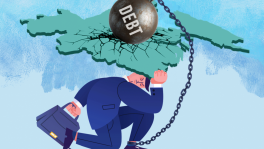
But here's where we need to stay grounded. Many of the reforms being cited as progress are still somewhere between "in progress" and "under consideration." Implementation remains the Achilles' heel of Bangladeshi policymaking, as it has been for decades. This is precisely why the "we're doing better than Indonesia and Sri Lanka" line needs a reality check. Bangladesh looks better not because of what the interim government prevented, but because the country did not begin its post-uprising journey from the same cliff edge.

Indonesia in 1998 was already in freefall — a banking implosion, capital flight, and a currency collapse all happening at once. Sri Lanka in 2022 was in a full-blown sovereign default with fuel lines stretching for miles. Bangladesh, by contrast, inherited a slow-burn structural crisis: high inflation, distressed banks, low reserves, and pervasive corruption. Serious, yes—but not remotely comparable in scale or immediacy. We didn't have a banking collapse. We didn't have hyperinflation.
A fair reading also requires acknowledging that Bangladesh did not glide into its transition on calm waters. The country spent much of the year inside a rolling protest bubble that repeatedly disrupted activity, mobility, and welfare. Streets were blocked, supply chains were strained, and uncertainty became a daily companion.
So it's not that Bangladesh enjoyed a sturdier political "tectonic plate" than Indonesia or Sri Lanka. The real difference lay in how quickly authority was restored once the old order collapsed—and why that speed was possible. Indonesia in 1998 endured weeks of drift after Suharto's fall, with no functioning executive and a fractured state arguing over succession. Sri Lanka in 2022 saw its president flee, its cabinet evaporate, and ministries abandoned while the country waited for someone—anyone—to take charge.
Bangladesh's vacuum, by contrast, was chaotic but short-lived, in part because Professor Muhammad Yunus's global stature and broad acceptability nationally provided an immediate focal point around which an interim government—however imperfect—could be assembled. That speed mattered. It prevented the kind of prolonged institutional paralysis that turns economic stress into economic collapse.
That personality mattered too. Professor Yunus is not your typical head of government. One aide joked, "He's the only leader who quotes Tagore, talks about blockchain, and asks about your mother—all in the same breath." He wears his signature Grameen check Panjabi and the same pair of sneakers he has reportedly owned for years irrespective of whether he is in the Chief Advisers Office, the UN or the Vatican!
So the relief we feel today is evidence of a different starting point. That is why the Indonesia–Sri Lanka comparison, however comforting, is ultimately a distraction. It obscures the real question: not whether we avoided someone else's disaster, but whether we are building our own success.
Building the best
That brings us to the heart of the matter. What held the interim government back from doing better? Time, mandate, and institutional capacity—the three constraints that shape every transitional administration. You cannot rebuild institutions at the same time you are relying on them to manage a crisis. Reform is not a sprint. It is a marathon. Running a marathon requires not only the will to start but the stamina to stay the course.
The interim government deserves credit—for stabilising the political process, for preventing economic freefall, and for navigating a period when society, not the state, held the line. But doing better than a disaster is not a development success. It is simply the first step toward one. History will ultimately judge, but having avoided the worst, we need to crave the best.
Building the best must begin with the election ahead—an election that is, in effect, a national referendum on the kind of political order we want to stand on. The choices made there will determine whether reform becomes a sustained journey or another interrupted promise.