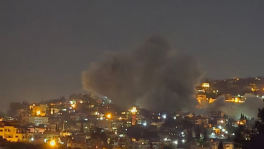
The Middle Eastern chronicle
Comprehending the true nature of this region requires a logical deduction of the lines drawn across desserts, coastlines and communities that eventually gave the identity of territorial fluidity into sovereign nations

The modern Middle East, which is often subjected to a landscape of conflict, underscore an intricate story that is shaped by resources, aspirations and determinations that have extended beyond the traditional border lines.
Comprehending the true nature of this region requires a logical deduction of the lines drawn across desserts, coastlines and communities that eventually gave the identity of territorial fluidity into sovereign nations.
The border lines created mostly due to external interventions redefined power distributions and enabled people to identify themselves uniquely. The region which was once dominated by unified cultural, historic and linguistic heritage were sliced apart into individual states and new identities imposed by political ideologies. As a result, the ramifications of altering centuries old habitual lifestyle continue to resonate though generations, transforming both domestic and international relations.
 Keep updated, follow The Business Standard's Google news channel
Discovery of vast oil reserves in the Middle East in the 19th century shifted the fortune of Middle East that was not limited to domestic economies but ultimately shifted the global balance of power distribution. Money that was once considered as the medium of transaction was now replaced by energy resources.
Industrialization and the fast-paced essential discoveries of science influenced Western nations to look for energy sources to secure their continued global dominance and authority. The 19th century marked not only the first step of mankind on extraterrestrial ground, explicitly the moon, but also the emergence of Middle East as a strategic focal point in a progressive world of scientific accomplishments and capitalistic dominance.
Global powers, especially the United States started to get deeply involved within the region in terms of politics, military and economy that continues to exist in the 20th century. Alliances were formed on the lone basis of immediate interests rather that determining the long-term impacts. Governments rose to the heights of ultimate power and later fell to the ground amidst the combined influence of internal disturbances and insurgencies and not the very least external pressures that regulated control of power within the region.
However, despite the significant occurrences throughout the Middle East from energy, the revolution in Iran, led by Ruhollah Khomeini in 1979 to overthrow Shah Mohammad Reza Pahlavi from power remains a key turning point. The drastic shift from monarchy to an Islamic republic challenged the existing alliances in terms of broader geopolitical landscape of the entirety of Middle East. In the leadership of Ruhollah Khomeini a new ideological dimension was introduced in the regional politics that gave a unique identity to Iran.
On the other hand, authoritarian figures such as Saddam Hussein in Iraq manifested a power model that mostly relied on dominance at the cost of internal stability. The mechanisms of such administrations were often provided international backing that later evolved into conflicts due to internal fractures in both society and the state system.
Another layer of complexity was added to the regional political stability with the rise of non-state actors such as the emergence of Osama bin Laden. What was once state-based conflicts was transformed into transnational ideological movements, effectively blurring the curtain between domestic, regional and global security. Such developments gave yet another piece of reason for international surveillance over the region.
The political phase of modern Middle East witnessed a lengthy and bloody chapter in 2010, the Arab Spring. Demands for economic justice, political freedom and end to authoritarian rule quickly shifted to uprisings that spread across the Egypt, Libya and Syria.
The long-time president of Egypt, Muhammad Hosni El Sayed Mubarak resigned from his post in 2011 amid massive protests throughout the country, only to face political instability and eventual military control in 2013. On the other hand, Libya faced prolonged chaos after president Muammar Muhammad Abu Minyar al-Gaddafi was ousted in 2011. Libya has ever since been subjected to extremist groups and militias fighting for control, leaving the country in a deeply fragmented and one of the most insecure states in the world.
Syria, however faced the most tragic humanitarian crisis of the century as peaceful demonstrations against president Bashar Hafez al-Assad eventually turned into a chapter of bloodshed. Civil unrest drew multiple domestic and foreign actors to get engaged in the situation that has not been resolved completely even though Assad was ousted from his position in 2024.
The consequences of the Arab Spring imply the complications of political reality of Middle East where hope for democratic transformation and political freedom paved path for conflict, insecurity and uncertainty.
The Middle East is also known for one of the most complex and painful geopolitical crises as the conflict between Palestine and Israel has claimed countless lives. Decades of displacement, was and identity crisis is not just a territorial dispute but a tragedy that the world has failed to acknowledge. Generations have grown up in Palestine amid fear, violence and uncertainty, while numerous efforts to establish peace and order have failed due to retaliatory attacks and mistrust of each other.
Despite longstanding struggles for power, communities and states rich in diversity, culture, history and resilience are often left behind by political narratives, which have long been governed by greed and power. While facing the never-ending challenges both from internal administrative complications and international pressure of capitalistic ideologies, communities stretched across the Middle East have redesigned, resisted and learnt to survive.
The region remains a point of concern where the fluidity of external influences and internal implications have shaped the fate of the people living in it. While foreign actors have sufficiently played a crucial part in major administrative and policy making decisions, locals have also been part in shaping the trajectory of Middle East's future.
Revolutions and rectifications have essentially played crucial role in the changing landscape of Middle East that can only be comprehended through various analytical perspectives. The land, considered holy in Islam, Christianity and Judaism is not just a story of control or conflict, but a history that will remain incomplete without a clear understanding of why the region has been of utmost importance.
Ultimately the Middle East is a chapter of a grand story that is still unfolding its pages, only to reveal that the deserts are not to be abandoned. The border lines drawn decades ago still inform future paths.
Disclaimer: The views and opinions expressed in this article are those of the author and do not necessarily reflect the opinions and views of The Business Standard.