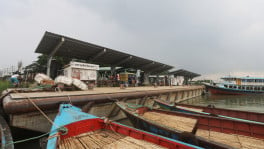
Kathpatti: How the Dhaleshwari's busiest launch terminal was silenced
In its heyday, most launches operating along these routes would call at Kathpatti, the busiest launch terminal on the Dhaleshwari. More than just a hub for passenger traffic, it also played a vital role in the loading and unloading of goods

The launch terminal used to be surrounded on three sides by four rivers — the Buriganga River, Shitalakshya River, Ichamati River and Meghna River. These waterways connected with the Dhaleshwari River to the north, east and west.
In its heyday, most of the launches operating along these routes would stop here on their journeys. Not only a vital hub for passenger traffic, the terminal also played a crucial role in the loading and unloading of goods.
Two decades ago, this bustling terminal — the busiest on the Dhaleshwari — was located in Panchasar Union of Munshiganj District. After being shifted a short distance westwards, it now falls within the jurisdiction of Mirkadim Municipality.
 Keep updated, follow The Business Standard's Google news channel
The Padma River also lies to the south of the terminal, although it is situated at the far end of Tongibari police station area and is therefore considered relatively distant.
Today, only one Chandpur-bound launch still docks at Kathpatti Terminal — a vessel named Green Water.
Shah Alam, captain of the Green Water has navigated launches and cargo vessels on the Kushiyara, Surma, Baleshwar, Gomti and Jamuna rivers. He has also transported fly ash for cement companies from India's Haldia Port via the Pashur River.
Over four decades on the water, Shah Alam has travelled along hundreds of rivers. Yet he says he has rarely seen a freshwater river as pristine as the Dhaleshwari. The water used to be crystal clear and sparkling.
The river's water was so clean that crews bathed in it and even used it for cooking.
On numerous occasions, Shah Alam moored trawlers at this terminal carrying hundreds of sacks of mung beans, red lentils and animal feed, including oil cake and bran.
The memory of the once-thriving Kathpatti Terminal still lingers vividly before his eyes. Seeing the terminal now, reduced to a shadow of its former self and struggling for survival, fills him with melancholy.
Eighty-year-old Abdul Kadir, who collects entry fees, reflected on its history. He said, "This terminal is probably around 60 to 65 years old.
The waterway itself, however, had been important long before that. Goods from southern Bengal were transported along this route on ghasi boats pulled by men using tow ropes. Later, steamers also operated here during the latter half of the nineteenth century.
"The route held considerable economic significance because it connected several trading centres. Among them, Kamlaghat, adjacent to Kathpatti, is around 150 years old. Firingibazar, Rikabibazar, Betka, Malkhanagar, Baligaon and Taltala are all historic commercial hubs. But with the decline of river transport, these trading centres are now struggling to survive."
The era of wood-hulled launches began during the Pakistan era. It was on that basis that Abdul Kadir estimated the terminal's age at around 60 to 65 years.. Yet many local residents believe its history stretches back even further. They speak of stories passed down through generations of ancestors who used the terminal during the British period.
In its early days, Kathpatti Terminal had no jetty. Wooden gangways were lowered from the launches, and passengers boarded by steadying themselves against bamboo poles held in place from above.
After Bangladesh gained independence, traffic along the river routes increased significantly. New routes to southern Bengal were opened, leading to a steady rise in the number of launches operating on the waterways.
Steel-hulled vessels joined the traditional wooden-bodied launches. Alongside single-deck launches, two-storey and even three-storey vessels began to appear.
As the number of launches serving southern Bengal grew, so too did the commerce of Kamlaghat. Launches arriving from Bhola, Barishal, Kalaiya, Lalmohan, Hatiya, Rangabali and Patarhat carried paddy, mung beans, red lentils and grass peas, unloading their cargoes at Kathpatti.
The goods were then transported to the rice mills of Rikabibazar and the wholesale warehouses of Kamlaghat, helping sustain a thriving river-based trading economy.
Thousands of sacks every day
Recalling the bustling days of the river port, labour leader Muktar Hossain Sardar said that Rikabibazar was once home to more than two hundred rice mills.
Every single day, workers unloaded between 4,000 and 5,000 sacks of paddy, along with another 3,000 to 4,000 sacks of pulses. Shipments of potatoes bound for southern Bengal were equally impressive, amounting to around 2,000 to 2,500 sacks daily. Each sack would typically carry between 80 and 90 kilogrammes of goods.
The activity around the ghat was relentless.
Nearly five thousand people passed through Kathpatti Ghat every day. Along the riverbank stood potato storage sheds, while Bharat Pal's shop was a familiar landmark. The sweet shops that once served the crowds have long since disappeared. Today, only the timber depots remain — a reminder of the trade that gave Kathpatti its name.
According to Muktar Hossain Sardar, many of the workers employed in the rice mills had come from Rangpur.
Meanwhile, Kamalaghat drew thousands of labourers from both northern and southern Bengal, and even non-Bengali workers found employment there.
Adding to the memories, veteran labourer Yasin Mia recalled that four jetty foremen — Jublu, Noor Ali, Abul Kalam, and another colleague — who once oversaw operations. Under their supervision worked around 150 labourers, while Kalu Mia served as the jetty supervisor.

As evening gave way to night, the waterfront came alive. From dusk until around eleven o'clock, launches travelling from Sadarghat, Dhaka, to southern Bengal would arrive one after another, crowding the jetty.
After a brief pause of roughly three hours, another wave of vessels began docking from around two in the morning — these were the launches returning from southern Bengal on their way to Dhaka.
"The volume of cargo was extraordinary," Yasin Mia remembered. "There was so much to unload that we scarcely had time to catch our breath. Had the ghat retained its former level of activity, the government could have earned crores of taka in revenue from this port alone."
When seven launches docked side by side
In its heyday, Kathpatti Ghat was a scene of remarkable activity, with launches arriving from across the riverine districts of southern Bangladesh. Among the regular vessels were Srinagar from Lalmohan; Jamal and Zahid from Rangabali; Tasrif and Tipu from Hatiya; Mayurpankhi, Sagarkanya, Sandra, and Lali from Bhola; Karnaphuli from Daulat Khan; and Dhulia and Bandhan from Kalaiya. Almost every launch travelling to and from Chandpur also called at the ghat.
The port was equipped with three pontoons, and at its busiest, as many as seven launches could berth there at the same time. The sight of multiple vessels moored side by side was once a defining feature of the waterfront.
The Taltala–Dhaka, Dahari–Dhaka, and Sirajdikhan–Narayanganj routes were served by 36 launches operated by 18 different companies. Every one of these vessels, travelling along the Ichamati River route, stopped at Kathpatti. Veteran labourer Yasin Mia still remembers some of their names: Prince of Madhyapara, Queen of Madhyapara, Taizuddin, Milan, Samrat, Bahrain, and Sonar Bangla, among others.
These launches were modest by modern standards, measuring around 50 feet in length and 25 feet in width. Wooden benches lined the lower deck, while the seats upstairs were fitted with cushions for added comfort. At the entrance to the upper cabin, a sign informed passengers of a simple luxury: "Fare one and a half times higher for the deluxe section."

Jhalmuri on the move
For Akhtar Hossain, now sixty, the launches were more than just a means of transport. As a young man, he earned a living walking the decks, selling jhalmuri and coconut sweets to passengers.
Looking back, he recalled that the journey from Taltala to Dhaka took around three hours. Travellers would settle in comfortably, prepared for the long voyage ahead. Those who stood by the railings enjoyed the cool river breeze that swept across the water, offering welcome relief from the heat.
"Jhalmuri was one of the passengers' favourite snacks," he said. "We hawkers would board with 2-2.5 kilogrammes of puffed rice. The chillies and onions were chopped in advance. We mixed everything with mustard oil, sprinkled in salt, and shook it thoroughly before serving. For just two taka, enough jhalmuri could be shared by two people."
Coconut sweets were equally popular. Other hawkers moved through the cabins selling needles, thread, and combs. Some even carried small hand mirrors decorated on the back with photographs of film heroines — items that often caught the attention of travellers.
The launches also welcomed a different kind of performer. One or two blind minstrels would occasionally come aboard, carrying a dotara in hand. In their melodious voices, they sang four or five songs, collecting small donations from appreciative passengers along the way.
Taken together, the river journey was far more than a trip from one destination to another. It was a lively social experience — a floating world of music, conversation, snacks, and commerce that many still remember with fondness.

The Ichamati shrinks to a ribbon
Yasin Mia, a labourer at the terminal, recalled a time when the waters of the Dhaleshwari were clean enough to drink. "Now," he said, "you do not even feel like washing your hands in it."
More than a hundred brick kilns line the river's western bank, while dyeing plants, match factories and cement factories occupy the eastern shore. Coal residue from the kilns and industrial waste from the factories have severely polluted the river.
There was a time when the Dhaleshwari flowed with a strong current. Even hilsa would drift in from the Meghna River. Saltwater species such as feua and tuladandi were also found in its waters. More commonly, however, fishermen caught boal, cheua, baila, tapaswi and prawns.
Today, the river has largely lost its current, and fish are only caught occasionally.
From Kartik to Chaitra (October-April); roughly six months of the year — the water depth at Kathpatti remains only eight to ten feet. During the dry season, the Ichamati River, a distributary of the Dhaleshwari, shrinks to little more than a ribbon of water.
As the river declined, so too did the terminals that once depended on it — Abdullahpur, Betka, Taltala, Sirajdikhan, Baligaon, Dohori and Baktabali.
Launch services on the Taltala–Dhaka and Dohori–Dhaka routes were discontinued around 20 to 22 years ago.
Sand and silt carried from the Padma River gradually accumulated on the riverbed, reducing navigability. The situation worsened after construction of the Padma Bridge began.
Even dredging operations failed to stem the problem.
The entrance channel to the terminal continued to fill with sand and silt. Over time, the waterway became so clogged that the terminal was left on the verge of extinction.
Nearly 200 people lost their livelihoods and were left searching for work.
Yet the crisis was caused by more than the loss of navigability alone. Improvements in the road network also transformed travel patterns and undermined river transport.
Street vendor Akhtar Hossain explained it this way: "People are much busier now. They no longer have time to enjoy the breeze on the river. Most work or run businesses in Dhaka, and their time is valuable. They want to reach their destinations as quickly as possible, and the roads have made that possible.
"That is why launches no longer attract passengers. Even when a river dies, few people stop to mourn it."
Yet hope refuses to fade
Today, the once-thriving Kathpatti–Dhaka route bears little resemblance to its glory days. Apart from the Green Water launch operating to and from Chandpur, only two passenger launches now travel the route, each making just two trips a day.
A handful of cargo trawlers still dock at the ghat, but the bustle that once defined the waterfront has largely fallen silent.
Yet not everyone has given up hope.
At eighty years of age, Abdul Kadir remains optimistic about the future of Kathpatti. In his view, the ghat could regain some of its lost vitality if the government were to shift it roughly half a kilometre further north.
Such a move, he believes, would provide sufficient water depth for the propellers of a number of launches travelling to southern Bengal, allowing them to use the route once again.
He does not expect a return to the extraordinary crowds and commercial activity of the past. Even so, he believes the ghat could recover much of its importance and once again become a lively hub of river transport and trade.