



Dhaka filling stations: Some closed, some see long queues
A spot visit to Hajipara Petrol Pump at noon showed staff using megaphones to announce the unavailability of fuel to frustrated drivers.

The capital is grappling with a severe shortage of petrol and octane, as a number of filling stations across the city have reportedly run dry of petrol and octane amid a surge in panic buying fuelled by global supply chain fears.
The situation worsened today (14 March), as more and more stations suspended operations. However, long queues were seen in some stations that were open.
A spot visit to Hajipara Petrol Pump at noon showed staff using megaphones to announce the unavailability of fuel to frustrated drivers.
 Keep updated, follow The Business Standard's Google news channel

Despite the entrance being blocked with ropes and a sign stating "No petrol or octane," many cars and motorcyclists continued to wait at the gates, hoping for a refill.
"We have visited four different pumps since morning, and all of them are empty," said a frustrated commuter, adding, "The search for fuel is actually wasting more of the little I have left in our tanks."
At the Meghna Filling Station opposite Dhaka College, the pump was found closed since morning due to a shortage of fuel. Bamboo poles had been placed across the entrance, preventing vehicles from entering the premises.
Nasir, an operator at the pump, said people had been coming for fuel but were leaving empty-handed. He said fuel might arrive later in the afternoon, after which dispensing could possibly resume.
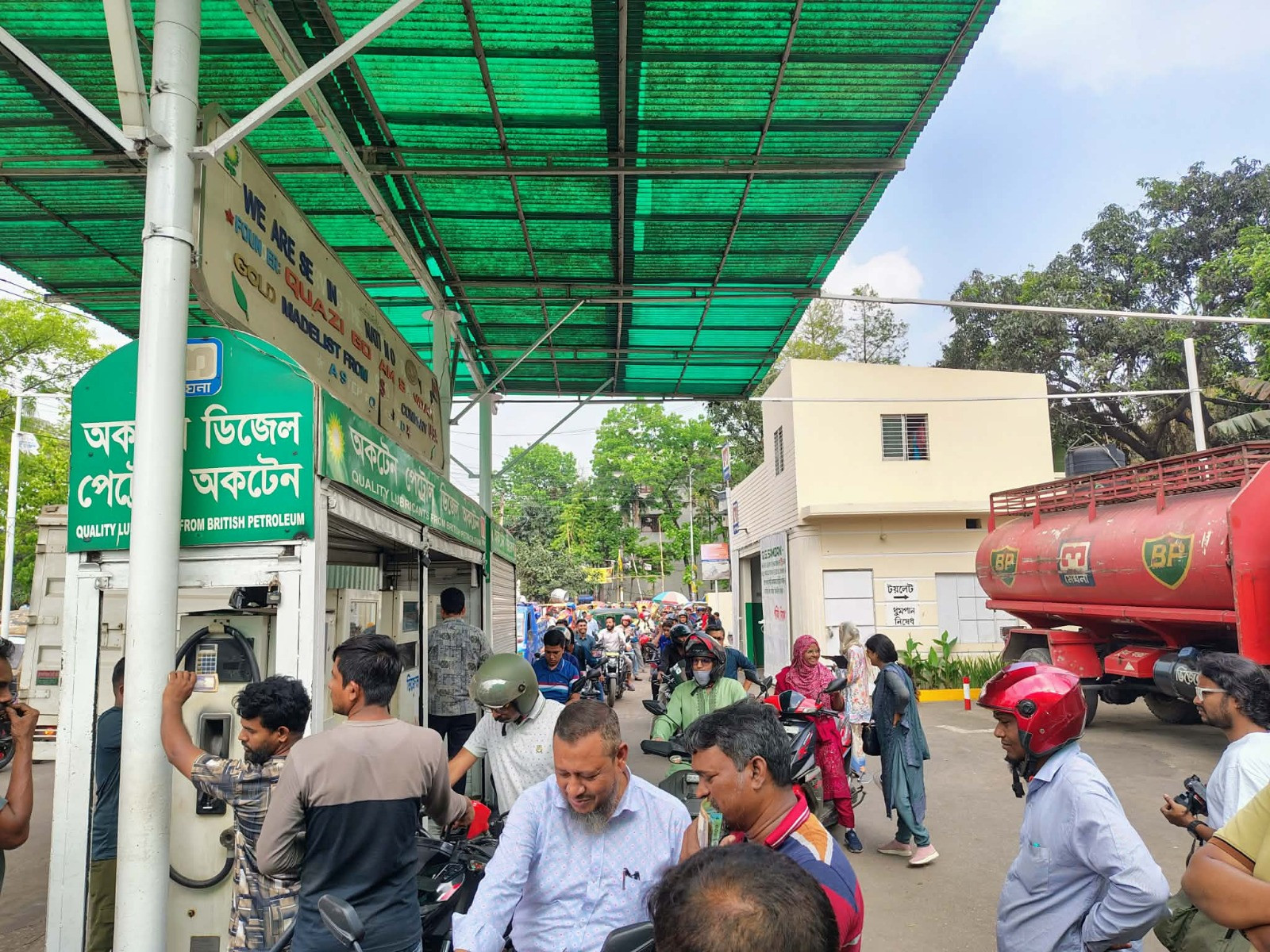
Shamim, a motorcyclist who had been waiting for nearly an hour for fuel, said, "I took fuel yesterday, but my bike stopped after running out. There is no way to go without fuel, so I am just standing here."
One Uttara resident Julhas Alam, wrote in a Facebook post today, "There are four fuel stations near Uttara – one in Azampur, two on the opposite side of the airport, and another in Nikunja, which is government-run.
"Yesterday morning, I went out looking for octane. All of them were closed – no fuel. The one in Azampur had a sign saying 'No octane'. In front of the two stations near the airport, there was a line of cars stretching for more than a kilometre. When I got to the front, I saw they were closed as well. There was no one to ask whether they would sell fuel or not.
"I then drove to Nikunja, taking the road past the opposite side of the Radisson, but had no luck there either. So, I returned home. The little fuel I had in the car was further reduced during this trip.
"Around 1am, I went out again. The situation in Azampur was the same – no fuel. The two stations across from the airport were only supplying gas [CNG]; they said there wasn't even a litre of fuel available. I went to Nikunja again, but it was closed too.
"I had thought that since the Nikunja station is government-operated, it might at least remain open at night in the public interest. After all, it is a highway area. With the little fuel left in my car, I did not dare to drive to Tejgaon or Asad Gate. So, I came back home again. If I had stayed on the road a bit longer, I might have had to push the car back.
"The government says there is no crisis and that sufficient reserves are available. But people like me, whose cars run only on Octane, are clearly in serious trouble. If this is the condition of government-run fuel stations, where else are we supposed to go? I haven't taken the car out for the past week. I'll continue using buses, CNG and Uber for a few more days. But if there is an emergency, the problem will still remain."

However, a different picture was seen at the Nilkhet Fuel Pump and the Meghna Filling Station opposite Hotel InterContinental Dhaka. During a visit, motorcyclists and drivers of other vehicles were seen standing in line to buy fuel. Fuel was being supplied normally at the pump, and drivers did not have to wait long.
Pump operator Abdur Razzaq said there is no fuel shortage there. "We have sufficient fuel. That is why we are regularly supplying fuel to motorcycles and other vehicles," he added.
"However, sometimes due to high pressure we have to keep some fuel for the next day, so the pump is kept closed for a certain period. Earlier we used to receive 10,000 litres of octane and 1,500 litres of petrol, and we are still getting nearly the same amount," he said.
Ahmed Rush, owner of Meghna Filling Station located opposite Hotel InterContinental Dhaka, said their station is a specialised pump and therefore does not remain open 24 hours a day.
"We usually receive the amount of fuel we request. Earlier we used to get 3,000 litres of petrol and 30,000 litres of octane, and we are still receiving roughly the same amount," he said.
Since yesterday afternoon (13 March), motorists have encountered "No stock" signs at numerous stations, leading to a reduction in the number of motorcycles and private cars on Dhaka's streets.
Yesterday, the Gulistan Filling Station remained shut with a notice hanging from the gate.
"We are completely out of octane and petrol. There is no possibility of a fresh supply before Sunday afternoon (15 March)," said Shamser Ali, a salesman at the station.
He noted that while the pump remained open to sell its limited stock of diesel, most customers are being turned away disappointed.
The crisis has been exacerbated by a rush of consumers attempting to stockpile fuel in response to the Iran crisis.

While government officials have previously stated that reserves are adequate, the sudden doubling of demand has overwhelmed local distribution.
Motorists who do find a station with stock report waiting in queues for hours, often only to be met with rationing limits.
Meanwhile, in Rajshahi, the district petrol pump and tank lorry owners' association has threatened to halt operations from Monday (16 March) if the government fails to ensure an adequate supply of fuel to the northern region.
The announcement came following reports of severe supply disruptions across all 42 petrol pumps in the district.
What petrol pump owners say
Owners claimed that while a few filling stations are receiving limited supplies, many others have been forced to suspend operations entirely as they are not receiving fuel according to their requirements.
Nazmul Hoque, president of the Bangladesh Petroleum Dealers, Distributors, Agents and Petrol Pump Owners Association, said petrol pumps are not receiving enough fuel to meet demand.
For example, a pump station that previously received around 20,000 litres of fuel per day is now being allocated only 3,000-4,000 litres, he said.
"But the government is saying there is enough supply, which is sending the wrong message," he told The Business Standard.
Nazmul also claimed that tensions have escalated at several pump stations, with staff at two pumps reportedly stabbed and incidents of vandalism occurring in multiple locations.
Petrol pump owners in Khulna and Rajshahi have already threatened to suspend services, saying they are receiving only one-tenth to one-fifth of their daily fuel demand.
He also expressed surprise that no government authorities have held discussions with them regarding the crisis.
"I have been trying to speak with the BPC chairman for the past two days to offer some suggestions, but there has been no response," he said.


