Where bulls still turn: The fading world of Savar’s ghani oil makers
Once deeply woven into Bengali rural life for centuries, this traditional oil-grinding method is on the verge of extinction

Seventy-year-old Ashraf sat quietly in his ancestral ghani (wood press) shop, a place that has been in his family's possession for generations. Late evening draped the tin-shed building in a soft, shadowy grey.
Behind the shop, two bulls rested after their day's walk around the ghani. The air was thick with the warm, pungent aroma of freshly pressed mustard oil. Around the sticky cash box lay old, oil-stained tin containers reused for months, their colours faded.
After a brief conversation, Ashraf, one of the last cattle-driven mustard oil producers in Bangladesh, received a customer. Carefully pouring the last drops of freshly pressed oil into a bottle, he handed it over, wiped his hands on a cloth, and slid the money gently into the cash box.
 Keep updated, follow The Business Standard's Google news channel
"This has been our family business since the time of my father and grandfather," said the man, who has been running this business for almost 50 years, said, "For generations, the cows have been walking around, and the oil keeps flowing."
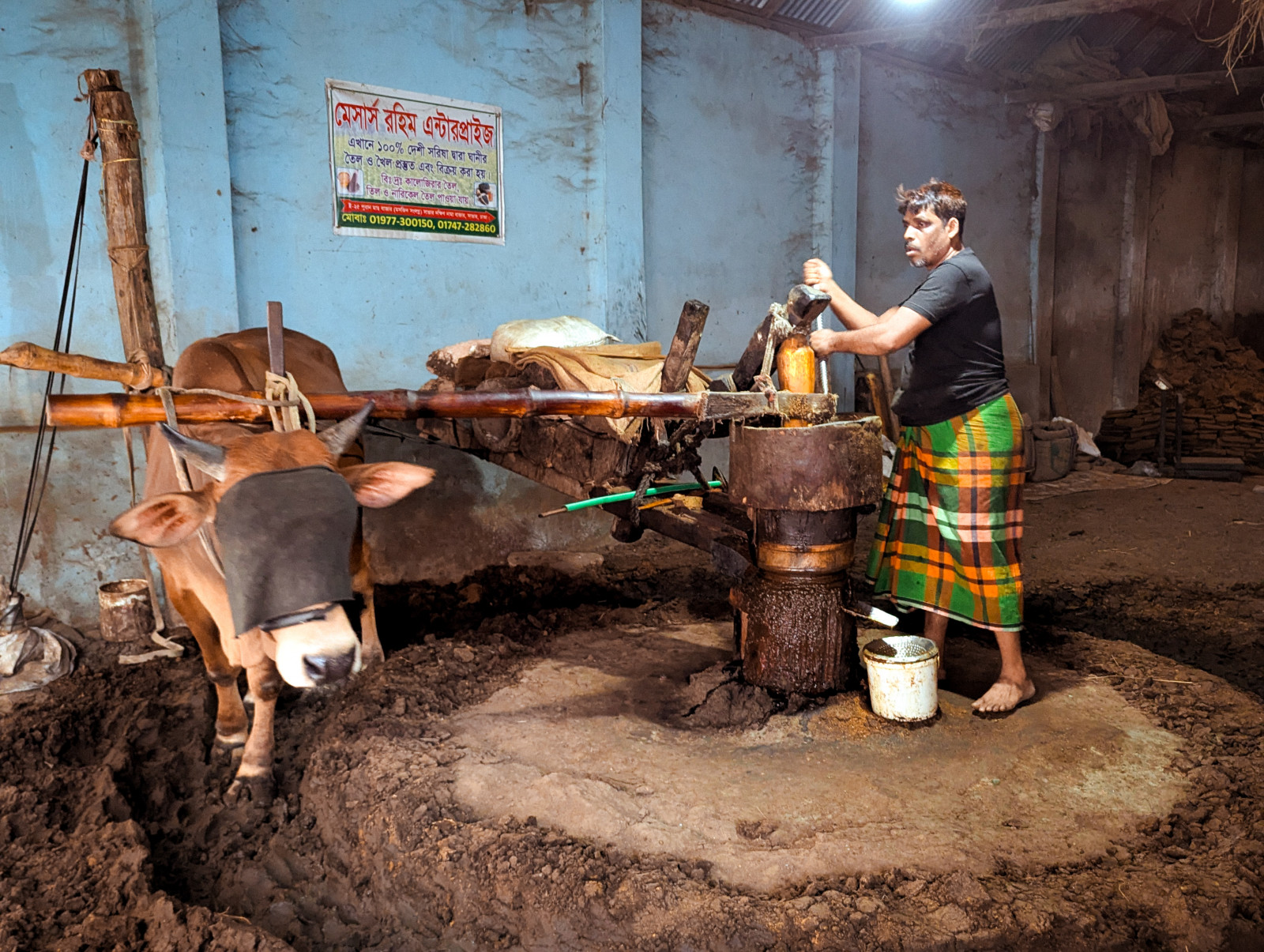
In Savar Upazila's Nama Bazar, only seven producers still use cattle-driven (mainly bulls) wood presses (ghani) to produce mustard oil. Once deeply woven into Bengali rural life for centuries, this traditional oil-grinding method is on the verge of extinction due to a shortage of mustard seeds, high production costs, a shortage of skilled artisans and labourers, and the rise of mechanised oil mills.
Meanwhile, countless machine-run mills are humming all day long across Nama Bazar, producing gallons of oil. Owners say these mills have only developed over the last 10-15 years.
Yet, the remaining producers of wood press oil stay committed to their ancestral tradition, as they say, "It is not about mass production; it's about purity and respect for our heritage and the trust of our consumers." But uncertainty looms over the future, as few heirs are willing to take over their forefathers' age-old business.
Despite low production and high costs, mustard oil from wood presses remains in high demand, with many buyers from Dhaka city travelling to Nama Bazar for the authentic product.
Oil extracted from a wood press is believed to preserve the natural quality of mustard and retain more nutritional value than oil produced in mechanised mills.
"When we press the seeds in a ghani, the oil comes out directly, without any refining process," said Momin Hossen, proprietor of Hazi Ahammad Ali Enterprise.
Machine-extracted oil, on the other hand, is exposed to heat while processing, which affects its nutritional value, and gets refined before reaching the market," said Momin.
Although production continues year-round, February and March mark the peak season, as they are the only months when mustard is harvested. Consumption remains high until summer.
"Prices are fixed – Tk320 for now – across the market." Momin said, "We sell at a relatively higher price than mills," explaining that the ghani oil production costs more and claiming the quality is way better. Machine-milled oils are sold at Tk200-220.
Cattle spin, wood creaks, and sharp kicks of ghani oil
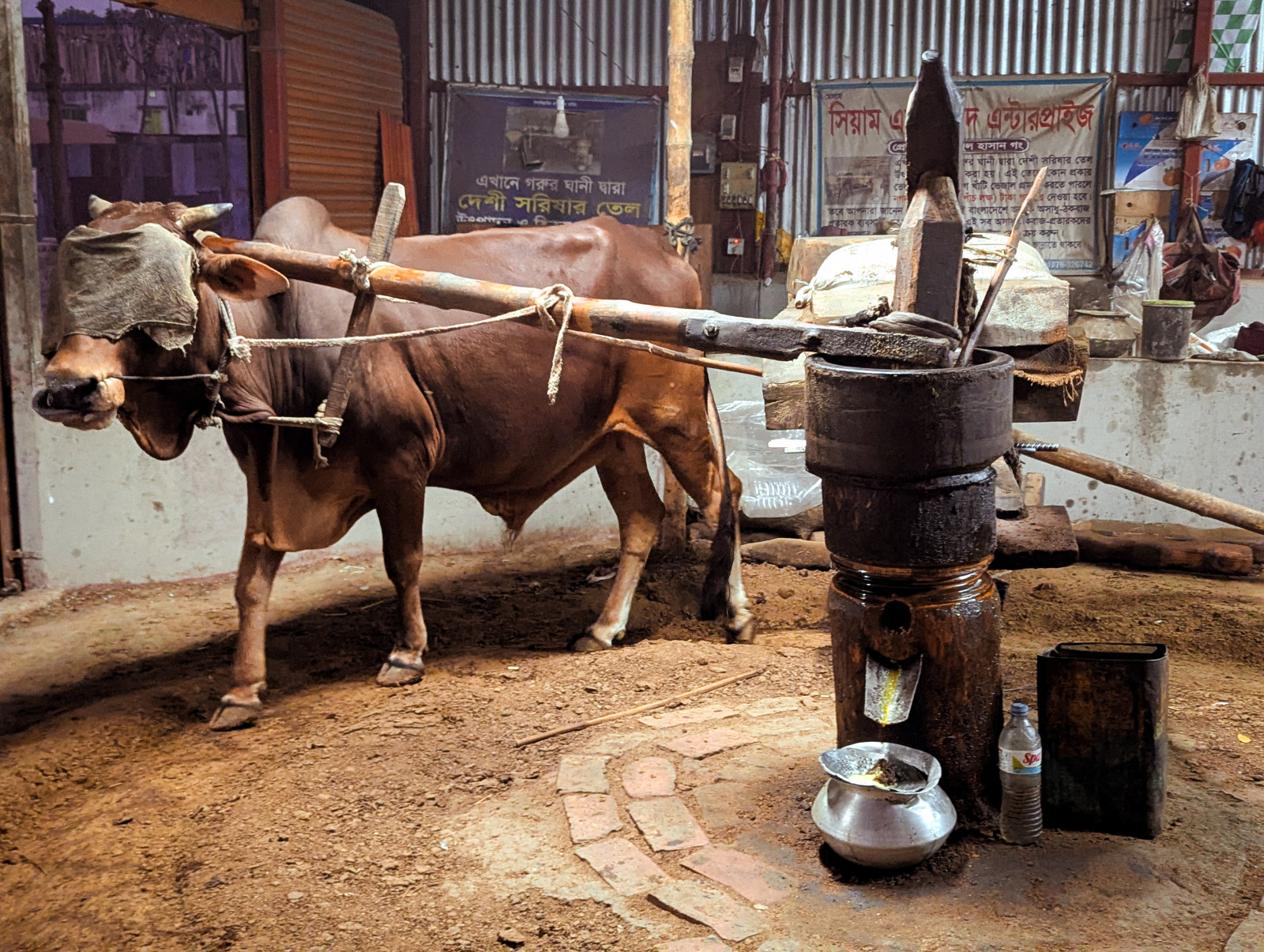
At M/S Hazi Ahammad Ali Enterprise, Savar's oldest cattle-driven ghani producer, two blindfolded bulls are spinning in muddy circles for almost two hours in two wood presses. The extracted oil seeps through a metal chute and accumulates in an aluminium pot.

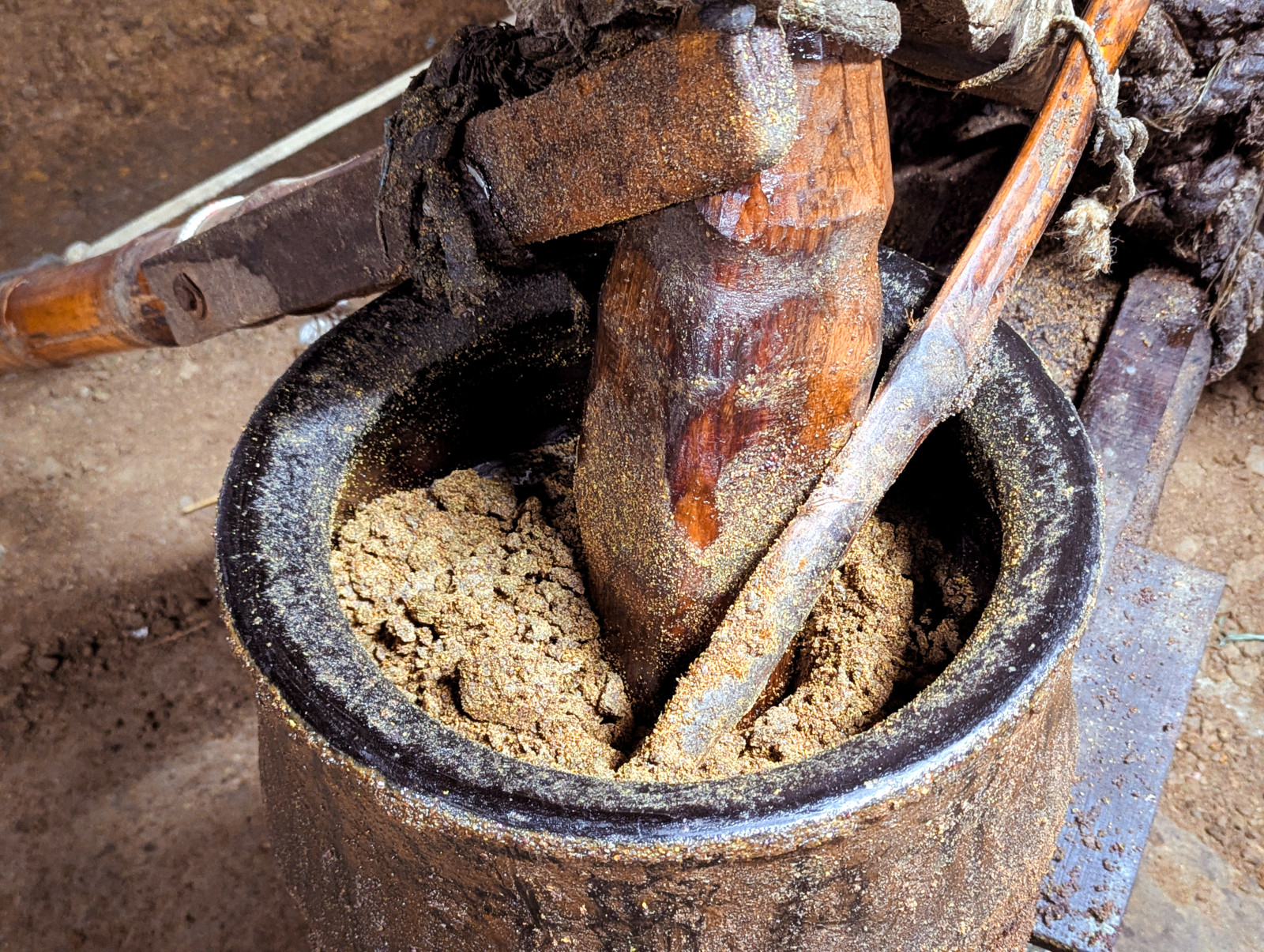
Once the current batch is properly ground and the leftovers turn into a sticky powder called 'khail', which is a vital cattle feed, the flow of oil slows to lazy drops. Md Faruk, 45, one of Savar's last wood press artisans, then unties the wood yoke from the bull's rope bound shoulder. "You're free now for a few minutes!" Faruk told the bull.
After a short break, Faruk and his fellow colleagues prepared another batch of 7 kg of seed (1 ghani) in a bowl for each press. "After this, the bulls will rest for the whole night," he said.
Shouts shook the place when the next batch began, as the bulls slowed their usual pace. "Every day, from morning, we extract about six to seven batches of seeds in each press. By the end of the day, the bulls are exhausted," Faruk explained.
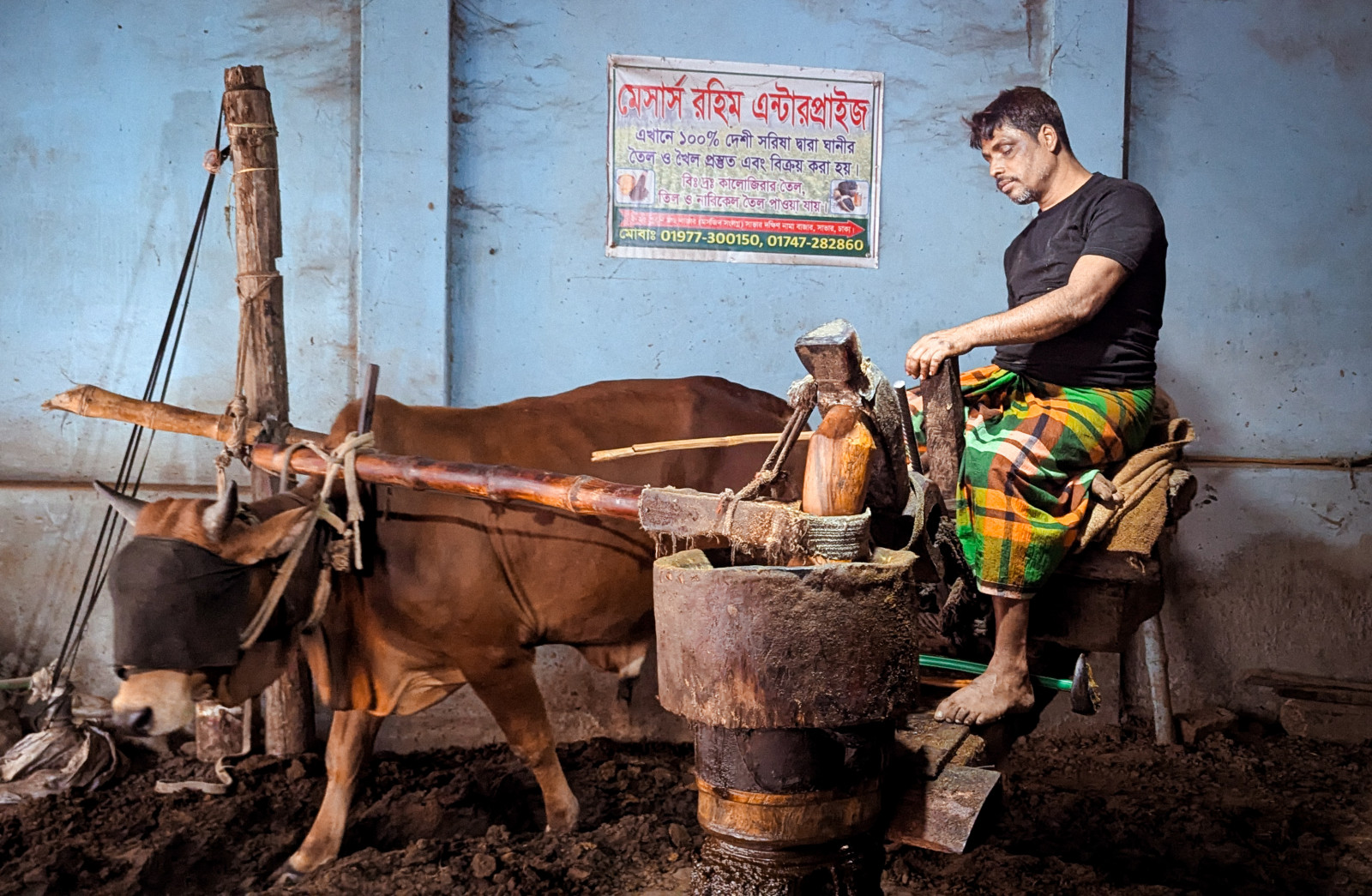
Visitors often wonder why the bulls are blindfolded. Faruk said, "Blindfolding prevents them from being disturbed by external factors so that they don't try to run away." Some people believe that blindfolding makes the bulls think they are walking straight.
"Every batch needs at least two hours to extract oil properly," he added. A new wood ghani set crushes faster, depending on the bull's pace.
Seated on the wooden beam of the press, Faruk explained the functions of a wood press. "The main round timber embedded in the ground is made of shil koroi (white siris).

The beam consists of a mortar-like bowl on top of the timber where the seeds are put, Faruk continued explaining. Inside the bowl, there is a thick wood crusher attached to the long beam set on the shoulder of the bull. As the bull moves, the crusher creates pressure on the seeds, and then the oil comes out through a narrow hole connecting the bowl.
"A set of ghanis can cost Tk30,000–40,000 and require five days of labour," he said.
Year-round production fails to meet daily demands
Momin Hossen owns eight presses across three places. One is where he runs his vending point and a ghani; the other two are for the rest of the presses. "From eight ghanis, we can produce a maximum of 140-150 litres of oil per day," he said, adding that only in his shop, daily demands amount to an average of 300 litres.
A ghani (6-7 kg) of mustard seeds yields about 2 kg of oil, meaning a maund (40 kg) produces roughly 12 kg of oil. Momin extracts an average of 950-1000 kg of oil per week.
Despite low production and high costs, mustard oil from wood presses remains in high demand, with many buyers from Dhaka city travelling to Nama Bazar for the authentic product.
Meanwhile, a customer came from the Gabtoli area to buy three litres of oil, but he could only purchase one. Momin said, "Almost every day we have to turn customers away or sell less oil than they ask for."
Customers often leave with less than they wanted. "Almost every day, we have to turn them away or sell less than they require," he said. Ahead of Ramadan, the peak consumption period, shortages force customers to buy mill-extracted oil.
However, in the off-season, typically in the summer, the demand for mustard oil remains low. "As a result," Momin said, "we can stock oil and meet the daily demands."
Producers collect mustard oil weekly from the local market. Prices fluctuate depending on the supply. They said that in recent years, seed prices have risen sharply due to a drop in domestic production.
"At one time, we used to buy a maund, spending only Tk1,500-1,600. Now, it is Tk3,000-3,200, exceeding Tk4,000-4,200 in the off-season," said Abdur Rashid of Master Oil Mills.
Eroding legacies
When the late Abdus Samad of M/S Master Oil Mills fell ill, leaving no heirs interested in the business, it seemed the family legacy would end, as all his children turned to other occupations.
Fortunately, Abdur Rashid, son-in-law of Samad and a former high school teacher, stepped in. "I have been running the business for almost 20 years since then," he said.
Momin Hossen, 61, expressed similar concerns regarding the fact that he came to this business after his maternal grandfather retired. "My two sons are in their 20s. I see no interest among them in continuing this business," he said, though he hopes that someday they will realise the importance of their family tradition.
The scarcity of skilled artisans adds to the vulnerability of this craft. Md Faruk, who came from Pabna 27 years ago and has been working in Momin's ghani since then, has a mastery in crafting a ghani set and a long experience in monitoring the extraction process.
"People no longer want to enter this work like before. Many experienced artisans have passed away," said Faruk, and once people like him are gone, there will hardly be anyone left.
More physical labour and lower wages compared to mechanised mills have also caused workers to leave. Md Yunus, 49, who now works at a nearby mill, said, "Working in a ghani is extremely laborious. The financial returns aren't satisfactory, so I left that work a few years ago."