Rural Bangladesh catches the World Cup bug as cities pipe down
Every four years, Bangladesh has traditionally turned the World Cup into a national carnival. Today, however, the way that passion is expressed has changed. While enthusiasm has become quieter and more private in cities, it remains vibrant, public, and celebratory in rural areas

Outside one shop in Sonagazi, Feni, the owner Moudud Islam has put up a 40-feet banner of Argentina. For him, it is not mere decoration. It is inheritance.
"I have supported Argentina since my childhood. When I was a kid, I saw Maradona play, and then I saw Messi. Now we are the world champions. This World Cup, I have hung a 40-feet banner in front of my shop showing support for Argentina. My wife thinks it's crazy, but it is worth it," said Moudud.
His neighbouring shopkeeper, Abul Kalam Azad, responded with yellow and green.
 Keep updated, follow The Business Standard's Google news channel
"I support Brazil. I have a 17-feet flag waving in front of my shop. Whether they win or lose, I support Brazil. We are five-time world champions; we will win our sixth, Inshallah," he said.
Asked whether it is right to spend so much on supporting a foreign country rather than Bangladesh, both men replied almost in one voice, "Bangladesh is not in the World Cup. If they were playing, we would definitely spend more than what we are spending now."
That explains much of Bangladesh's strange and enduring relationship with the FIFA World Cup. It is passion in absentia: a country missing from the tournament, yet emotionally present in it.
But that passion no longer feels evenly spread.
In urban Bangladesh, the old World Cup fever appears to have cooled. The tournament is still watched, discussed and followed, but the all-consuming madness that once took over streets, rooftops, balconies, cafés, and office conversations feels quieter now.
In Dhaka, Chattogram and other major cities, excitement has become more selective, more digital and more contained. It lives in Facebook posts, football pages, private screenings, café gatherings and late-night group chats, but it does not always spill into public life with the same force as before.
The flags are still there, but fewer. The arguments continue, but often online. The jerseys are worn, but less as a citywide uniform and more as individual expression. In many urban neighbourhoods, the World Cup no longer transforms the streets the way it once did.
In rural Bangladesh, however, the carnival has not disappeared. On the contrary, it seems to have grown exponentially.
Take a village market in Pabna's Ishwardi for instance, where 27-year-old rickshaw-van driver Rabiul Islam has painted the back of his van in Argentina's flag colours. A picture of Lionel Messi sits between two small Bangladeshi flags, as if the foreign football hero has been locally adopted.
"I do not have much money to make a big banner," Rabiul said. "So I painted my van. Wherever I go, Argentina is with me."
At the same market, tea-seller Harun Sheikh has taken the opposite side. His stall is covered with Brazil posters, and a small yellow-green flag hangs from the bamboo frame above the stove. During match nights, he says, customers no longer come only for tea. They come to argue.
"If Brazil plays, my shop will be full," Harun said. "Argentina supporters also come, but they come to fight. That is fun."
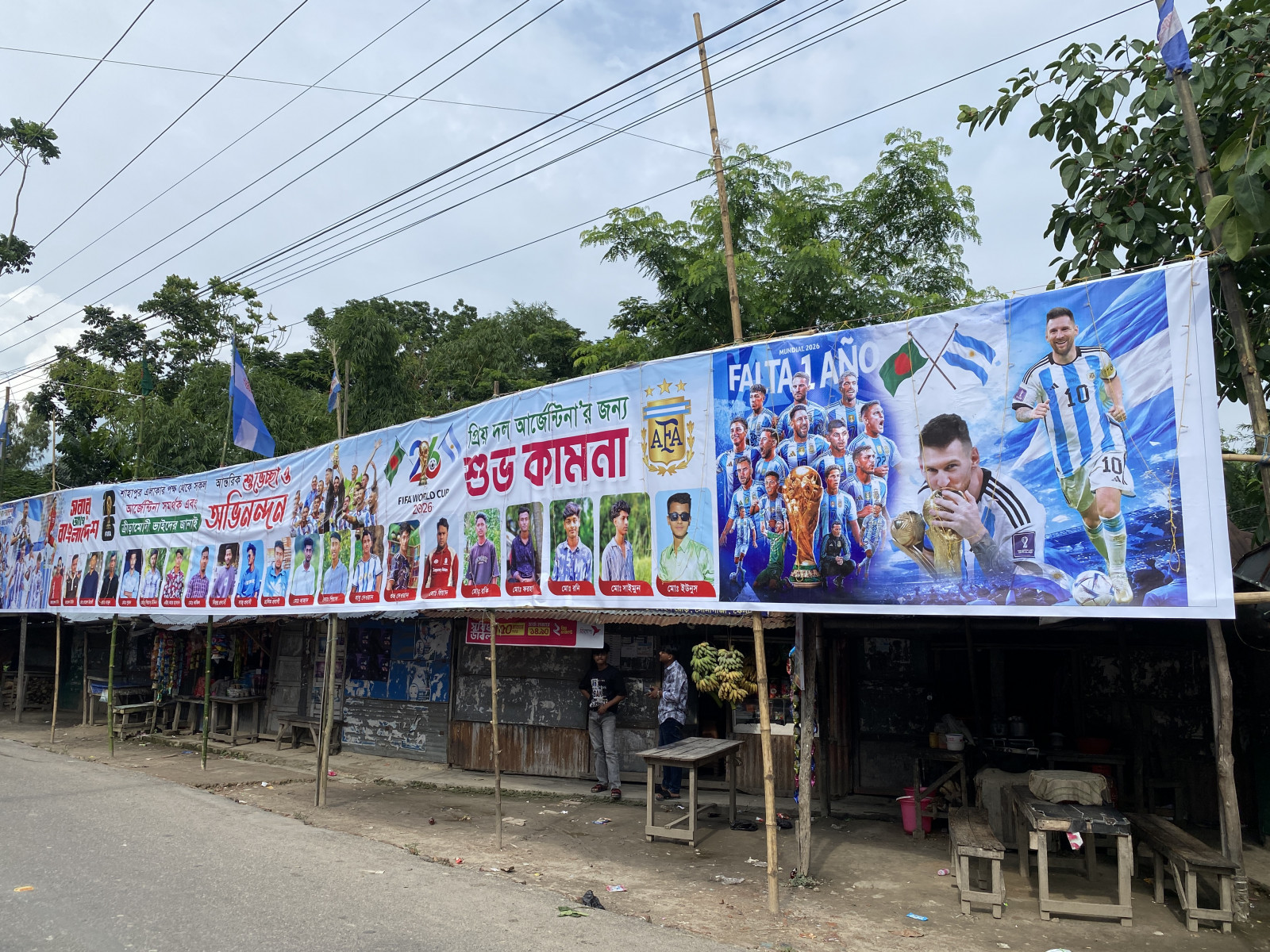
This is where Bangladesh's World Cup madness still feels physical. It is not confined to phone screens or café reservations. It is hung from bamboo poles, painted on vehicles, stitched into flags and shouted across markets. It becomes part of the local landscape.
In Brahmanbaria's Akhaura upazila, 35-year-old Brazil fan Rubel Mia has turned his home into a colourful tribute to the Brazil national football team. Painted in yellow and green, the house features murals of Ronaldo, Ronaldinho, Kaka, Roberto Carlos and Neymar, along with Bangladesh's national flag. The eye-catching home has become a local attraction, drawing football lovers from nearby and distant areas.
In Pabna, Argentina supporters in Baludiar village of Chatmohar upazila created a 2,022-foot-long flag to honour Lionel Messi's 2022 World Cup triumph and inspire Argentina in the 2026 tournament. Built through donations from villagers and stitched over ten days, the giant sky-blue-and-white flag was carried in a festive procession. Supporters claim it is the largest Argentina flag ever made in Bangladesh.
In Noakhali's Begumganj, the rivalry has taken over a narrow village road. On one side, a group of young men have tied Argentina flags from one electricity pole to another. On the other hand, Brazil supporters have responded with a long banner showing Neymar, Vinicius Junior and old photographs of Ronaldo and Ronaldinho.
Further north, in Dinajpur's Biral upazila, the World Cup announces itself beside paddy fields and quiet roads. Farmer Abdul Mannan has raised a bamboo pole taller than his house to fly an Argentina flag. A few houses away, his cousin Mokhlesur Rahman has done the same for Brazil.

The two men farm together, pray in the same mosque and share equipment during harvest season. But during the World Cup, their football loyalties divide the family courtyard.
"We are brothers in everything except football," Mannan said. "When Argentina plays, he does not sit beside me."
Mokhlesur replied immediately, "Because Argentina supporters shout too much."
Their children have turned the rivalry into theatre. One group wears blue and white, another wears yellow and green. They play barefoot football in the afternoon, copying celebrations they have seen online but defending teams they inherited at home.
In cities, the hype has become more cautious. Part of it may be the cost. Flags, jerseys, banners, screenings and late-night outings are not as effortless as they once were for many urban families. Part of it may be distance. Urban life is increasingly fragmented by work stress, traffic, private routines and screens. The World Cup still matters, but it competes with many other distractions.
In Satkhira's Tala upazila, Argentina fans in Harinkhola village have painted an entire bridge and a school wall in Argentina's blue and white colours. The initiative was funded by young Messi fans with their own pocket money, with support from local villagers. Residents say almost the whole village supports Argentina, and the colourful display has quickly become a symbol of their football passion.
Moon Rahman, who introduces himself as Afrid Zada Mohammad Brazil Khan Afridi, has become a local attraction by riding through town on a motorcycle decorated with Brazilian flags and fan gear. A Foodpanda delivery rider from Rajarbagan, he says he even changed his name out of love for Brazilian football. With his decorated bike, ordinary delivery runs become a moving World Cup parade.
In Teknaf, Bangladesh's southernmost border town, Brazil fever has already taken over the coast. Long before the tournament began, hundreds of Brazil supporters brought the Marine Drive area alive with a motorcycle rally, carrying green and yellow flags, wearing jerseys and chanting "Brazil, Brazil" through the streets.
The procession moved from the upazila gate through Teknaf land port and gathered at Marine Drive Zero Point, turning the town into a festival of football loyalty.
This is how World Cup fandom often works in Bangladesh. It is inherited before it is explained. A father supports Argentina because of Maradona. A son follows because of Messi. A shopkeeper waves Brazil's flag because Brazil has always meant beauty, victory and footballing joy.
Many fans cannot trace the exact beginning of their loyalty, but they know the colour they belong to.
Every four years, Bangladesh has traditionally converted the World Cup into a national carnival. With the native team missing in the race, millions of fans adopt foreign nations with a seriousness that can look irrational from outside but feels deeply familiar at home.
Yet the contrast between city and village is now hard to ignore.

In cities, the hype has become more cautious. Part of it may be fatigue. Argentina's 2022 victory was so emotionally overwhelming for many Bangladeshi fans that the next cycle was always going to struggle to match that intensity.
Part of it may be the cost. Flags, jerseys, banners, screenings and late-night outings are not as effortless as they once were for many urban families. Part of it may also be distance. Urban life is increasingly fragmented by work stress, traffic, private routines and screens. The World Cup still matters, but it competes with many other distractions.
Rural fandom works differently. It does not need fan parks, commercial campaigns or expensive screenings to announce itself. A flag or banner is enough. A painted van is enough. A tea-stall argument is enough. A village road split between Brazil and Argentina is enough to turn the tournament into a public festival.