Fear and loathing in Mohammadpur: When will the muggers’ reign end?
For many residents of Mohammadpur, the fear is no longer dramatic or sudden. It is something quieter, more persistent — a calculation that shapes when they leave home, what they carry, and which streets they avoid

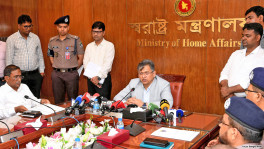
On Saturday night (8 March), a man was mugged near Shaheed Farhan Faiyaz Chattar beside Dhaka Residential Model College after Taraweeh prayers. According to police, three assailants armed with sharp weapons surrounded him, assaulted him, and snatched his iPhone, cash, and wristwatch before fleeing. Two suspects were later arrested and the phone was recovered within 24 hours.
The victim was Motahar Hossain, Director General of the Anti-Corruption Commission (ACC). If an ACC official himself can endure this, one can only imagine the situation for ordinary people.
Take the case of Mahir. At around 10:20 pm on a recent Monday night, Mohammadpur Police Station carried a faint, damp smell. Past a queue of complainants waiting with papers in hand, Mahir Shariar stood near the duty officer's desk, looking less like someone reporting a crime and more like someone who had simply lost his way.
 Keep updated, follow The Business Standard's Google news channel
Mahir, 20, is a graduate of Dhanmondi Ideal College, now preparing for university admission. Until recently he believed in the ordinary logic of systems — study hard, move forward, trust institutions. But 40 minutes earlier, near Ittyadi Mor, that logic had collapsed.
At 9:40 pm, a mugger stepped out of the shadows, started a short, meaningless conversation, and within minutes Mahir's phone — a Samsung S22 — was gone.
For Mahir, this was not a new experience. Just before Ramadan last year he had been stopped within shouting distance of the same police station and forced to hand over Tk1,400. But the loss of the phone felt heavier. It was the kind of device that many middle-class students treat as an essential tool — part notebook, part library, part connection to the future.
He had come to the police station to file a report, though he moved with the slow resignation of someone who already knew the outcome.
"As a student, I don't have any powerful connections," he said quietly. "So I'm not very hopeful."
During the two hours spent watching the station's open door, it became clear that Mahir's resignation was not unique. At least four other complainants arrived that evening with similar stories — phones snatched, money taken, threats made with blades.
Among them was Siyam Islam, a 20-year-old autorickshaw driver who walked in holding the empty cardboard box of his phone.
Around 5:40 pm near Nabinagar 3 No. Road, he said, two men armed with machetes blocked his path and demanded his belongings. They took his Vivo Y75 — a phone that represented weeks of work behind the wheel of his autorickshaw. The box was all that remained.
Scenes like these have become increasingly familiar in Mohammadpur. Residents say mugging and extortion incidents have grown more frequent in recent months, reshaping how people move through the neighbourhood. For many, the police station has become less a place of resolution and more a place where losses are formally recorded.
The geography of the dark
Certain locations in Mohammadpur have quietly gained a negative reputation among residents: Tin Rasta, Ittyadi Mor, Mohammadia Housing Limited, Balur Math, and the Beribadh Road. They are ordinary intersections and lanes during the day, but for many locals, they have become mental markers of vulnerability.
For Shariful Islam, a rickshaw puller who migrated to Dhaka from Jhenaidah, these places form a map he navigates every day.
One evening in February near Balur Math, Shariful said, men carrying machetes intercepted him and took Tk150 from his pocket. The amount might sound small. But for a daily wage earner, it meant the loss of several hours of labour.
More lasting than the money was the effect on his confidence.
Now when Shariful drives through Mohammadpur's inner roads, his eyes constantly scan the surroundings. During a recent ride through Mohammadpur Housing Limited, he suddenly slowed his rickshaw and lowered his voice.
"We should stop here," he whispered, pointing to a motorbike behind them. "Some guys are following us."
Whether the suspicion was real or imagined, the fear was unmistakable.
Police acknowledge that the area presents difficult conditions. Mezbah Uddin, officer-in-charge (OC) of Mohammadpur Police Station, says the neighbourhood's crime problems are closely tied to its social and geographic realities.
"You cannot change an area like Mohammadpur overnight," he said.
He pointed to nearby Geneva Camp and surrounding informal settlements, arguing that unemployment and poverty contribute to petty crime in the area.
"We put them behind bars. They stay inside for one or two months. If they come out and commit crimes again, we apprehend them again. It's a broader issue of economic struggle and human rights."
But residents say environmental factors also play a role. In several of the locations locals describe as hotspots, streetlights have been broken or inactive for long periods.
When asked about the issue, the OC said street lighting falls under the jurisdiction of the city corporation.
The result is a strange situation. While the police are responsible for enforcing the law, residents often end up installing lights outside their own homes in order to illuminate nearby streets.
In darker corners of the neighbourhood, the absence of a working streetlight can turn a narrow lane into an invitation for muggers.
The shrunken life
The effects of this insecurity are not always visible in crime statistics. Often they appear in smaller, quieter changes in people's lives.
Tanisha, a student at the University of Liberal Arts Bangladesh (ULAB), located in Mohammadpur, remembers the moment her phone was snatched. A motorbike slowed near her rickshaw, the rider grabbed the device from her hand, and disappeared before she could react.
"It was an iPhone 16 Pro," she said.
Replacing it would normally have been a simple decision. But Tanisha made a different calculation. Carrying an expensive phone in Mohammadpur, she felt, meant carrying a target. "I am not gonna buy another iPhone of course. Not until I graduate and leave Mohammadpur," she added. Instead of buying another high-end device, she switched to a cheaper one.
It was, in her words, a "safety downgrade".
For many young residents, this adjustment has become routine: avoiding expensive gadgets, taking shorter routes home, limiting time outdoors after dark.
Anika Tasnem, another ULAB student, describes living with a constant undercurrent of caution.
A year ago, her brother's phone was snatched at dawn near the university's campus along the Beribadh road while he was coming to meet her.
The incident changed how her family approached her daily life. "A shadow of fear is always there," Anika said.
Her mother now calls repeatedly whenever she leaves home, checking that she has reached her destination safely. As a result, Anika spends little time outside beyond what is necessary for classes or errands.
The neighbourhood's public spaces — once part of ordinary student life — have gradually been replaced by a routine of quick movements between home and campus.
Police officials, however, argue that Mohammadpur's reputation may be exaggerated.
OC Mezbah Uddin says snatching and petty crime occur throughout Dhaka, but incidents in Mohammadpur tend to attract more attention.
"Mohammadpur is being branded as a bad place," he said. "It is more noise than reality. I would say the crime even decreased here," he added.
For residents like Anika and Tanisha, though, the issue is less about reputation and more about daily experience.
The comparison they make is not with other parts of the city, but with the sense of freedom and safety they feel walking through their own neighbourhood.
The branding of a crisis
Inside police offices, the street-level chaos is often translated into numbers. Abdul Malek, officer-in-charge of Adabor Police Station, said law enforcement has been conducting regular operations against gangs involved in mugging and extortion.
"A few gangs have become active," he said. "We are doing our jobs."
He mentioned one recent operation where police detained more than forty suspects in connection with criminal activity in the area.
Yet statistics can obscure as much as they reveal.
In many cases, victims are encouraged to file a General Diary (GD) rather than a formal criminal case. A GD allows someone to report a lost phone or document, but it does not necessarily trigger a full investigation.
Filing a formal case, on the other hand, increases the official crime count for a police station and requires more administrative work.
As a result, many incidents never enter official statistics as crimes.
Residents say this practice has created a gap between the numbers recorded by police and what people experience on the streets.
Even when suspects are arrested, officers acknowledge that deterrence is difficult.
"We put them behind bars," OC Mezbah Uddin said. "They stay inside for one or two months. If they come out and commit again, we apprehend them again."
He described the problem as rooted in broader economic pressures — unemployment, poverty and the dense population around the area.
"It's a broader issue of economic struggle and human rights," he said.
For residents like Mahir and Shariful, however, such explanations offer little immediate reassurance.
Their experience is simpler: walking through certain streets has become a risk.
Long wait for a way out
As the night deepened at Mohammadpur Police Station, Mahir finished his paperwork and prepared to leave. His phone was gone. The report had been filed. The next step was unclear.
Outside, the neighbourhood continued its usual rhythm — rickshaws passing, street vendors closing stalls, students returning home.
But the sense of unease lingered.
For Mahir, the experience had already shaped a larger decision.
"I just want to go abroad and not come back to this country," he said quietly. Then he looked up and added, half-seriously, half-tired, "You should leave too."
For many residents of Mohammadpur, the fear is no longer dramatic or sudden. It is something quieter, more persistent — a calculation that shapes when they leave home, what they carry, and which streets they avoid.
And while officials debate statistics and branding, the people who live there continue adjusting their lives to a reality that feels harder to escape.