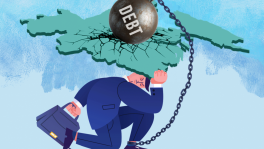
Private credit growth dips to record low at 6%
Weak investment demand and tight monetary policy weigh on lending

The country's private sector credit growth plummeted to an all-time low of 6.03% in January, as prolonged political instability and a high-interest-rate regime forced businesses to stall expansion plans and led banks to adopt a highly cautious lending stance.
According to the latest data from the Bangladesh Bank, credit growth edged down from 6.1% in December, continuing a sharp decline from the 10.13% recorded in July 2024.
Although a brief spike to 6.58% occurred in November, analysts attribute this to loan restructuring ahead of the 12 February national election rather than genuine new investment in productive sectors.
 Keep updated, follow The Business Standard's Google news channel
In its monetary policy statement for January-June 2026, the central bank attributed the slowdown to tight monetary conditions, rising government borrowing to finance the budget deficit and subdued demand for loans amid continued uncertainty surrounding new investment decisions.

The decline has been steady over recent months, with growth recorded at 6.29% in September, 6.35% in August, 6.52% in July, 6.40% in June, 7.17% in May and 7.5% in April. In contrast, private sector credit growth stood at 10.13% in July 2024 before falling sharply following the political transition in August that year.
Economists say prolonged political uncertainty, weak business confidence and structural weaknesses in banks have discouraged investment, prompting many businesses to postpone expansion plans despite the BNP securing a landslide victory in the February election.
Newly appointed central bank Governor Md Mostaqur Rahman has indicated that policy support will be introduced to revive private sector lending and restore economic momentum.
On his first day in office, he said lending rates would be gradually reduced to encourage investment and that reopening closed factories and business establishments would be essential to revitalise economic activity – signalling a possible shift away from the prolonged contractionary monetary stance.
Bankers, however, say high borrowing costs are only part of the challenge. Syed Mahbubur Rahman, managing director of Mutual Trust Bank, told TBS that banks are currently extending loans at even around 11% interest while paying similar rates on deposits, leaving minimal margins.
He noted that although high lending rates remain a constraint, investors prioritise reliable infrastructure – including gas, electricity and port facilities – before financing considerations.
Persistent energy shortages and infrastructure bottlenecks, he said, have prevented both existing businesses from expanding and new investors from entering the market.
A major factor behind the credit slowdown has been increased government borrowing from banks. During July-December of the 2025-26 fiscal year, net credit to the government reached Tk50,782 crore, equivalent to 43% of the revised annual target of Tk1.18 lakh crore.
Net government borrowing from the banking system rose 32.8% by December 2025, effectively crowding out private borrowers in an already tight liquidity environment.
Banks are simultaneously struggling with soaring non-performing loans, which climbed to a record Tk6.44 lakh crore at the end of September 2025 – roughly one-third of total outstanding loans.
Elevated default levels have weakened bank capital positions, increased provisioning requirements and made lenders more cautious in approving new credit.
Liquidity pressures and slow deposit growth have further constrained lending capacity. In an effort to curb inflation, the central bank earlier raised its policy rate to 10%, pushing commercial lending rates close to 15% and discouraging businesses, particularly small and medium-sized enterprises, from taking fresh loans.
The effects of weak credit expansion are increasingly visible across the economy. Imports of capital machinery have declined, signalling slower industrial growth, while reduced investment has dampened money circulation. Many factories are operating below capacity, consumer demand remains subdued and private sector job creation has slowed.
The central bank had set a target of 9.8% private sector credit growth for July-December 2025, but actual performance fell significantly short.
Experts warned that if lending growth fails to recover, industrial output could weaken further, private investment may remain stagnant and employment recovery could face prolonged delays.