



Newborn deaths at Ad-din hospital: Oxygen shortage, negligence found, says health minister
Probe finds hospital building not suitable for providing medical services.
Highlights
- Hospital found with serious infrastructure, management and service failures
- Building deemed unfit for safe medical care
- Poor ventilation led to low oxygen and high carbon dioxide levels
- Faulty AC system contributed to unsafe conditions for newborns
- Ward was severely overcrowded beyond capacity
- No doctor was present during the critical period
- Staff failed to respond adequately to guardians' concerns
- No functional emergency medical response system was in place
The investigation committee formed over the death of six newborns at Ad-din Medical College Hospital has found evidence of negligence by the hospital authorities, Health Minister Sardar Md Sakhawat Husain said today (4 June).
The primary factors behind the incident included a malfunctioning air-conditioning system, oxygen shortage, and overcrowding in a small ward, he said while presenting the committee's findings at a press briefing at the ministry in the Secretariat.
 Keep updated, follow The Business Standard's Google news channel
Legal action would be taken in accordance with existing laws, he added.
The health minister said after conducting an on-site inspection, reviewing statements from the victims' families, doctors, nurses, and staff, and considering the surrounding circumstances, the investigation committee has unanimously concluded that the tragic and sudden deaths of six newborns at Ad-Din Medical College Hospital in Moghbazar between approximately 5am and 9am on 27 May 2026 were clearly caused by negligence.

According to the report, the hospital's infrastructure, management, and healthcare services suffered from multiple serious shortcomings. The committee found that the building where the hospital was operating was not suitable for providing medical services.
The investigation also revealed that oxygen levels in the affected ward had dropped while carbon dioxide levels increased, creating a highly risky environment for newborns.

Quoting the investigation committee, the minister said that Post-Operative Room- 2 of Ad-Din Hospital was completely unfit for hospital use. The 900-square-foot room had far more people than its capacity. Due to prolonged shutdown of the air conditioning and lack of alternative ventilation, oxygen levels dropped dangerously while carbon dioxide levels increased, which was unbearable for the newborns.
The health minister further said that nurses on duty failed to respond adequately to requests from patients' guardians. In addition, the ward housed more patients than its designated capacity, further worsening the situation.
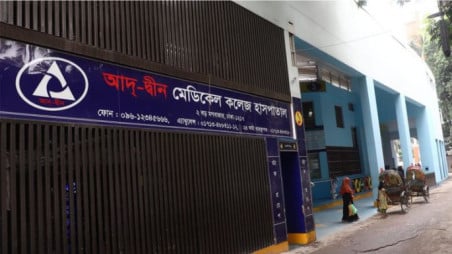
The report noted that the hospital authorities failed to ensure the necessary standards and preparedness required to operate the facility. It also identified the absence of any doctor in the concerned ward at the time of the incident on 27 May as a serious lapse.
"Doctors' absence, nurses' non-cooperation, and negligence by the hospital authorities have all been established," the minister said.
He said a decision on punitive measures against those responsible would be made by Sunday.
The probe committee also recommended that authorities conduct physical inspections of buildings before granting licences to private hospitals in the future.
The exact causes of death could not be determined, as the families of the deceased newborns did not consent to post-mortem examinations.
Responding to a question from journalists, the minister added, "The investigation report clearly establishes criminal acts and negligence. The post-operative room where the incident occurred has already been sealed. However, as more than 200 patients are currently admitted in the hospital, it cannot be shut down immediately. Over the next two days, we will review the legal aspects and, by Sunday, we will reach a final and firm decision regarding the hospital, Insha'Allah."

He also noted that the investigation committee has recommended making prior clearance from the Department of Environment and mandatory building inspections a requirement for issuing new licenses to private hospitals. The ministry has already begun working to implement these measures.
In response to a question, the minister said, "Due to emotional reasons, the families took the bodies without autopsy, which the accused may try to use as a legal loophole. However, this was not a secret incident that took place under the cover of darkness; it is a fully established and proven fact. I firmly believe the honorable court will not grant any leniency to the accused."
The minister further stated that the health ministry is taking appropriate steps to curb the unchecked mismanagement in hospitals. "We are organising surprise inspections involving the Secretary, the Director General, and the State Minister, and we are preparing to take strict legal actions. I firmly believe that in the future, no hospital authority will dare to keep patients or children in such confined and unsafe conditions."
Ad-din served show-cause notice
The Directorate General of Health Services (DGHS) has issued a show-cause notice to the authorities of Ad-din Hospital over the deaths of six newborns on 27 May. The notice asks why the hospital's licence should not be cancelled for violating the provisions of the Medical Practice and Private Clinics and Laboratories (Regulation) Ordinance.
The hospital's owner, Dr Sheikh Mohiuddin, has been instructed to respond to the notice within 72 hours, by 4 pm on 7 June.


