



Can an app clean up Bangladesh's land offices?
The initiative also aims to monitor officials’ attendance as part of a broader effort to tackle corruption, delays and the influence of brokers.

Buying and registering land in Bangladesh has long been a headache due to the bribes and delays involved. Now, the government is turning to tech like geo-fencing and mobile apps to clean up the system.
The government's goal is to reduce human contact and prevent fraud. However, a recent survey shows that land corruption has actually increased, proving that while tech can speed things up, changing a decades-old system of bribes is a much tougher fight.
The initiative also aims to monitor officials' attendance as part of a broader effort to tackle corruption, delays and the influence of brokers.
 Keep updated, follow The Business Standard's Google news channel
Speaking to The Business Standard, State Minister for Land and Chittagong Hill Tracts Affairs Mir Mohammed Helal Uddin said the ministry's objective is to minimise human interaction in service delivery while making land services easier, faster and more transparent.
"The more services people can access digitally, the fewer opportunities there will be for corruption and harassment," he said.
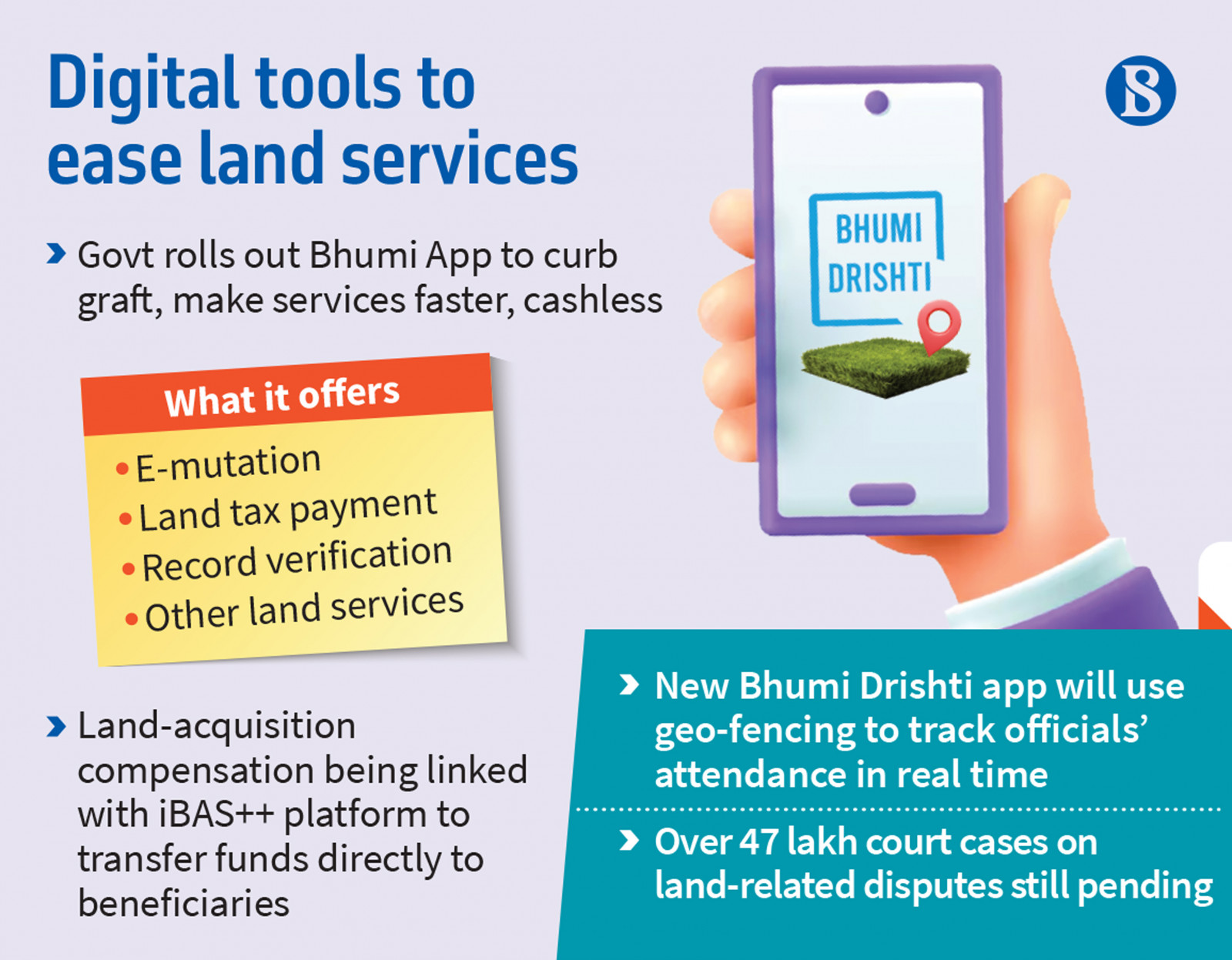
The Bhumi App, which has crossed 100,000 downloads, allows users to pay land development tax, apply for and track e-mutation requests, search and verify land records, access digital copies of khatians and mouza maps, submit complaints online, calculate inheritance shares and maintain a unified landowner profile linked to national identity information.
To ensure access for people unfamiliar with digital platforms, the ministry has approved 893 service centres across the country where citizens can receive assistance for a nominal fee, he said.
Recognising that digital adoption remains a challenge, particularly in rural areas, the ministry has launched awareness campaigns through local administrations, educational institutions and religious establishments. Instructional videos and information materials are also being distributed to familiarise citizens with online land services.
Despite these efforts, many people continue to rely on brokers.
Rashedul Islam, a Dhaka resident who recently used digital land services, said the online system significantly reduced the hassle associated with land administration.
"I completed several steps online and received support from a service centre when needed. Compared to the conventional process, it saved both time and effort," he said.
Akhter Hossain, a resident of Shailkupa upazila in Jhenaidah, said limited digital literacy and internet access continue to prevent wider adoption in rural areas.
"There is still a perception that files move faster through brokers. Technology can help, but implementation and awareness at the local level remain critical," he said.
Officials acknowledge that technology alone cannot transform a system shaped by decades of informal practices.
To address another long-standing concern, absenteeism among officials, the ministry plans to launch "Bhumi Drishti" after completing field trials. The platform will establish virtual boundaries around land offices, enabling supervisors to monitor officials' attendance through a central dashboard in real time.
"If an official leaves the designated office boundary during office hours, the system will immediately reflect that on the dashboard," the state minister said.
Helal Uddin also pointed to a structural challenge: land administration and land registration fall under separate ministries. While many people assume sub-registrar offices operate under the land ministry, they are administered by the law ministry.
According to him, many irregularities associated with land administration actually originate during the registration process, including forged deeds and documentation-related disputes.
To tackle these issues, the government is expanding digital cadastral surveys, developing a central land repository and integrating land registration with land information systems to improve record accuracy and reduce disputes.
It is also linking land acquisition compensation to the iBAS++ platform so payments can be transferred directly to beneficiaries, reducing manual intervention and opportunities for irregularities.
According to Transparency International Bangladesh's latest survey, 66.2% of households receiving land services experienced some form of corruption, up from 51% in 2023. Nearly 47.6% of service recipients reported paying bribes, with the average unauthorised payment reaching Tk11,310 per household.
The survey estimated that bribery in land services generated around Tk3,081 crore nationwide, the highest among all public service sectors covered.
Land disputes also continue to weigh heavily on the judicial system. Bangladesh's courts currently have more than 4.7 million pending cases, with the Association for Land Reform and Development identifying land-related conflicts as a major contributor to the country's civil litigation backlog.


