



How Iran's 'Woman, Life, Freedom' movement reshaped public dissent
A long protest, impact of which extends beyond Iranian streets

Iran has witnessed recurring waves of protests and unrest for more than four decades since the 1979 Islamic Revolution, reflecting long-standing tensions between the state and sections of society.
As fresh unrest again draws attention to the country, many Iranians and international observers are revisiting the "Woman, Life, Freedom" movement of 2022 – one of the most significant protest waves in recent decades.
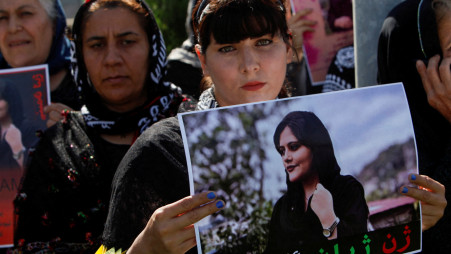
The movement was sparked by the death of Mahsa Amini, a 22-year-old Kurdish Iranian woman who died in custody after being detained by Iran's morality police.
 Keep updated, follow The Business Standard's Google news channel
What began as public anger over her death quickly evolved into nationwide demonstrations that placed women at the centre of dissent and challenged social and political restrictions more broadly.

Although the 2022 protests did not bring institutional change, they marked a turning point in how dissent was expressed in Iran.
Understanding how the movement emerged, what it represented and how it unfolded provides essential context for the country's recurring unrest today.
Who was Mahsa Amini and what happened?
Mahsa Amini was a 22-year-old Kurdish Iranian woman from the western city of Saqez. In September 2022, she was detained in Iran's capital, Tehran, by the morality police for allegedly violating the country's mandatory hijab regulations.
Iranian authorities said Amini collapsed after suffering a sudden heart problem while in custody and died three days later in hospital.
Her family rejected that account, saying she had no history of heart problems and had shown signs of injury.

Witness testimony and medical reports cited by international media raised serious doubts about the official explanation.
News of her death quickly spread across social media and state-controlled outlets, triggering anger among many Iranians, particularly women and younger people who had long expressed frustration over compulsory dress codes and broader restrictions on personal freedoms.
Protests began at Amini's funeral in Kurdistan province and soon spread beyond Kurdish areas to cities across the country.
Why her death resonated so widely
Compulsory hijab laws have been in place in Iran since the 1979 Islamic Revolution and have long been a source of tension between the state and sections of society.
Enforcement has varied over time, becoming stricter during periods of political conservatism and more relaxed during more pragmatic administrations.
According to reporting by Reuters and the Associated Press, confrontations between women and morality police had become more frequent by the late 2010s, particularly in major urban centres.
Previous incidents involving deaths in custody or allegations of police abuse had also triggered protests, though none had spread as widely as those in 2022.
Amini's case resonated not only because of the circumstances surrounding her death, but also because of who she was.
Her Kurdish identity mattered in a country where ethnic minorities have long complained of discrimination and marginalisation.

Protests in Kurdish regions were among the first to erupt, giving the movement both a gendered and ethnic dimension from the outset.
As demonstrations spread nationwide, Amini's death came to symbolise broader grievances over state authority, social control and the limits placed on personal and political freedoms.
What did "Woman, Life, Freedom" mean?
The slogan "Woman, Life, Freedom" emerged as the defining phrase of the 2022 protests in Iran, marking a shift in the language and focus of public dissent.
The phrase has its roots in Kurdish women's movements, where similar expressions had been used for years before 2022.
Following Mahsa Amini's death, the slogan was adopted nationwide and came to symbolise opposition not only to compulsory hijab rules but also to broader forms of social and political control.
Unlike slogans used in earlier protest movements – which often centred on economic hardship, corruption, fuel prices or disputed elections – "Woman, Life, Freedom" placed women at the centre of the demonstrations.
By doing so, it reframed gender equality as inseparable from wider demands for dignity, autonomy and freedom.
Analysts cited by international media described the slogan as going beyond a single policy demand.
While opposition to compulsory dress codes acted as an initial trigger, the phrase allowed demonstrators to articulate a wider range of grievances related to personal freedoms, state authority and the limits imposed on everyday life.
As the protests spread, the slogan became a unifying expression across different regions and social groups, helping to connect gender-based grievances with broader calls for change.
What changed – and what did not
In political terms, the 2022 protest movement did not lead to institutional change. Iran's leadership did not repeal mandatory hijab laws or introduce major legal or constitutional reforms in response to the demonstrations.
By early 2023, sustained street protests had largely subsided following widespread arrests and security measures.
However, international reporting suggests that social norms shifted in more subtle ways. According to Reuters, instances of hijab non-compliance became more visible in some urban areas, while enforcement of dress regulations appeared uneven, varying by location and over time.
In certain areas, morality police patrols were reported less frequently, while in others enforcement continued.
Women continued to test social boundaries in public spaces even after large-scale demonstrations ended.
Public criticism of state authority was also reported to have crossed class, ethnic and regional lines more visibly than before, challenging assumptions about political disengagement.
Analysts described these changes as forms of quiet or everyday resistance that were difficult for authorities to fully reverse. While the movement did not alter political institutions, it exposed limits to state control over social behaviour and expression.
How it connects to what is happening now
Recent episodes of unrest in Iran have been driven largely by economic pressures, including high inflation, a weakening currency and labour-related grievances, according to international media reports.
The BBC, citing rights groups, reported sharply differing estimates of casualties and arrests. The US-based Human Rights Activists News Agency (HRANA) said it had confirmed more than 6,000 deaths, while Norway-based Iran Human Rights said the final toll could be significantly higher.
Iranian authorities, however, said at least 3,117 people were killed, claiming most were members of security forces or bystanders and blaming deaths on what they described as "rioters".
Rights groups also said tens of thousands had been detained during the crackdown, with Iran Human Rights estimating that at least 40,000 people were arrested since the protests began.
Independent verification of casualty figures has been difficult due to internet disruptions and restrictions on reporting inside the country.
While the immediate triggers differ from those of 2022, analysts note a significant overlap in the social groups involved. Students, women, urban workers and ethnic minorities – who played a central role in the "Woman, Life, Freedom" protests – continue to feature prominently in later demonstrations.
For this reason, the 2022 movement is often seen as a reference point rather than an isolated episode, having lowered the threshold for public dissent and shaped how grievances are expressed, even when the causes are primarily economic rather than social or cultural.


