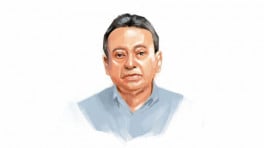
Rajshahi Cadet College student reaches North Pole on Rosatom expedition

Rajshahi Cadet College student Malehul Salehin Prottoy has reached the North Pole after joining Rosatom's 7th International Scientific and Educational Expedition, "Icebreaker of Knowledge", aboard the nuclear-powered icebreaker 50 Let Pobedy.
The 10-day voyage aboard the nuclear-powered icebreaker 50 Let Pobedy followed the Murmansk–North Pole–Franz Josef Land–Murmansk route and marked the 200th expedition by a surface vessel to reach the North Pole, according to a press release. The release said participants were invited to join the expedition through Rosatom's 7th International Scientific and Educational Expedition, "Icebreaker of Knowledge".
Prottoy, a Class 10 student, returned to Murmansk after completing the expedition with school students from around the world.
 Keep updated, follow The Business Standard's Google news channel
"From a dream to the top of the world, my journey aboard the Icebreaker of Knowledge was unforgettable," Prottoy said.
"I met people from 22 countries, experienced 22 cultures and heard 22 languages.
"I also learned from experts in marine biology, nuclear physics, artificial intelligence and many other fields. The Arctic gave me knowledge, friendship and memories I will cherish forever," he added.
The expedition brought together students aged between 14 and 16.
Prottoy has previously succeeded in several international competitions, including the International Astronomy and Astrophysics Competition, The Queen's Commonwealth Essay Competition, the International Youth Math Challenge and the Bangladesh Artificial Intelligence Olympiad.
"Such voyages truly contribute to the development of the next generation," said 50 Let Pobedy Captain Ruslan Sasov.
"The brightest and most talented young people take part in these expeditions. Many of them dreamed of visiting the North Pole and seeing polar bears, and I am very glad that Rosatom and our crew helped make those dreams come true."
The ship also arranged a scientific and educational programme for participants.
The facilities included an aerospace laboratory, where students took part in practical scientific activities.
During the voyage, participants worked with scientists on two experiments.
They launched a radiosonde designed to support communications in remote areas of the Arctic and along the Northern Sea Route.
The students also helped test what organisers described as the world's first recoverable stratospheric platform.
"At Rosatom, we work every day on technologies that seemed like science fiction just yesterday," said NIITFA Project Manager Yegor Plakhotnyuk. NIITFA is part of Rosatom's Scientific Division.
"During the expedition, the children saw that Russian science is focused on the future and on real technologies that can make people's lives better," he added.
After reaching the North Pole, participants joined what the organisers described as the northernmost and most international circle dance around the 90° point.
AY YOLA, a musical group from Bashkortostan, performed live during the event.
The expedition also featured a creative project in which the participants worked with science-fiction writer Sergey Lukyanenko to produce a story.
The story will later be published on the social media accounts of Rosatom's Icebreaker of Knowledge project.
Supported by Rosatom, Icebreaker of Knowledge is a scientific and educational project that encourages young people to explore natural sciences and nuclear technologies.
The project also seeks to identify and support talented students, develop their abilities, and provide career guidance.
Across seven seasons, the project has brought more than 470 schoolchildren from different countries to the Arctic and the North Pole.
The release said Russia was the only country operating a fleet of nuclear-powered icebreakers and offering young people opportunities to experience the Arctic through educational expeditions.