



How govt plans to finance Tk2.51 lakh crore deficit
The foreign loan target is 84% higher than the revised one for the current fiscal year and 66% higher than external assistance received in the last budget before the fall of the Hasina government

Highlights:
- FY27 external borrowing target rises to Tk1.16 lakh crore
- Government plans Tk1.20 lakh crore borrowing from banks
- External financing received far below current fiscal targets
- Political stability expected to accelerate foreign-funded project implementation
- IMF loan tranches and World Bank support declined sharply
- Economists warn bank borrowing may crowd out private investment
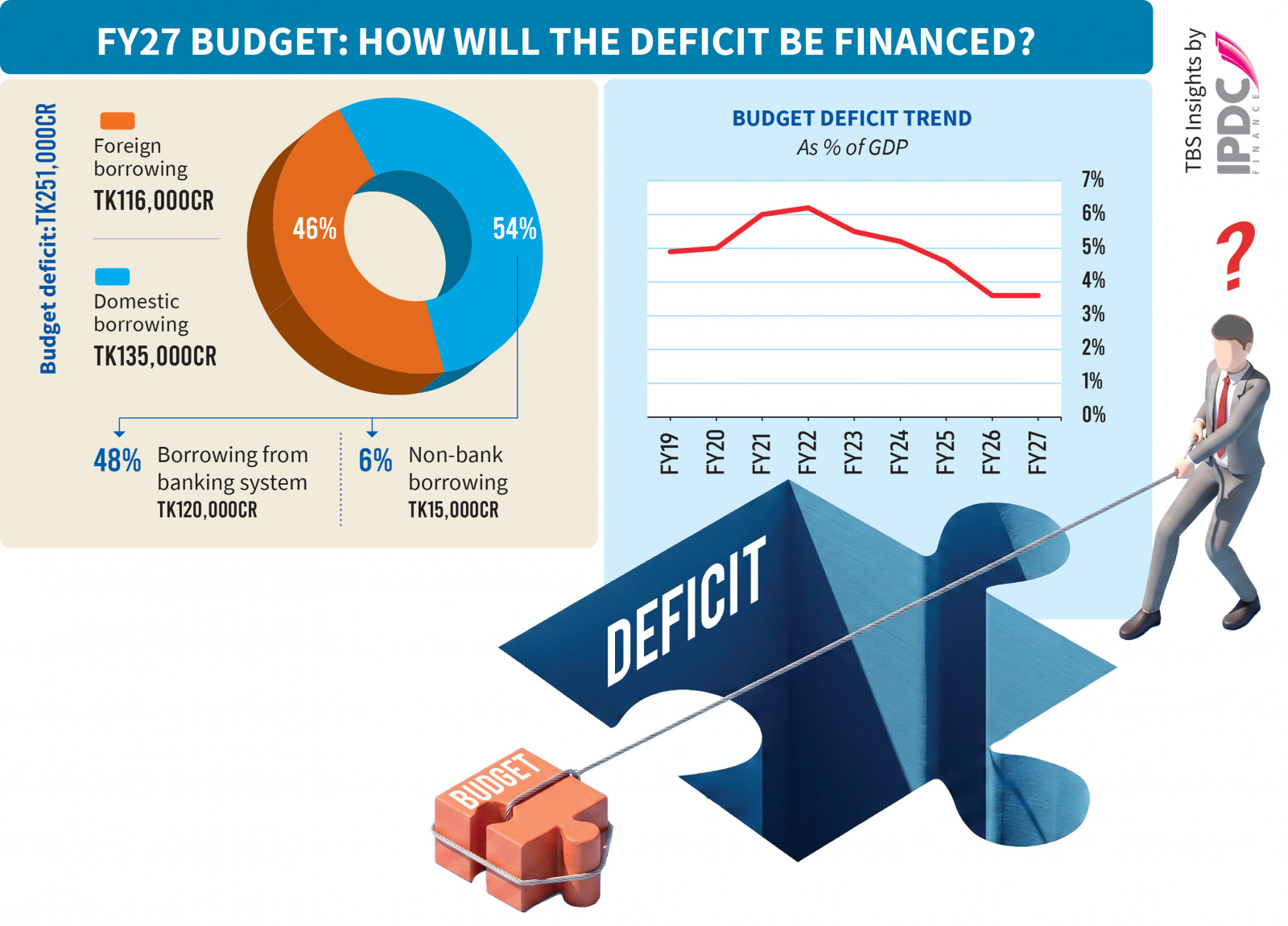
The government has set a target of borrowing Tk1.16 lakh crore from external sources and Tk1.35 lakh crore from the banking system in the upcoming FY27 to meet the deficit in the upcoming fiscal budget for development and non-development expenditure needs.
The foreign loan target is 84% higher than the revised one for the current fiscal year and 66% higher than external assistance received in the last budget before the fall of the Hasina government.
 Keep updated, follow The Business Standard's Google news channel
In the current fiscal year's original budget, the external borrowing target was set at Tk1.01 lakh crore. However, due to sluggish project implementation and weak prospects of receiving adequate budget support, the target was revised down to Tk63,000 crore.
By the end of May, only Tk26,700 crore in external financing had been received.
Finance and ERD officials said development projects are expected to proceed in a more stable political environment under the current administration.
They also anticipate a revival in several stalled foreign-funded mega projects that slowed during the interim period, which is likely to lift project aid disbursements.
Officials said the new government has a full fiscal year for budget execution. Discussions have already begun with development partners to restart several stalled projects.
In addition, a number of large projects have been included in the BNP government's approved ADP. As a result, implementation of externally funded projects is expected to pick up in the next fiscal year, along with higher disbursement of foreign loans.
Finance Minister Amir Khosru Mahmud Chowdhury is set to announce a budget of nearly Tk9.38 lakh crore on Thursday, with the fiscal deficit contained at 3.6% of GDP. The IMF generally recommends that developing countries keep deficits within 5%.
For the upcoming fiscal year, the government plans to finance 46% of the Tk2.51 lakh crore deficit through external sources, equivalent to 1.7% of GDP.
Fahmida Khatun, executive director of the Centre for Policy Dialogue (CPD), said external loan mobilisation in the current fiscal's revised budget has fallen well short of the target.
She said the main reasons are slow project implementation, delays in approval and procurement, and administrative bottlenecks in meeting donor conditions.
"In addition, political and economic uncertainty has made development partners more cautious in disbursing funds, limiting external financing," she told The Business Standard.
She added that higher mobilisation would depend on rebuilding donor confidence, with some partners likely to respond if conditions improve.
Recent external financings
ERD officials said that against the current fiscal year's original target of Tk1.01 lakh crore in external borrowing, about $1 billion in project loans and $1.67 billion in budget support have been confirmed so far. This brings the total by May to $2.67 billion, or Tk26,700 crore.
As a result, the revised budget target for external borrowing was cut to Tk63,000 crore. However, ERD has still secured less than half of this revised target.
In FY25, the government received Tk90,700 crore in external loans, compared to Tk74,587 crore in the previous year.
Officials said many foreign-funded projects initiated during the Awami League tenure were paused under the interim administration, particularly before the election period in February. Budget support also declined significantly during the current fiscal year.
They added that Bangladesh received the lowest World Bank support in a decade, while two IMF tranches worth $1.53 billion were missed due to unmet conditions.
ERD officials said the government had sought $3.2 billion in budget support this fiscal year from development partners, but responses have been limited. As an alternative, authorities are considering using undisbursed portions of existing loans that are not urgently required.
So far, assurances have been received for $1 billion from the ADB, $315 million from Japan, $250 million from AIIB, and $100 million from the Opec Fund.
The government has also begun repurposing $2 billion from ongoing projects. Most of these funds are expected to be disbursed in the next fiscal, according to ERD officials.
Efforts to accelerate projects
ERD officials said that soon after the FY25 political transition, many project directors went untraced, while others were removed. Replacements took time, delaying implementation, while several projects also required revisions, further slowing their restart.
They added that the recently approved public procurement rules caused additional delays, as many ministries and agencies took longer to initiate tendering processes.
As a result, several foreign-funded projects could not spend according to their allocations, prompting development partners to withhold disbursements, officials said.
They also said development activities slowed in the run-up to and immediately after the February elections, disrupting project execution and fund releases during the current fiscal.
Since taking office, the BNP government has begun reviewing ongoing projects, including those misaligned with its election manifesto. The scrutiny covers both domestic and foreign-funded initiatives, leaving many externally financed projects to regain momentum.
According to the Implementation Monitoring and Evaluation Division (IMED), external loan utilisation stood at Tk32,580 crore in the first 10 months of the current fiscal year (July–April). It was Tk35,559 crore in FY25, and Tk48,468 crore in the preceding year.
Bank borrowing target may reach Tk1,20,000cr
The government is planning to finance 54% of next fiscal year's budget deficit through domestic sources, including banks and savings instruments. Of this, Tk1.20 lakh crore may be borrowed from the banking system, while Tk15,000 crore from savings certificates.
Although domestic borrowing carries no default risk, it is costlier. It is likely to raise the government's interest burden and crowd out private sector credit, pushing up lending rates and dampening investment and job creation.
Economist Fahmida said excessive reliance on borrowing from the banking system and savings certificates to finance the budget deficit could crowd out private sector credit.
"This may constrain private investment at a time when recovery and job creation require stronger private sector participation. Although credit demand is currently subdued, firms are waiting for favourable conditions, which could lift borrowing demand," she said.
In the current budget, Tk1,04,000 crore was the borrowing target from banks. Despite weak budget execution, revenue shortfall pushed the revised target up by Tk14,000 crore.
However, borrowing from high-interest savings instruments is set to be reduced in the next fiscal year. While the original budget for the current year targeted Tk21,000 crore from this source, the revised estimate was cut to Tk19,000 crore.


