



Bangladesh must reform its business environment to address job crisis, experts warn
Experts warn policy uncertainty, a weak banking sector and excessive protectionism are hindering investment, job creation and long-term growth in Bangladesh

Economists and business leaders have called for urgent reforms to Bangladesh's business environment, warning that policy uncertainty, a weak banking sector, and excessive protectionism are holding back private investment, job creation, and long-term growth.
The warnings came at a dissemination event titled "Bangladesh Development Update: Special Focus – A Business Environment that Delivers Jobs," jointly organised by the Policy Research Institute of Bangladesh (PRI) and the World Bank in Dhaka today (18 May).
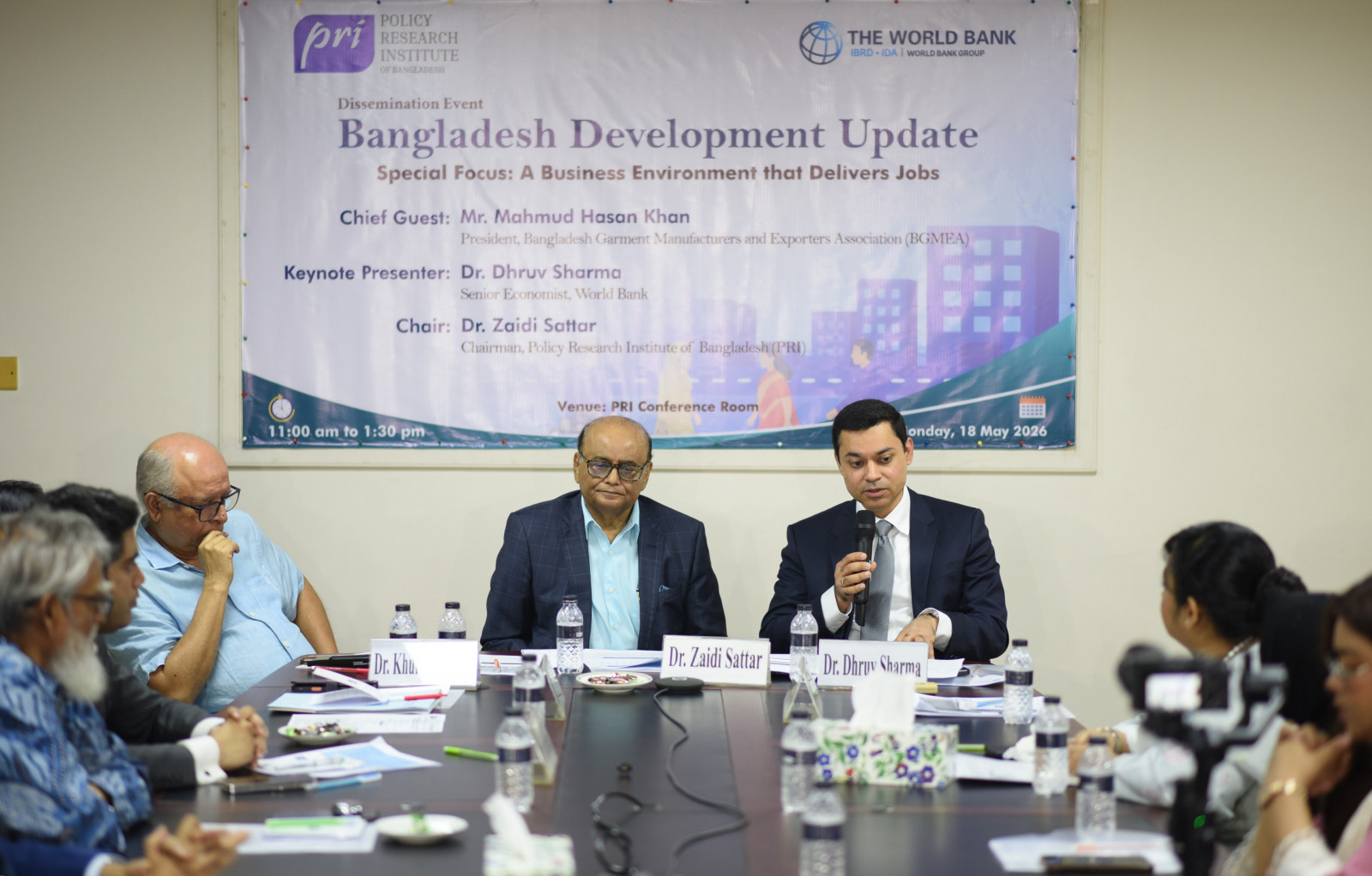
Presenting the keynote, Dhruv Sharma, senior World Bank economist and lead author of the report, said improving the business environment is essential to absorb Bangladesh's rapidly expanding workforce. "Reducing regulatory uncertainty, targeted deregulation, stronger competition, and easing constraints on firm growth will help unlock private investment and jobs," he said.
Session chair Zaidi Sattar, PRI chairman, called job creation Bangladesh's defining economic challenge. With youth unemployment at nearly 40%, he said growth, employment, and poverty reduction are inseparable. "Without growth, there will be no jobs, and without jobs, poverty reduction cannot be sustained."
 Keep updated, follow The Business Standard's Google news channel
He noted that Bangladesh cut its poverty rate from 60% in 1990 to 18.7% in 2020 through export-led growth and trade liberalisation – a model he said must now be renewed.
Several structural distortions emerged in the discussion. Zaidi Sattar questioned whether the government's 2.5% cash incentive on remittances remains necessary, arguing the taka's sharp depreciation has already made formal channels more attractive.
Reducing regulatory uncertainty, targeted deregulation, stronger competition, and easing constraints on firm growth will help unlock private investment and jobs.
On taxation, he said the ready-made garment sector enjoys significantly lower corporate tax rates than other industries, while high protective tariffs keep domestic prices elevated and discourage export diversification.
The report flagged a deeper imbalance: frontier firms account for nearly 70% of exports and 75% of revenue, yet contribute only 15% of total employment – reflecting how unevenly growth has been distributed.
Fahmida Khatun, executive director of the Centre for Policy Dialogue, said Bangladesh must move beyond a model built on cheap labour and protectionism toward a diversified, competitive economy.
She stressed that industrial protections must carry sunset clauses to prevent long-term market distortions, and identified banking sector weaknesses as a major obstacle to affordable private sector financing.
TIM Nurul Kabir of the Foreign Investors' Chamber of Commerce and Industry attributed falling foreign direct investment to inconsistent fiscal policy. Frequent changes and sudden supplementary duties, he said, deter expansion and reduce tax revenue. "Investors require long-term policy stability."
Ashikur Rahman, principal economist at PRI, said credible fiscal and financial reforms are now essential to restoring Bangladesh's growth momentum.


