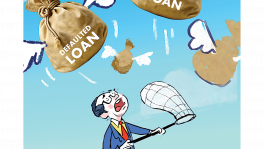
Bangladesh cannot escape fragility without dismantling 'loot and plunder economy': Expert
Professor Mahbubullah expressed deep concern over what he termed a “sluggish and depressed” investment environment, warning that Bangladesh’s productive base is not expanding fast enough to absorb labour or support stable long-term growth.

Former chairman of the Development Studies Department at Dhaka University, Professor Mahbubullah, today (8 December) stressed that Bangladesh's persistent economic fragility cannot be overcome without establishing a genuine balance of power within society and dismantling what he described as a long-running "loot and plunder economy."
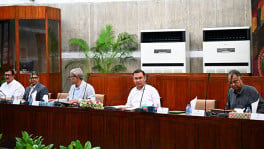
Speaking at the seminar on the publications "Bangladesh State of the Economy 2025" and "Sustainable Development Goals: Bangladesh Progress Report 2025" at the National Economic Council (NEC) Conference Room of the Planning Commission in Sher-e-Bangla Nagar, the eminent economist said that the country has been stuck in a cycle of wealth accumulation since 16 December 1971—an economic structure he argued continues to distort incentives, hinder productive growth, and sustain inequality.
He said that despite adopting numerous policies and reforms, Bangladesh has failed to achieve sustainable outcomes because "economic extraction and redistribution of wealth from one set of hands to another" remain deeply embedded in the system.
 Keep updated, follow The Business Standard's Google news channel
"Unless we end this continuous reshuffling of wealth, real productive growth will remain elusive," he cautioned.
"Unless we transition to a production-based economy, the country's growth will remain vulnerable and uneven," he added.
Professor Mahbubullah underscored that meaningful economic reforms, including those relating to governance, investment, and market functioning, cannot take root unless the social and political power structure is rebalanced.
"We talk about democracy and good governance, but neither will materialise as long as this accumulation process continues. A fair distribution of power across society is the precondition for a functional economy," he said, adding that without such a foundation, reforms risk remaining superficial.
Turning to inflation, the economist expressed doubt about the country's ability to bring price pressures under control within the next one to three years.
He argued that supply bottlenecks, limited productive capacity, and a large demand burden—partly driven by population growth—make a quick recovery unlikely.
"Inflation cannot be tamed while commodity supply remains insufficient compared to money supply. Production must rise, but investment is stagnant. Without new investment, expanding supply in the short term is impossible," he said.
He also pointed to the effects of high government expenditure and increased liquidity injected into the economy, which have exacerbated the imbalance between money circulation and commodity circulation.
Concern over 'sluggish and depressed' investment environment
Professor Mahbubullah expressed deep concern over what he termed a "sluggish and depressed" investment environment, warning that Bangladesh's productive base is not expanding fast enough to absorb labour or support stable long-term growth.
He noted that while readymade garments and foreign remittances remain the two primary pillars of the economy, other promising sectors—such as pharmaceuticals, ceramics, and light engineering—have not been able to scale up due to structural constraints and unfavourable incentives.
"A proper incentive structure across fiscal, monetary and planning policies is yet to be formulated. Without it, investors cannot be expected to take risks or expand production," he added.
Describing the prevailing economic order as one driven by extraction rather than production, he said that wealth continues to be generated and redistributed through rent-seeking, misuse of state power, and distortive incentives, rather than productive investment.
"This loot and plunder economy has existed under every government for 54 years—sometimes more intensely, sometimes less—but we have never truly escaped it," he said.
He emphasised that addressing inequality, understanding the dynamics of the informal economy, and strengthening governance are essential steps for shifting towards a productive and inclusive growth model.