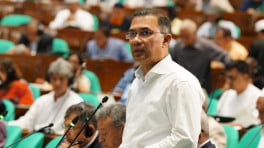
Supporting Hasina not a crime unless law criminalises it: Zahed
Until something is criminalised, criminal charges cannot be brought against anyone. It has to be criminalised through legislation, he says.

Prime Minister's Adviser on Information and Broadcasting Zahed Ur Rahman today (1 September) said simply speaking in favour of or supporting deposed prime minister Sheikh Hasina cannot be treated as a criminal offence unless a law criminalises such conduct.
"No one can be declared a criminal merely because allegations have been brought against them. Action must be taken on the basis of law," he said while responding to questions from reporters at a press briefing at the Secretariat on the progress of various government activities.
Asked about allegations that some journalists had acted as accomplices to Sheikh Hasina in crimes against humanity, Zahed said those against whom there are allegations of involvement in crimes against humanity and sufficient evidence are being tried at the International Crimes Tribunal (ICT).
 Keep updated, follow The Business Standard's Google news channel
Several journalists have already been included in such cases, he said. "But there must be a law if simply speaking in favour of Sheikh Hasina or supporting her is to be considered a crime," he said.
"Until something is criminalised, criminal charges cannot be brought against anyone. It has to be criminalised through legislation," the adviser said.
Zahed stressed the need to ensure that no one becomes a victim of injustice under the current government or any future democratic government.
Referring to demands for a separate law to protect journalists following attacks on them, he said existing laws already provide scope for taking strict action against attacks and torture.
A new law could be enacted, Zahed said, but simply introducing a new law will not by itself guarantee journalists' safety.
He said legal proceedings over attacks on journalists should continue under existing laws.
Asked about the inclusion of cultural activists' names in cases filed with ICT, the adviser said it will be inappropriate to speculate about anyone while an investigation is ongoing.
The adviser said the chief prosecutor has mentioned obtaining preliminary information about the involvement of a cultural activist, but no name should be disclosed until a formal allegation or charge is brought.
"There should be no naming of anyone merely for sensationalism. If there is an allegation against someone, it should first be verified through investigation. Once a formal charge is framed, the media will learn about it," he said.