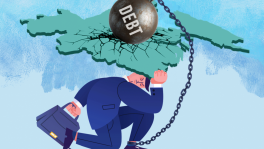
Pay bonanza for govt staff amid inflation, energy crisis
Govt approves 9th National Pay Scale, raising public servants’ salaries by up to 142%.

The government yesterday (31 August) approved the 9th National Pay Scale, raising public servants' salaries by up to 142% – at a time when the country is grappling with energy crisis-driven production disruptions, weak revenue collection and years of high inflation.
Implementing the new structure will cost an additional Tk105,580 crore. Once all allowances take effect in January 2028, annual government spending on salaries and allowances will reach nearly Tk200,000 crore – roughly half of the revenue collection last fiscal year.
Under the new scale, basic pay for the lowest, 20th grade – where employees with Class VIII education are recruited – will rise 142%, from Tk8,250 to Tk20,010. This represents a 388% increase over the past 17 years.
 Keep updated, follow The Business Standard's Google news channel

Employees will also receive a house rent allowance of 50-60%, along with medical, education, transport and mobile phone allowances. Including these benefits, total monthly remuneration for a 20th-grade employee will reach around Tk35,000.
Grade 9 is the entry level for BCS cadre officers and first-class non-cadre officials. Their basic pay, which rose from Tk11,000 in 2009 to Tk22,000 under the 2015 pay scale, will double again to Tk44,000 under the new structure – a 300% increase from 2009.
Private sector employees in similar stages receive much less salary.
At the top of the hierarchy, Grade 1 basic pay will double to Tk156,000 from Tk78,000. Secretaries generally fall under this grade. Their basic pay was Tk40,000 in 2009, meaning it will have risen 290% over the period.
The new basic salaries will be introduced in three phases from 1 July this year to 1 July 2027, with all allowances taking effect simultaneously from 1 January 2028. Public servants retiring from July this year onwards will also receive pensions calculated under the structure.
Cabinet Secretary Nasimul Gani told journalists after the Cabinet meeting that the scale was approved considering the government's financial capacity, the broader economic situation, inflation, living costs, public servants' living standards, and the need for a balanced and rational pay structure.
However, sources said several ministers opposed implementation amid the government's financial constraints and difficulties in financing higher energy import costs. Prime Minister Tarique Rahman approved the proposal after hearing the ministers' views, they said.
Gani was also asked whether MPO-listed teachers would be covered by the new pay scale. He replied, "I cannot say at this stage. A decision will come when the matter is settled."
Asked whether the government had any plans regarding journalists' salaries, he said the issue had been discussed, but it was too early to say what decision would follow.
Government-appointed FBCCI administrator Md Fazlur Rahman said the phased implementation would not put significant pressure on private-sector wages or fuel inflation.
"Private-sector employees know their companies are stagnant. As the new pay structure will be implemented gradually, it will not significantly fuel inflation or force private firms to raise wages," he told TBS.
In a press release, the Cabinet Division said the new pay scale would strengthen public servants' financial security and motivation while helping build an efficient, dynamic and people-oriented administration.
When the 8th National Pay Scale was introduced in 2015 with a 100% increase in basic salaries, then finance minister Abul Maal Abdul Muhith said higher pay would curb corruption and restore dynamism to the administration.
Mahbub Ahmed, finance secretary at the time, told TBS yesterday that corruption had instead increased after the pay hike. "Corruption cannot be directly linked to whether a new pay scale should be introduced. Many officials are honest and shouldn't remain on the same pay scale for 11 years," he said.
One rank, one pension
The new pay structure also proposes a "one rank, one pension" system for military and civilian personnel, in line with the BNP's election manifesto.
Currently, military officers appointed to civilian organisations can receive pensions from both positions, with the same provision applying to civilian officials.
The dual-benefit system will be abolished and replaced with one-rank, one-pension. As data on civilian retirees before 2019 are unavailable, the system will be phased in by 2030.
The government will also raise pensions for long-retired public servants who receive much less than those retiring today from equivalent positions.
Pensions of up to Tk9,000 will be doubled; those of Tk9,001-20,000 will rise 75%; Tk20,001-30,000 by 65%; Tk30,001-40,000 by 60%; and pensions above Tk40,000 by 55%.
Employees with children with disabilities will receive Tk3,000 a month for each child with special needs. Mobile phone allowances, previously available only to officials up to Grade 5, will now be extended to all government employees.
From dearness allowance to new pay scale
Following the fall of the Hasina government, the interim government announced a dearness allowance amid protests by public servants. It later dropped the plan after facing criticism for raising VAT on more than 100 products to boost revenue.
The interim government subsequently formed a pay commission, despite no fresh demand from public servants. The commission recommended a new structure days before the election, proposing salary increases of 100% for Grade 1 and up to 142% for Grade 20.

The interim government left office without implementing the recommendations, leaving the elected government to do so and creating pressure for their adoption.
The BNP had pledged a new pay scale in its election manifesto. Given the government's limited financial capacity, the Cabinet, chaired by Prime Minister Tarique Rahman yesterday, decided to implement it in four phases over two years.
Lessons from the 2015 pay scale
In 2015, a pay commission headed by Dr Farashuddin recommended doubling public servants' salaries and introducing a 5% annual increment.
It also recommended no further pay commissions, with annual increments to be adjusted for inflation whenever it exceeded 5%. The commission proposed scrapping the time-scale and selection-grade systems and automatically promoting officials to the next grade after 10 years without promotion.
Mahbub Ahmed, who was the finance secretary when the 2015 pay scale was implemented, told TBS yesterday that the government had planned a Finance Division wing to calculate inflation and recommend annual increments accordingly.
"But that did not happen. I can't remember why," he said.
As inflation rose amid the Russia-Ukraine war, the then Awami League government introduced an additional 5% incentive on top of the regular 5% annual increment after the 2024 election. The interim government later raised the incentive to 15%, which remains in effect. Public servants will lose the incentive once the new pay scale takes effect.

New pay scale justified amid inflation, but funding a challenge
-Fahmida Khatun, Distinguished Fellow, Centre for Policy Dialogue
The government pay structure has remained unchanged for a long time. During this period, inflation has risen significantly. As a result, the real income and purchasing power of employees, particularly those in lower and middle grades, have declined. Therefore, there is a reasonable case for increasing their salaries.
However, the key consideration is how the increase is implemented.
A salary increase does not necessarily lead to higher inflation. Its impact will depend on how it is financed, the scale of the increase, the availability of goods and services in the market, and coordination between monetary and fiscal policies.
If the increase is financed through bank borrowing, money creation or cuts in development spending rather than higher tax revenue, it could put additional pressure on the economy.
Higher incomes for government employees will increase consumption and aggregate demand. The government should therefore take steps to increase the supply of food, housing, transport, and goods and services to contain any resulting inflationary pressure.
Another important consideration is fairness. If government employees receive significant salary increases while the incomes of employees in autonomous institutions, state-owned enterprises, project-based and outsourced positions, as well as teachers, journalists and private-sector workers, remain unchanged, disparities and dissatisfaction among different professional groups could widen.
Although mechanisms exist to determine wages in different sectors, including the Wage Board for journalists, they are often irregular, outdated and weakly implemented. Salaries in the public and private sectors cannot be determined in the same way.
Nevertheless, there should be reasonable alignment among minimum wages, Wage Board decisions and the cost of living.
Financing the new pay structure will be a major challenge. The government already faces a budget deficit, which could widen significantly as a result of the additional expenditure. The budget, however, already includes an allocation for implementing the new pay structure.
Another key issue is whether higher salaries will be matched by improvements in the efficiency and capacity of government employees. If productivity does not improve, the country and the economy will receive little return from the additional expenditure.
On the other hand, if greater efficiency among government officials speeds up project implementation and reduces waste and corruption, the government could save money. In that case, the impact of the pay increase on inflation may be limited.
The government is introducing the new pay structure to improve the welfare of its employees, but it also has responsibilities towards workers in other sectors, particularly the private sector. It should take effective measures to prevent the new pay structure from widening the wage gap between public- and private-sector employees.

Salary was supposed to be inflation adjusted, can't recall why it didn't happen
-Mahbub Ahmed, Former finance secretary
The Pay Commission formed in 2015 under the leadership of Dr Farashuddin Ahmed had recommended that no new pay commission should be formed. Instead, government employees were to receive a 5% annual increment every 1 July.
If the inflation rate in any year was higher, the increment would also be adjusted in line with inflation.
A small wing comprising three or four officials under the Finance Division was supposed to be set up to calculate inflation and determine the appropriate rate of annual increments. But that never happened. I do not remember now why it was not done.
Even after salaries were doubled in 2015, corruption did not decline. Rather, it increased.
But it would not be right to compare corruption with whether or not a new pay structure is introduced. There are many honest officials in the administration. Those who do not engage in corruption should not have to remain on the same pay structure for 11 years.
At the same time, there are some positions where, if the salary offered is specified, many people would be willing to take up those jobs.
Government employees have been receiving salaries under the same pay scale for 11 years. Although they receive annual increments, those increases have not kept pace with inflation and the rising cost of living over this period.
A proposal has now been made to increase the salaries of peons by 100% and set their pay at Tk20,000. How can a family live in this country on less than that?
But the question is: where will the money for implementing a new pay structure come from?
The additional spending will ultimately put pressure on ordinary people. Government employees also pay taxes and VAT, so the burden will fall on them as well.
When the eighth pay structure was implemented in 2015, we conducted a study and found that the new pay structure did not cause a significant increase in inflation.
This was because the amount of money spent as a result of the new pay structure was not very large compared with the amount of money already circulating in the market.
But Bangladesh's financial problems have now become two-pronged. Whichever way you go, there is a problem. The revenue collection situation is not favourable. The target set in the budget is unlikely to be achieved.
As a result, a budget deficit is inevitable. Although funds have been allocated in the current fiscal year's budget to implement the new pay structure, there would be a budget deficit even without this additional expenditure.
Bangladesh's budget is equivalent to 15% of GDP, but actual spending stands at 12% to 14% of GDP. As a developing country, the budget should be around 25% of GDP. But this is not possible because of weak revenue collection.
Therefore, the government needs to focus on increasing revenue collection both to keep the economy dynamic and to implement the new pay structure.

Inflation will rise, putting pressure on private sector
-Anwar-Ul Alam Chowdhury Parvez, President, Bangladesh Chamber of Industries
It was not the right time to announce the new pay scale for government employees as the country is already facing persistent inflationary pressure.
The announcement could further fuel inflation in the market, which may have a negative impact on private-sector employees as well as industries, particularly labour-intensive sectors.
It will become difficult for private-sector employees to make ends meet. As a result, they are likely to demand higher salaries, which is understandable. However, given the current situation, does industry have the capacity to accommodate such wage increases?
The industry is already facing multiple challenges, including severe shortages of gas and electricity, high lending rates and an unstable law-and-order situation.
In this situation, if companies are forced to raise salaries, they will lose competitiveness as their production costs increase. They may struggle to sell their products, ultimately having a significant negative impact on industry.