



Dhaka mosquito-control allocations rise up to 707%, yet dengue persists
Dhaka North accounted for 70% of decade-long allocation

Mosquito-control allocations in Dhaka's two city corporations have risen by up to 707% over the past decade, yet dengue control has mostly remained weak. This year infections are rising again.
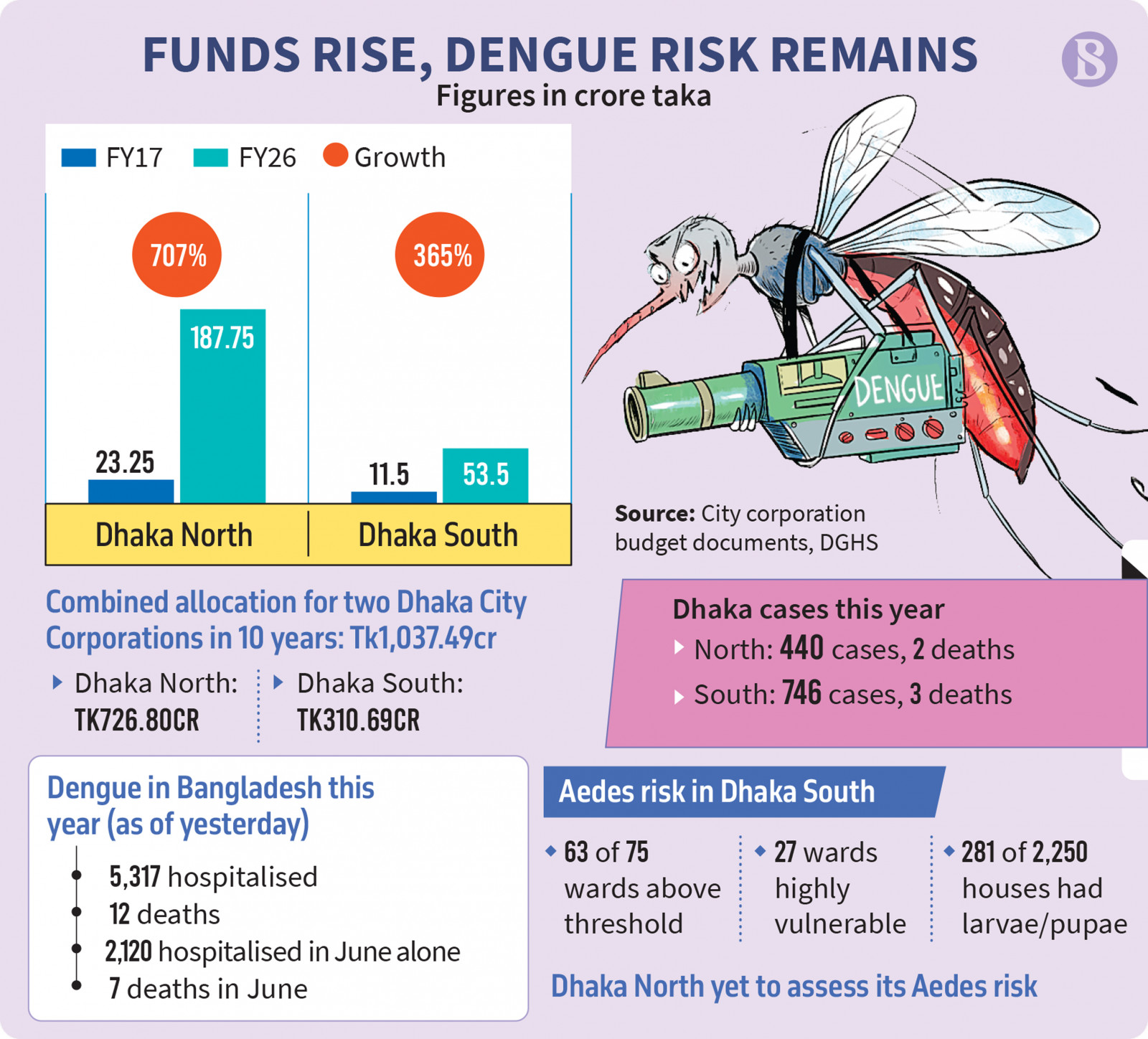
A review of budget documents shows the two city corporations allocated more than Tk1,037 crore for mosquito control from FY2016-17 to FY2025-26, with Dhaka North accounting for about 70% of the total as its annual allocation rose 707%, against a 365% rise in Dhaka South.
Despite the rise in allocation, however, dengue cases have started increasing again.
 Keep updated, follow The Business Standard's Google news channel
According to data from the Directorate General of Health Services (DGHS) released yesterday, Dhaka North recorded 440 dengue cases and two deaths, while Dhaka South recorded 746 cases and three deaths so far this year.
Across the country, 5,317 dengue patients have been hospitalised so far this year, with 12 deaths recorded. Of them, 2,120 cases and seven deaths were recorded in June alone.
Over Tk1,037 crore allocated in 10 years
Dhaka North's annual allocation rose from Tk23.25 crore in FY17 to Tk187.75 crore in FY26, making the latest figure about eight times higher.
In total, Dhaka North allocated Tk726.80 crore for mosquito control over the decade.
Dhaka South's annual allocation rose from Tk11.50 crore in FY17 to Tk53.50 crore in FY26, making the latest figure about 4.7 times higher. Its decade-long allocation stood at Tk310.69 crore.
Aedes risk found in 63 Dhaka South wards
The growing allocation, however, has not reduced risk in many areas.
A recent pre-monsoon Aedes larvae survey by Dhaka South found mosquito density above the acceptable threshold in 63 of its 75 wards.
Of them, 27 wards were identified as highly vulnerable to dengue transmission.
The survey was conducted from 12 May to 23 May by Dhaka South with support from the Communicable Disease Control wing of the Directorate General of Health Services.
Data were collected from 2,250 households. Aedes larvae and pupae were found in 281 houses.
Among the premises where larvae were detected, the highest proportion was found in multi-storey buildings at 35.23%, followed by single-family houses at 27.76% and under-construction buildings at 17.44%.
Although Dhaka South conducted the survey with a lower allocation than Dhaka North, Dhaka North has not conducted any official Aedes survey this season.
The city corporations have taken several initiatives over the years, including using drones to identify breeding grounds, buying discarded tyres and plastic waste, and running awareness campaigns through Baul songs.
However, dengue cases continue to rise, pointing to weaknesses in control and monitoring.
The absence of elected ward councillors for nearly two years has also raised concerns that ward-level supervision of mosquito-control and dengue-prevention activities has weakened.
These concerns, experts say, show why higher allocations alone may not be enough without targeted Aedes control.
Targeted control needed
Jahangirnagar University entomologist Professor Kabirul Bashar told The Business Standard that conventional fogging and drain-focused mosquito-control methods are not effective against Aedes mosquitoes.
"Aedes mosquitoes do not breed in dirty drain water. They breed in clean stagnant water in and around homes," he said.
He said city corporations need evidence-based and target-specific control measures.
"Breeding sites have to be identified scientifically first. Then control activities should be targeted accordingly. Community engagement must continue throughout the year," he said.
He also said modern technology and data-based methods are needed to make mosquito control more effective and accountable.
"Dengue control is not possible by the government or city corporations alone. Citizens also need to take part actively," he added.
City officials said higher costs, expanded services and new wards had pushed up allocations.
Dhaka South Chief Health Officer Jahane Ferdous Binte Rahman said costs have increased because of higher manpower needs and expanded service areas.
"We are conducting larviciding, fogging and cleanliness drives using the budget. Special crash programmes are also being carried out in risky areas," she said.
She said citizens also need to remain alert as dengue cannot be controlled without collective efforts.
Dhaka North Chief Health Officer Brigadier General Imru-al-Quais said the budget and capacity were increased due to higher insecticide prices and the addition of new wards.
"As a result, mosquito-control work is now being carried out three times a day instead of twice. Free dengue testing has also been arranged for people at urban health centres," he said.


