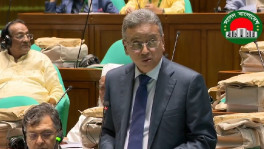
Govt's reform agenda facing lack of support from key business groups: Shafiqul Alam
Shafiqul criticised what he termed “motivated narratives” from certain business figures that, he said, distort economic realities while ignoring the administration’s achievements

Chief Adviser's Press Secretary Shafiqul Alam today (8 December) criticised sections of the business community for sending "mixed signals" and failing to extend adequate support to the government's reform agenda, particularly the port modernisation drive.
Speaking at a seminar at the NEC conference room, he noted that the very sectors poised to benefit from upgraded logistics have not publicly endorsed the reforms.
The event was organised marking the release of State of the Bangladesh Economy 2025 and Sustainable Development Goals: Bangladesh Progress Report 2025.
 Keep updated, follow The Business Standard's Google news channel
"If the Chattogram Port becomes efficient, the garment sector benefits first. Yet we have not seen a single welcoming statement from the BGMEA or BTMA," he said, pointing to a reluctance among major trade bodies to align with efforts aimed at reducing delays and financial losses.
Shafiqul criticised what he termed "motivated narratives" from certain business figures that, he said, distort economic realities while ignoring the administration's achievements.
"Someone who did not export anything 40 years ago and now ships out $700 million a year claims this is the worst time for business in four decades. Such claims have no meaningful basis," he said.
He stressed that selective interpretation of indicators over the past 16 months has clouded public understanding, with negative data repeatedly amplified while progress remains under-reported.
On poverty figures, the press secretary said recent debates were framed in a way that implied sudden spikes traceable solely to the current government.
Citing World Bank estimates, he said poverty declined to around 21% by June and is expected to fall further.
"Yet the framing was as if poverty jumped from 20% to 28% during this government – an entirely distorted picture," he added.
Shafiqul also argued that mischaracterisation of issues such as gas supply constraints and port operations has undermined constructive discourse.
"Professor Yunus and his administration want a healthy national debate. But some voices amplified in newspapers and on television are not presenting the real picture," he said.
He reiterated that job creation remains the core economic priority and that global investors consistently underline port modernisation as the precondition for Bangladesh to remain a competitive manufacturing hub.
"Every country that has grown has modernised its ports. Yet here, the debate is being hijacked by very small groups amplified far beyond their actual relevance," he said.
Despite these challenges, Shafiqul described the economic turnaround under Chief Adviser Muhammad Yunus as "historic," especially given the scale of national transition over the past year.
Drawing a historical comparison, he said the current economic management team may be "one of the finest Bangladesh has ever had," placing it above the reform teams under President Ziaur Rahman (from 1977) and Begum Khaleda Zia (1991-96) in terms of capability and alignment.
He, however, made no reference to the BNP-Jamaat administration's 2001-06 economic team.