



Panic buying continues at filling stations as govt enforces fuel rationing
Filing stations' authorities cautioned of the uncertainty regarding whether the local fuel depots will disburse the required supply of fuel by tomorrow
Panic buying at petrol pumps across the capital and its outskirts showed no signs of abating today (7 March), as motorists continued to swarm filling stations despite government assurances and the enforcement of strict rationing measures.
The rush, which began on 5 March following an escalation in the US-Israel war on Iran, has seen consumers scrambling to top up their tanks in anticipation of a potential supply disruption.
Upon site visits by The Business Standard to several filling stations, long queues of motorbikes and cars were seen at Trust Filling Station in Tejgaon and two others in Paribagh.
 Keep updated, follow The Business Standard's Google news channel

Many such stations are closed down as fuel has run out.

"We last received fuel from the depot on Wednesday (4 March). We got 4,500 litres of octane and 13,500 litres of diesel, but that stock is nearly exhausted," said Md Shahin Alam, manager of Afzal Filling Station in Savar.
Filing stations' authorities cautioned of the uncertainty regarding whether the local fuel depots will disburse the required supply of fuel by tomorrow (8 March).
The closure of the Strait of Hormuz has triggered global supply fears, particularly for a country like Bangladesh, which meets 95% of its fuel demand through imports.
In response to the mounting pressure, the Bangladesh Petroleum Corporation (BPC) has implemented a tiered rationing system to manage dwindling stocks and prevent hoarding.

Under the new directive, motorcycles are limited to two litres of petrol or octane per day, while cars are capped at 10 litres.
Larger vehicles, such as SUVs and microbuses, are permitted 20 to 25 litres, while long-haulers and heavy trucks have been allocated between 200 and 220 litres of diesel daily.
Long queues of vehicles and crowds of waiting drivers were seen in front of several filling stations in Dhaka.

At the Purbachal Traders filling station in the capital's Paribagh, a signboard reading "No Octane, No Petrol" was seen hanging at the entrance. One after another, motorcyclists arrived only to leave disappointed, with some engaging in heated arguments with the pumps' authorities.
A pump operator of this filling station stated that their stock of octane and petrol ran out at 4am today.
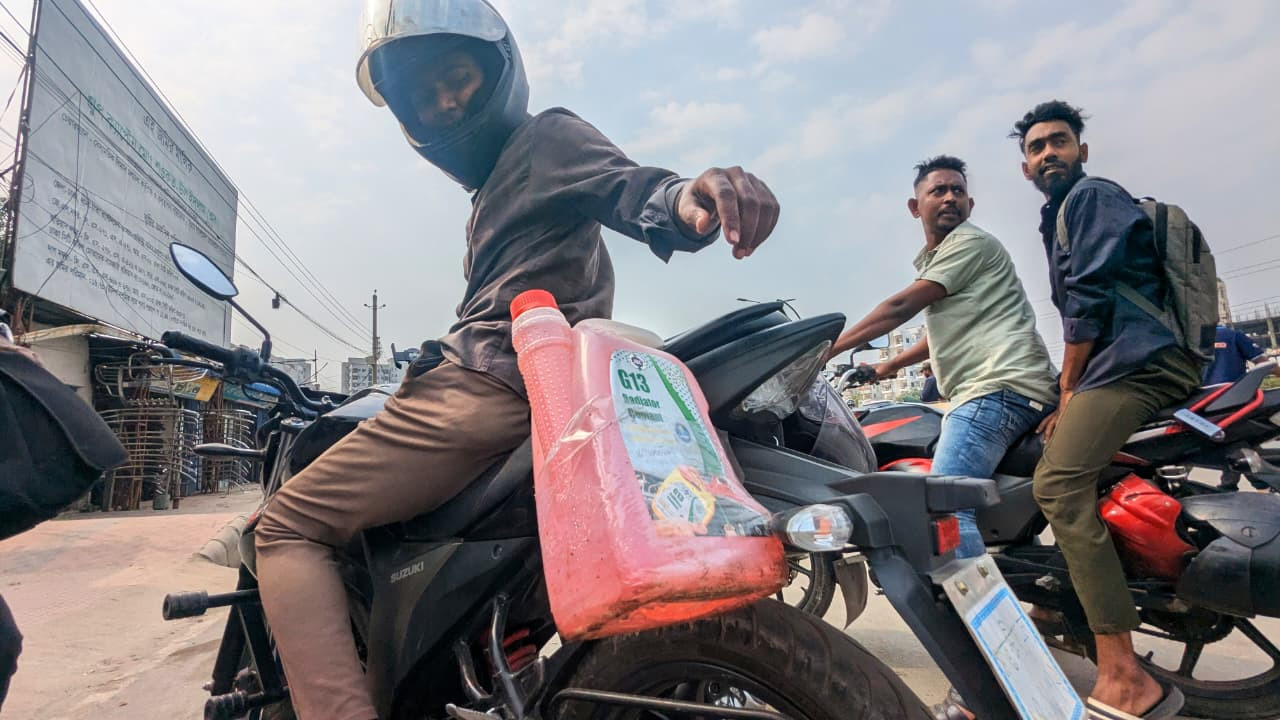
"We last collected fuel on Thursday (5 March) and have not been able to get any since. We have never faced such a situation before. Bikers are buying far more than they actually need out of panic," he said.
Rubel Ahmed, a motorcyclist who came to the station, told TBS, "I have visited seven petrol pumps so far, and none are providing fuel. At two places, they told me outright that they would only sell once the government sets a new price. Others claim they are out of stock.
"I suspect pump operators are hoarding fuel to sell at higher prices later," he claimed.
'In fear of what will be'
While octane and petrol were unavailable, the station still had gas. Long rows of CNG-run autorickshaws and cars were seen waiting for gas.

At the Meghna Model Service Center just beside Purbachal Traders, fuel was being sold according to the government-mandated limits: a maximum of two litres for motorcycles and 10 litres for sedans.
As with all others, a long queue of vehicles was seen stretching outside the station.
A long line of motorcycles was also spotted in front of the Ramna Petrol Pump where Limon Hasan, a service holder waiting there for about 20 minutes, told TBS, "They have set a two-litre limit for bikes. My office starts tomorrow, and I am worried about commuting.
"It would have been helpful if they allowed at least five litres. I am in fear of what the situation will be like in the coming days," he opined.
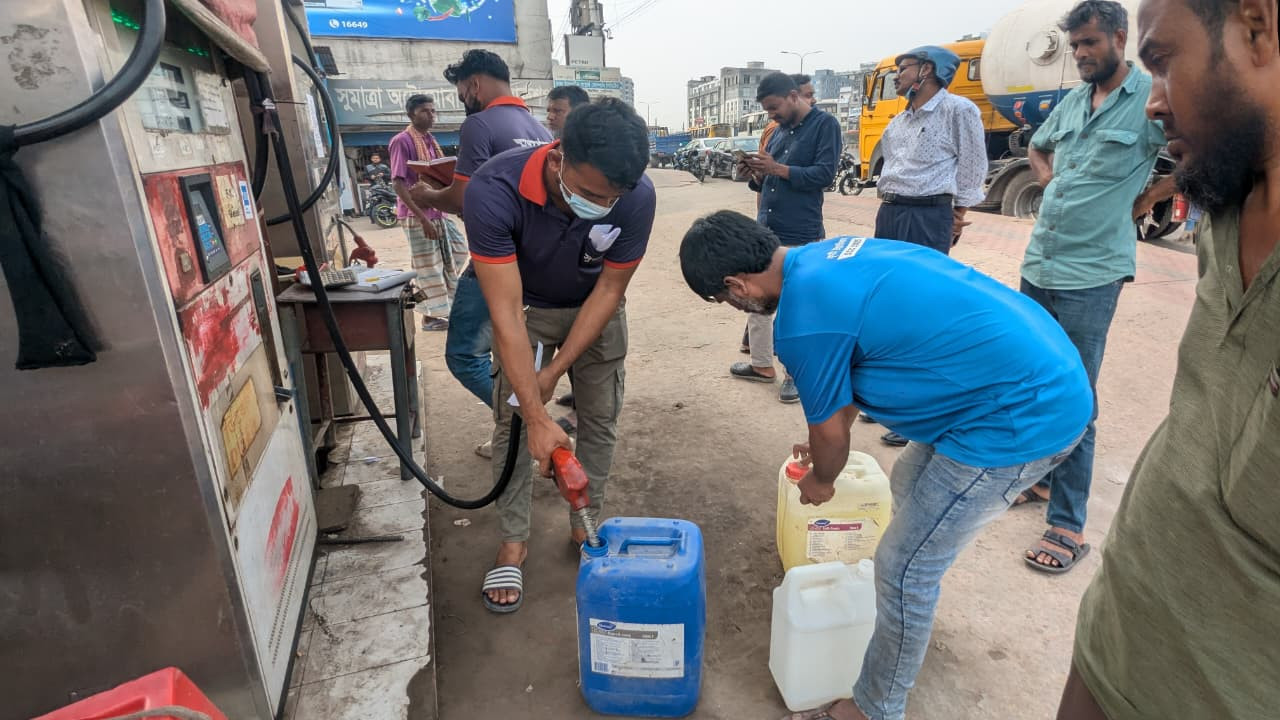
At a fuel pump near Dhaka College. Al Amin, a microbus driver who came to refuel, told TBS at 2:32pm, "I have been waiting here since 1pm. Upon arriving, I found there is no fuel and the pump is closed.
"There is only a tiny amount of fuel left in the vehicle. It might run out in the middle of the road. I am waiting for them to start dispensing oil again," he added.
A similar scene of crowding and waiting was evident in front of M/S Pather Bondhu Filling Station in Nilkhet.
Upon visiting, it was seen that the pump had been temporarily shut down due to a lack of fuel.
However, an on-duty pump operator said that sales would resume shortly as soon as the fuel supply arrived.

Energy emergency
To further conserve energy, Prime Minister Tarique Rahman has ordered a 10% cut in fuel allocations to all filling stations and reduced gas supply for power generation by 50mmcfd to prioritise essential sectors.
Despite these steps, the energy emergency is palpable.
Diesel stocks have dropped to just seven days' supply, while octane reserves stand at 15 days.

Energy Minister Iqbal Hasan Mahmud Tuku stated, "There is no reason for panic," clarifying that while demand has surged due to public concern, stocks have not been exhausted.
BPC officials recently added that emergency shipments are being negotiated with G2G partners and suppliers in Singapore, Malaysia, Indonesia, China, and Africa to build up buffer stocks.
To curb artificial shortages, district administrations and the Border Guard Bangladesh (BGB) have been deployed as part of vigilance teams to prevent fuel smuggling and illegal stockpiling.

Filling stations have been strictly instructed to stop selling fuel in drums or containers and must now issue detailed receipts to ensure transparency.
While industry leaders, including the BGMEA, have called for waivers on duties and taxes to cushion the impact of rising global LNG prices, which have already surged by 35%, the government remains focused on managing the immediate supply-demand gap.
The government continues to urge citizens to limit private travel, use car-pooling, and practice maximum efficiency in domestic gas consumption to navigate the crisis.


