Ecnec approves Tk35,465.15 crore Eastern Refinery project to cut reliance on imported fuel
According to the project proposal, once implemented, the country’s reliance on imported petroleum products will fall substantially as the total crude oil refining capacity will be increased to 45 lakh tonnes per year

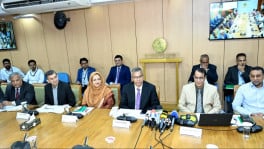
The Executive Committee of the National Economic Council (Ecnec) today (23 December) approved the Modernisation and Expansion of Eastern Refinery Limited (ERL-2) project for Tk35,465.15 crore, aiming to significantly reduce Bangladesh's dependence on imported refined petroleum products.
The meeting was chaired by Chief Adviser Muhammad Yunus at the NEC Conference Room in Sher-e-Bangla Nagar, Dhaka.
According to the project proposal, once implemented, the country's reliance on imported petroleum products will fall substantially as the total crude oil refining capacity will be increased to 45 lakh tonnes per year.
 Keep updated, follow The Business Standard's Google news channel
Planning Commission officials said that, as development partners did not respond positively, the government has decided to implement the ERL-2 project using public funds.
Of the total project cost of Tk35,465.15 crore, Tk21,277.59 crore will come from government funds, while the remaining Tk14,187.56 crore will be financed by Eastern Refinery Limited.
Officials said the second unit of Eastern Refinery will be built with the capacity to refine crude oil sourced not only from the Middle East but also from Europe and Africa, reducing the government's dependence on Middle Eastern crude.
They added that the basic design has been completed using Arabian Light Crude (ALC) and Murban crude as feedstock. However, arrangements will also be made to refine crude imported from various sources, including Russia, Norway and Nigeria.
According to the project proposal, ERL-2 will be designed to process Russian Urals crude or Nigeria's Brass River crude by separately boiling the fuels before refining.
The proposal also states that crude-blending facilities will be included to enable the refining of heavier grades of crude. To this end, the new unit will be equipped with a flexible system capable of processing heavy crude from multiple countries.
On cost reduction, the energy secretary said the project expenses had been trimmed by removing all unnecessary components.
Initiative delayed by financial constraints
The plan to build ERL-2 was first taken in 2010, and in 2013 the government approved Tk13,000 crore for the project. However, no progress was made.
When Bangladesh Petroleum Corporation (BPC) revived the plan in 2022 through self-financing, the estimated cost rose to Tk23,000 crore, yet work still did not begin.
Officials said bureaucratic delays, complex implementation procedures and financing complications prevented the project from moving forward.
In 2024, the controversial S Alam Group expressed interest in building ERL-2 at a cost of Tk25,000 crore. The Energy Division approved the proposal on 9 July, but the project was halted after the Sheikh Hasina government fell amid a mass uprising.
The interim government later revived the project and sought foreign loans. However, as foreign financing could not be secured, it decided to implement the project using government funds and BPC's own financing.
Initially, the project cost was set at Tk42,973.70 crore, with Tk30,499.80 crore from government funds and Tk12,473.90 crore from BPC. Following scrutiny by the Planning Commission, the cost was subsequently reduced.