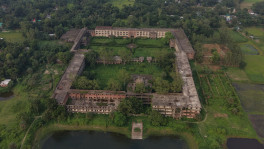
Jungle Salimpur: A Chattogram territory beyond state control
What exists in Jungle Salimpur is not chaos, but an alternative system of order enforced by armed groups rather than law enforcement

Barely a short drive from Chattogram city, Jungle Salimpur in Sitakundu upazila sprawls over nearly 3,100 acres of government-owned hills and forests, much of it illegally occupied. Criminal groups and land mafias have carved out unauthorised settlements along the Bayezid Link Road, leaving the area largely beyond state control.
On Monday, that parallel reality turned deadly when a team of Rapid Action Battalion-7 came under attack during an operation to recover illegal arms. RAB's Deputy Assistant Director Md Motaleb Hossain Bhuiyan was killed, and three others were taken hostage and beaten.
Intelligence sources said the attack occurred in front of a local BNP office, with hostages held inside, before a three-hour joint rescue by RAB, police, and the Army. The injured officers are now being treated at Chattogram Combined Military Hospital.
 Keep updated, follow The Business Standard's Google news channel
RAB Director General AKM Shahidur Rahman vowed to dismantle terror hideouts through legal action and sustained operations, after attending Bhuiyan's Namaz-e-Janaza.

A 'state' within the state
What exists in Jungle Salimpur is not chaos, but an alternative system of order enforced by armed groups rather than law enforcement. Factions led by feared gangsters Yasin, Rokon Member, and Ridwan hold defined zones with their own hideouts and weapons depots. Though they operate separately, their activities are loosely coordinated, sustaining a parallel system of authority.
This reporter entered the restricted area three times between 2022 and 2023, including twice during the 2023 eviction drive. Armed guards halted the first visit, permitting entry only after verification and imposing a strict ban on filming.

Armed to the teeth with local and foreign weapons, these groups maintain supply lines far beyond Salimpur. Armed guards man every entry point, residents carry identity cards, and outsiders are stopped, verified, and often refused entry without an escort.
CCTV cameras blanket the hills, giving the gangs eyes on any law enforcement presence from over a kilometre away – creating a climate of fear where the state's writ barely runs.
Geography has only cemented their grip. Straddling multiple jurisdictions – Sitakunda, Hathazari's Amanbazar road, and Chattogram city's Bayezid, Akbar Shah, and Khulshi police areas – Salimpur forms an administrative grey zone.
Criminals can slip from one zone to another in 10-20 minutes via hill paths, while poor coordination between urban and upazila police leaves operations slow, confused, and often doomed from the start.
A turf carved in blood and soil
The roots of this lawlessness go back to the 1990s, when Ali Akkas began cutting hills, setting up settlements, and forming an armed group to protect his turf. Government-owned plots were sold cheaply on non-judicial papers and organised under the "Chhinnamul Samabay Samity".
Disputes over money and power eventually escalated, ending in Akkas's death in a reported RAB gunfight. His associates – Kazi Mashiur Rahman, Yasin Mia, Gafur Member, and Gazi Sadek – split into factions, forming the backbone of Salimpur's current power structure.
Under political patronage, these groups now claim 30,000 members, though nearly 150,000 people live in the area.
Beneath a modest, informal economy lies a far more complex system. Khas lands are sold, hills cut and soil traded, illegal electricity and water connections maintained, vehicles pay tolls and protection fees, and an underground cash economy tied to arms and narcotics bypasses banks.

Medical care is internalised, with injured members treated discreetly within the territory. As one former Sitakunda police inspector told The Business Standard, "Jungle Salimpur is a different state where they have their own law. Disputes get settled internally, police intervention is discouraged, and some crimes never even get reported."
State authority under siege
Salimpur has long been a flashpoint of organised attacks on state authorities.
After Monday's assault, former assistant commissioner Himadri Khisa recalled a 2023 eviction drive, where over 100 law enforcement personnel and a dozen magistrates were repelled by women armed with crude weapons at the core hills.
In 2022, eviction teams were attacked twice, leaving many injured, and in 2019, Department of Environment personnel faced similar assaults.
The hills serve as a natural fortress, with stones, crude explosives, and gunfire making enforcement operations a dangerous gamble. Intelligence leaks exacerbate the problem, giving gangs advance notice of planned actions.
Former joint convener of Chattogram North District BNP Kazi Salah Uddin told the Business Standard, "The gangs in Jungle Salimpur try to take shelter of the party whoever comes to power. Sensing that BNP will win the election they are now trying to get in touch with some BNP leaders."
Regarding the attack on the RAB team in front of the local BNP office, he said, "I do not have any idea whether there is a BNP office there. The union committee might know about this."
He urged the government to take stern action against the people involved in the attack.
Aslam Chowdhury, BNP nominated MP candidate for Chattagram-4, which includes Sitakunda upazila, could not be reached for a comment on the issue as he did not answer calls from this reporter.
Sitakunda Upazila Assistant Commissioner (Land) Abdullah Al Mamun told TBS that evicting illegal encroachers would require national-level intervention. He suggested establishing a permanent police outpost or Army barracks and creating more entry and exit points to control the vast forested area.
Experts argue the issue is not manpower but commitment; small raids are like throwing pebbles at a fortress. Chattogram police spokesperson Mohammad Russel said a coordinated plan is underway, and once cleared, an operation will aim to reclaim the area.