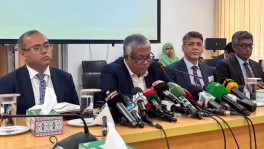
Corruption can decline if politicians act with integrity: Finance adviser
Corruption cannot be reduced by punishment alone, he says

Corruption will decline if politicians uphold honesty and integrity, Finance Adviser Salehuddin Ahmed said today (9 December).
Speaking at a discussion organised by the Anti-Corruption Commission (ACC) at the Bangladesh Shilpakala Academy to mark International Anti-Corruption Day, Salehuddin stressed that corruption cannot be reduced by punishment alone; communities must also socially resist and isolate corrupt individuals.
"In the past, corrupt people were socially avoided. They faced public disdain, and even struggled to arrange marriages for their children," he said. "Today, however, we rush to honour them, attend their ceremonies, and give them social acceptance. This mindset has to change."
 Keep updated, follow The Business Standard's Google news channel
He urged for a broader social movement to combat corruption, emphasising that moral and social pressure can be even more powerful than legal penalties.

Speaking at the event, ACC Chairman Mohammad Abdul Momen said that although the vast majority of people would vote against corruption if given the chance, eliminating it remains extremely difficult.
"If those who engage in extortion, violence and misrule are allowed to take charge after elections, achieving a developed nation will remain out of reach," he said.
He also urged citizens not to vote for those who previously aided corrupt individuals or helped them flee the country in exchange for money.
Momen expressed concern that in the past 15 years, large sums of money have been laundered to multiple countries, yet the ACC has no communication with those nations.
He called on the government to deploy officials at the level of first secretary to those countries to initiate the process of recovering the illicit funds.
AK Enamul Haque, director general of the Bangladesh Institute of Development Studies (BIDS), noted that no country in the world has eliminated corruption through punishment alone.
"We have to build public awareness. Bangladesh faces 14-15 different types of corruption, but our institutional efforts remain focused mostly on bribery," he said.
ACC Commissioner (Enquiry) Brig Gen (retd) Hafiz Ahsan Farid called for full transparency in government projects.
"All project details must be published online, and any updates should be made public. Once money is stolen, recovering it is extremely difficult, which is why prevention is crucial," he said.
He added that foreign anti-corruption models will not work for Bangladesh, and the country must develop its own framework.