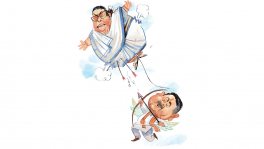
Will TMC hold its fort or BJP breach Bengal wall?

While most exit polls are giving BJP an edge in this year's West Bengal assembly election, at least one "People's Pulse" stood out for allowing Mamata Banerjee-led TMC to retain power in the state. Given the erratic track record of Indian pollsters, one has to wait for the official results when votes are counted on 4 May.
For BJP, which considers West Bengal as the final frontier to be won, this year's assembly election is a litmus test of whether anti-incumbency, corruption charges and citizenship politics can breach TMC's strongest bastion for the last 15 years For TMC, a win means a record fourth straight term.
The most high-profile contest in the election is no doubt in Bhabanipur locality in south Kolkata where Chief Minister Mamata Banerjee faces BJP Leader Suvendu Adhikari in a prestige battle seen as a symbolic rematch of Nandigram battle where he had defeated her in five years ago. 2021, it was then that Mamata shifted to Bhabanipur
 Keep updated, follow The Business Standard's Google news channel
The first phase of polling held on 23 April recorded a turnout of 93.19 % and the second phase around 92%, the highest ever in the state. Rival camps have interpreted this differently. BJP sees it as a sign of huge anti-incumbency while TMC claims it reflects the support for Mamata's welfare politics.
Eminent journalist and analyst R Jagannathan said in an article on a portal that the high turnout could mean widespread anti-incumbency on one hand and a desperate battle for survival for TMC in the face of BJP's challenge.
Unlike the first phase, where BJP sought to defend its gains in northern part of West Bengal, the second and final round shifted the battle squarely to TMC's strongest bastion in southern part and Kolkata where the ruling party had won 123 of these 142 seats, leaving just 18 for BJP in 2021. That arithmetic explains why BJP has treated the second phase as its real test.
Large-scale deletions mostly of absentee or dead voters in south Bengal districts have kept the issue of Special Intensive Revision of voters' list politically volatile all through. More than 12.6 lakh names in North 24 Parganas, 10.91 lakh in South 24 Parganas and nearly 6.97 lakh in Kolkata alone have been deleted from voters list.
In at least 25 constituencies, the number of deleted names is higher than the victory margin of the previous election in 2021.
While TMC has framed SIR as a targeted disenfranchisement of minorities, migrants and poor Bengali-speaking voters, BJP has defended the exercise as necessary to remove bogus voters and infiltrators.
The Matua Namasudra community voters may emerge as a force which could tilt the balance.
In phase 2 of polling, the Matua-dominated belt of North 24 Parganas and Nadia districts could turn out to be a decisive factor.
Media reports say the Special Intensive Revision (SIR) has led to significant deletions in Matua-dominated assembly constituencies. In North 24 Parganas alone, around 3.25 lakh names have been struck off the voter list following the exercise. Data from the Bongaon subdivision, a core Matua pocket near the border with Bangladesh, shows deletion rates ranging between 67 per cent and 88 per cent among those placed under adjudication.
The scale of deletions has come at a time when the Matua community, which migrated to India in 1947 and in 1971 remains in the middle of a long-pending Indian citizenship process.