Is gas shortage the only reason behind the electricity crisis?
A fire at Moheshkhali and a liquid fuel shortage have been blamed for Bangladesh's deepening electricity crisis — but the real problem is a power sector that has spent years building capacity it cannot afford to run, accumulating debt it cannot repay, and importing energy it cannot always access.

I spent almost my entire corporate banking life financing infrastructure, mainly power and energy companies from home and abroad- developing their financing model to signing the power purchase or energy supply agreements during the 1996-2010 period. Recent power shortage hence took me to my yesterdays in banking and sectoral due diligence.
As we could recently see-load shedding of minimum 2-3 hours has become a daily event in Dhaka city. Many areas are facing power cuts for 5-6 hours per day within the city. Outside the capital, the situation is much worse.
The fire break-out at Moheshkhali FSRU on 21 July has been mentioned as the main reason for gas supply shortage and hence, electricity crisis as 60-65% of total natural gas is being used to generate electricity. The liquid fuel shortage, due to the middle-east war, is another reason for less electricity generation in the liquid fuel-based power plants. But is the primary fuel shortage the only reason for this?
 Keep updated, follow The Business Standard's Google news channel
To understand the impact of fuel shortage on the power sector, we need to understand the structure of our electricity generation sub-sector. In 2010 the Quick Enhancement of Electricity and Energy Supply (Special Provisions) Act was enacted and a major shift in energy-mix was seen afterwards. The grid-connected total installed capacity, since 2010, increased from 6,300 MW to 29,593 MW. The share of gas-based generation capacity decreased from 83% of the total installed capacity to a mere 42%, coal-based generation increased from ~4% to 28%, HFO-based increased from ~7% to 19%, and cross-border electricity import increased from 0% to less than 4%.
The country has achieved fuel diversification, but became more dependent on imported energy. Natural gas and a meager amount of coal are sources of domestic primary fuel. Domestic natural gas extraction peaked in 2016-17 and has been decreasing afterwards. No new large gas-field has been discovered since 1998. Since 2018, a part of natural gas consumed in Bangladesh is also being imported as LNG, and the recent share of imported LNG to total gas supply is about 25%. The increase in import dependency has challenged energy security and made it more volatile.
The shortage of primary fuel has limited electricity generation. But this is not the only reason. The existing electricity shortage is about 5,000MW per day. The fire-worn Excelerate FSRU at Moheshkhali usually regasifies 450 mmcfd of LNG, has potential to generate 1,800-2,000MW per day. The supply disruption of liquid-fuel may add to the crisis, but the total is still less than the shortfall.
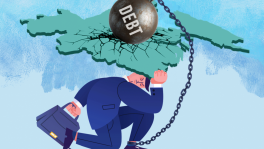
The financial health of the power sector is another reason for lower generation than demand. The financial health deteriorated due to: i) excessive capacity and capacity payment - the installed electricity generation capacity is about double than the demand. The capacity payment charges to the unused power plants, repeated renewal of inefficient and unused rental and quick-rental power plants, etc. have been impacting the BPDB balance sheet badly. ii) purchasing more and more LNG from the spot market at rising prices. In 2024, 26% of imported LNG was purchased from the spot market at a price of $11.50-14.00/MMBTU, in 2025 45% from the spot market at $12.50-16.00/MMBTU. The current spot market price is $21.00-24.00+. iii) less revenue collection due to subsidized electricity tariff along with iv) increasing system losses.
As of June 2026, BPDB owes about BDT 440 billion to privately owned facilities, joint ventures and foreign power exporters. Private sector power producers are reportedly holding electricity generation due to earlier non-payments.
Our system has been made more vulnerable over the years. The recent primary energy crisis has only exposed how vulnerable we have become. We have been focusing so much in adding capacity, that we neglected feasibility, financial health, and imported primary energy supply risks. Now we have a gigantic capacity installed with less supply of primary energy as well as less money to repay.
Mamun Rashid is the Chairman at Financial Excellence Ltd and former Head of Corporate and Institutional Banking at Standard Chartered Bank and Country Head-Bangladesh for Citibank N.A.
Disclaimer: The views and opinions expressed in this article are those of the author and do not necessarily reflect the opinions and views of The Business Standard.