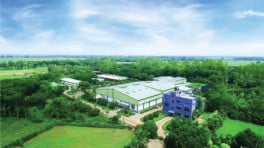
Can Japanese-style pocket forests help Dhaka breathe?
As Dhaka runs out of room for conventional greenery, a new Miyawaki forest in Diabari is testing whether dense pockets of native trees can help cool the city, restore biodiversity and reclaim space from concrete

A walk along the Diabari Lake in Uttara no longer reveals only open land. Just a few months ago, the area was covered with weeds and unused fields. Today, rows of native saplings stand in their place. Some have already grown waist-high, while others are still young. Planted close together, these trees are expected to grow into a small urban forest within the next few years, project officials say.
This is not a conventional tree-planting programme. The forest is being developed using the Miyawaki method, named after Japanese botanist Akira Miyawaki. The approach involves planting a dense mix of native species in a small area to create a multi-layered forest in a relatively short time. It has already been used in countries such as Japan, India, the Netherlands and Italy. Now, Dhaka is adopting the method on a much larger scale.
According to the Dhaka North City Corporation (DNCC), around 53,400 trees will be planted across 3.2 acres in Diabari. The project includes nearly 250 native species, ranging from timber and fruit trees to medicinal plants, flowering species and shrubs.
 Keep updated, follow The Business Standard's Google news channel
But the significance of the project goes beyond the number of trees being planted. It comes at a time when Dhaka's environmental challenges are becoming more severe than ever, making the search for nature-based solutions increasingly urgent.
Why Dhaka's urban planners are looking for new solutions
Dhaka, Bangladesh's economic powerhouse, is home to an estimated 36.6 million people living within just 306 square kilometres. Decades of rapid urbanisation have steadily eroded the city's natural balance, leaving it increasingly vulnerable to environmental stress.
In 1981, nearly 19% of the city's land was covered by greenery. Today, that figure has fallen to around 8.5 to 9%. More than 82% of Dhaka is now covered by concrete, while green space per person stands at only 0.42 square metres—far below the World Health Organization's recommended minimum of nine square metres.
Air pollution has become another defining challenge. In 2025, Dhaka's annual average PM2.5 concentration reached 68 micrograms per cubic metre—almost 14 times higher than the WHO guideline. The city's urban heat island effect has also intensified, with land surface temperatures in densely built-up neighbourhoods rising by as much as seven degrees Celsius during the day and five degrees at night compared with surrounding natural areas.
A joint assessment by the Bangladesh Forest Department and the US Forest Service estimates that the areas under Dhaka's two city corporations are home to around 1.3 million trees. Together, these trees absorb roughly 538 tonnes of air pollutants every year—an environmental service that would otherwise cost an estimated Tk35 crore to replicate through artificial means. Yet, experts say, the city's existing tree cover is no longer sufficient to keep pace with its mounting environmental pressures.
Finding space for large parks or conventional forests has become increasingly difficult in one of the world's most densely populated cities. As a result, urban planners are turning their attention to smaller but denser patches of greenery that can deliver environmental benefits within limited space. It is in this context that the Miyawaki method has begun to attract growing interest.
Why the Miyawaki method?
The Miyawaki method was developed by Japanese botanist Dr Akira Miyawaki in the 1970s after years of research on Japan's native forests. His goal was to create a technique that could restore self-sustaining forests in small urban spaces by relying entirely on indigenous tree species.
The approach is built on three key principles: planting native species, growing them at high density, and providing intensive care during the first few years until the forest becomes self-sustaining.
Unlike conventional plantations, where trees are spaced several feet apart, the Miyawaki method places three to five saplings in every square metre. Tall trees, medium-sized species, understorey plants and shrubs are planted together, mimicking the structure of a natural forest. As they compete for sunlight, the trees grow faster, forming a dense canopy within a few years.
How the Diabari forest is taking shape
The Diabari project did not begin overnight. After taking over responsibility for Rajuk's green belts, the Dhaka North City Corporation (DNCC) first established a pilot Miyawaki forest at Tajuddin Smriti Park in Gulshan. Only after monitoring tree survival and growth there did it move ahead with a larger project.
The corporation now plans to plant around 53,400 trees across 3.2 acres at Diabari. More than 39,400 saplings have already been planted on 2.6 acres. The first phase, involving about 14,000 trees, was completed between November last year and January this year. On 18 May, DNCC Administrator Md Shafiqul Islam Khan inaugurated the second and third phases of the project.
Before planting began, the soil was enriched with vermicompost, cocopeat, bone meal, rice husk, organic fertiliser and liquid nutrients to improve its water-holding capacity and biological quality. "Preparing the soil is the most important part of the process," said landscape consultant Arham Ul Haque Chowdhury. "If the soil is healthy, the trees will take care of themselves."
The project aims to create more than just a cluster of trees. It is designed as a functioning ecosystem. Artificial mounds have been built to improve natural drainage, while winding footpaths allow visitors to walk through the forest. The design also draws on the Japanese concept of Shinrin-yoku, or "forest bathing", which views forests not only as ecological assets but also as spaces that support physical and mental well-being.
According to Md Saeedi Karim, DNCC's arboriculture officer who oversees the Diabari Miyawaki forest, the project's objective is not simply to increase the number of trees but to establish a self-sustaining urban forest using native species. In a land-scarce city like Dhaka, he said, the method offers a practical way to create dense greenery that could help conserve biodiversity, reduce urban heat and strengthen the city's ecological resilience over the long term.
Karim said the Diabari forest is still in its early stages of development. Tree survival, growth rates and environmental changes are being monitored regularly. The lessons from the project, he added, will help determine whether the Miyawaki method can be expanded to other suitable locations across the capital.
Lessons from around the world
The Miyawaki method is far from new. Although it originated in Japan nearly five decades ago, it has gained momentum over the past 20 years, spreading to cities across Europe, South Asia and Southeast Asia.
Japan alone is home to more than 1,000 Miyawaki forests. In the Netherlands, the Tiny Forest initiative has transformed small vacant spaces in schools, parks and residential neighbourhoods into dense pockets of native woodland. Monitoring of several projects has reported tree survival rates of around 90%, alongside a noticeable increase in birds, butterflies and other pollinating insects.
India has also embraced the approach, with hundreds of Miyawaki forests established in cities such as Delhi, Mumbai, Bengaluru and Chennai. Yet the country has also become the source of some of the strongest criticism. Several forestry experts argue that applying the same planting model across different soil types and climatic conditions is not always scientifically justified, warning that local ecological conditions should guide restoration efforts.
In Bangladesh, the country's first Miyawaki forest was established at Sonapahar in Mirsharai, Chattogram. Spread across about 4,400 square feet, the site includes 120 native plant species. Drawing on three years of experience, project founder Amzad Hossain said the forest has already developed into a noticeably denser green space. However, he cautioned that a Miyawaki forest typically takes around a decade to reach maturity, making it too early to judge its long-term success or compare it conclusively with conventional afforestation.
Hossain also said he has not observed the dramatic growth rates often associated with the Miyawaki method. In his view, Bangladesh should place greater emphasis on expanding large-scale afforestation using native species that are well suited to local landscapes and ecological conditions, rather than relying on a single planting model.
Bangladesh's first Miyawaki forest was established at Sonapahar in Mirsarai, Chattogram. Spread across about 4,400 square feet, the site includes 120 native plant species. Drawing on three years of experience, project founder Amzad Hossain said the forest has already developed into a noticeably denser green space.
Does science support the claims?
As the Miyawaki method has gained popularity, so too has the debate over how well it lives up to its promises.
Promotional campaigns and social media posts often claim that Miyawaki forests grow 10 times faster, become 30 times denser than conventional plantations, and can develop the characteristics of a natural forest within just 20 to 30 years.
However, scientific evidence remains less definitive. A systematic review published in the Journal of Applied Ecology in 2025 examined 51 studies from different countries and found that robust, long-term evidence supporting these widely cited claims is still limited. The review also noted that Miyawaki projects generally require higher upfront investment than other ecological restoration approaches.
Amzad Hossain, who established Bangladesh's first Miyawaki forest in Mirsharai, shares a similarly cautious view. Based on his experience, he believes it is an exaggeration to present the Miyawaki method as the only—or the best—model for afforestation.
The review, however, does not dismiss the approach. Instead, it concludes that the method can be an effective option for rapidly greening small, unused urban spaces with native species. Its success, the researchers argue, depends largely on local conditions, including climate, soil quality, species selection and long-term maintenance.
Ahmed Kamruzzaman Majumder, a professor of environmental science at Stamford University Bangladesh, echoed that assessment. He said Miyawaki forests should not be viewed as a substitute for natural forests. Rather, they can serve as a practical tool for creating dense greenery in land-scarce cities, helping to moderate urban temperatures, provide habitats for birds and other small wildlife, and enhance urban biodiversity.
He added that successful implementation requires careful planning. Native species should be selected based on local soil conditions, climate and hydrology, with guidance from ecological experts. Rather than replicating the Japanese model unchanged, he said, Bangladesh should adapt the concept to its own environmental conditions. If implemented through research-based planning, the approach could make a meaningful contribution to improving the urban microclimate and strengthening biodiversity conservation.
Can it work in Dhaka?
Urban planner Prof Adil Muhammad Khan believes the Miyawaki method could become a promising nature-based solution to two of Dhaka's most pressing environmental challenges—rising urban temperatures and worsening air pollution.
"In a city where large tracts of open land are no longer available, dense forests in small vacant spaces can help restore biodiversity, expand green cover and create a healthier urban environment," he said. "But the method still needs to be adapted to Bangladesh's climate and ecological conditions through further research."
He stressed that planting trees alone would not guarantee success. Long-term maintenance and community participation would be equally important. He also called for closer collaboration among botanists, city corporations, Rajuk and other relevant agencies to ensure that suitable native species are selected and the forests are managed properly.
Experts also caution against viewing the Miyawaki method as a silver bullet for Dhaka's environmental problems. It cannot replace large public parks, protected forests, wetlands or other open green spaces. Instead, they argue, it should complement broader urban greening efforts, including roadside tree planting, park conservation, rooftop gardens, wetland protection and other forms of urban afforestation.
A small forest, a bigger question
The Diabari project has generated both optimism and caution. From local practitioners to international researchers, there is broad agreement on one point: the true value of the Miyawaki method can only be assessed through long-term monitoring.
Over the coming years, the survival of the trees, the growth of the forest canopy, changes in biodiversity and the project's impact on local temperatures will provide a clearer picture of whether the approach can deliver on its promises in Dhaka's unique urban landscape.
Md Saeedi Karim, DNCC's arboriculture officer overseeing the project, said future expansion of Miyawaki forests across the capital would depend on the evidence gathered from Diabari. "The experience and data from this project will help determine where and how the method can be applied elsewhere in Dhaka," he said.
A few thousand trees alone will not solve Dhaka's environmental crisis. But if the project encourages city planners to place greater value on urban greenery, protects small open spaces from disappearing under concrete, and brings nature closer to the centre of future development plans, its impact could extend far beyond the boundaries of this forest.
In a city dominated by concrete, the Diabari Miyawaki forest may be modest in size. Yet it could represent something much larger: the beginning of a different way of thinking about how Dhaka grows.