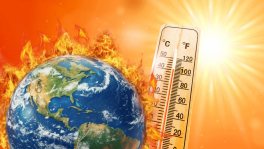
The planet is sending danger signals. Can you hear?
Every moment, alarm bells are ringing. For decades, the world has heard the climate story—warnings, targets, distant deadlines, and lofty promises to strengthen climate action and financing. Too often, the response has been clouded by noise: delay, distraction, and denial.

Open your ears to the air. Can you hear it? The planet is sending signals—louder and more urgent than ever. It is becoming too wet, too dry, and too hot to ignore.
Asia is flooding. Europe is sweltering. Africa is drying out. Glaciers are melting. Sea levels are rising. Wildfires are raging. Heatwaves are sweeping across continents.
The world pledged to limit global warming to 1.5°C. But we are crossing the line.
 Keep updated, follow The Business Standard's Google news channel
Every moment, alarm bells are ringing. For decades, the world has heard the climate story—warnings, targets, distant deadlines, and lofty promises to strengthen climate action and financing. Too often, the response has been clouded by noise: delay, distraction, and denial.
But listen. Beneath the noise, change is taking place—silently but steadily. Solar panels stretch across rooftops. Wind turbines line the horizon. Cities are being redesigned for people. Forests are being replanted. Climate solutions are taking root in every corner of the planet.
Yet these efforts are not advancing fast enough, because emissions are rising faster than climate solutions.
The situation is even more acute for Bangladesh. Our country is among the world's lowest contributors to climate change, yet one of its worst victims. Instead of lamenting its fate, Bangladesh must move faster to deliver on its climate action commitments.
According to data recorded by the weather tracker AQI platform at the end of April, all of the world's 50 hottest cities were located in India. The average highest temperatures across India reached 44.7°C, even hitting 47.4°C in some places, with warnings that temperatures could exceed the "survival threshold" even by 2050.
The danger is not far from Bangladesh, either by location or by time. This summer is forecasted to be more intense in Bangladesh. This is not the end. Rising sea level and riverbed siltation are causing salinity in the coastal belt, which is increasingly exposed to flooding.
Drinking water is becoming scarce in southwestern coastal districts as groundwater is going down fast. Many forests, rivers, and canals now appear only in old maps.
Bangladesh has to pay the price for being a lower riparian country. In 2024, the country saw severe flooding in regions that have a rare history of floods.
Amid such a critical juncture, World Environment Day 2026 is being observed worldwide on 5 June. This year's theme is "A Global Call for Climate Action."
As part of its global campaign, the United Nations Environment Programme (UNEP) calls for stepping in NowForClimate and has set "A Global Call for Climate Action" as this year's theme for the day.
Azerbaijan is hosting the global commemoration of World Environment Day this year in its capital Baku.
Every year, Bangladesh joins global climate events to renew its commitments and hear from others about protecting the environment. But actions often do not match the desired goals and pace.
The new government in Bangladesh expressed its commitment to protecting the environment while pursuing its development goals. It has decided to reduce dependence on fossil fuel imports and speed up renewable and clean energy ventures, with exploration of local natural gas and setting up solar and wind energy plants. To ensure water in downstream rivers, the government has taken up the Padma Barrage plan.
But much more remains to be done.
Our future path must be in harmony with nature. Natural resources are not to be exploited only. They are to be protected for future use. This is why economic policies must be redesigned, not in Bangladesh alone, but across the globe.
The planet is still speaking. Are we listening and finally prepared to act upon?