



May export earnings dip 7% on demand slowdown and Eid closure
Despite the annual decline, export earnings increased by nearly 10% compared with April, indicating a month-on-month recovery.
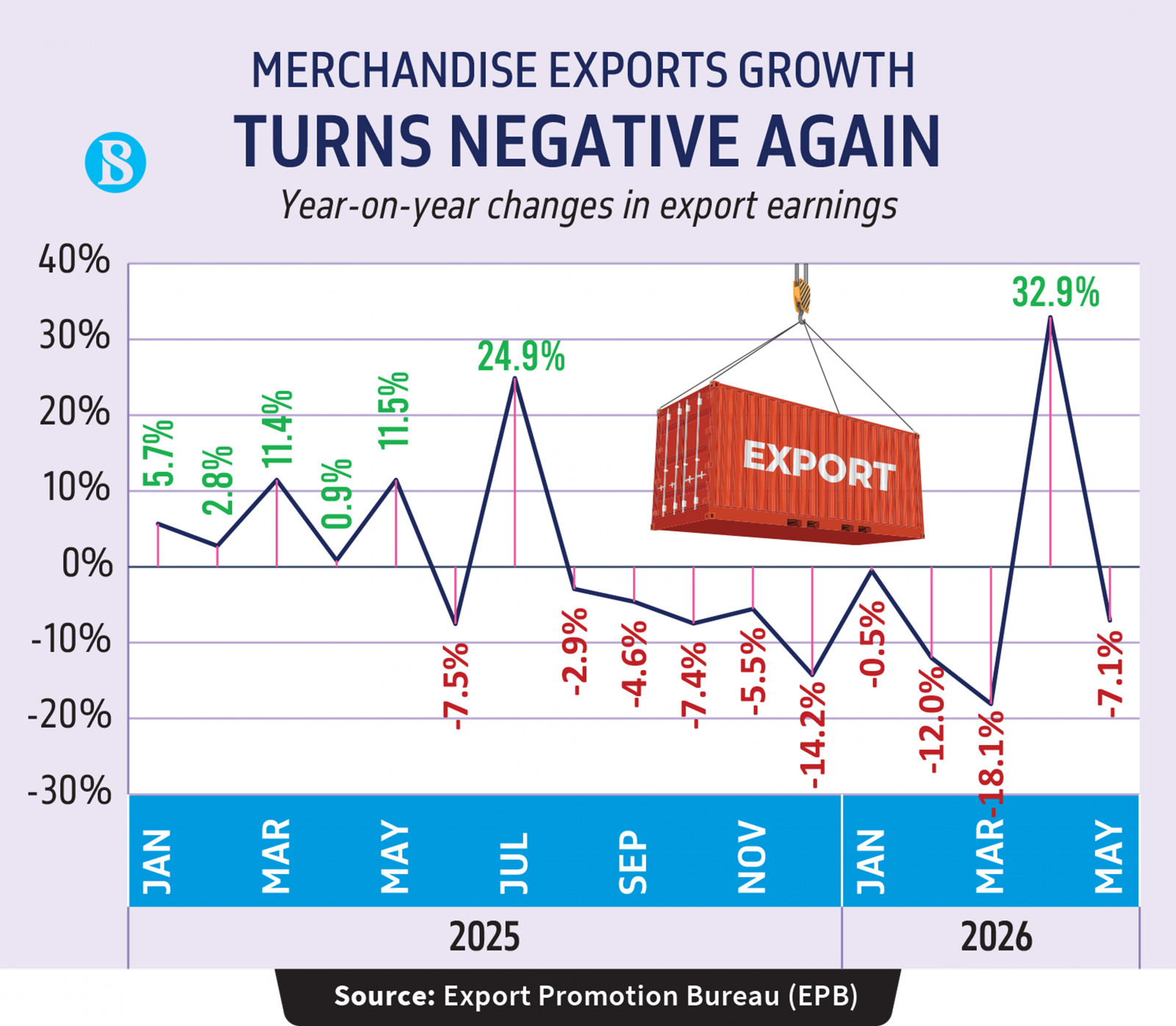
After a strong rebound in April, Bangladesh's export earnings fell again in May by 7.07% year-on-year, according to Export Promotion Bureau (EPB) data released today (3 June).
Exporters attribute the fall mainly to factory closures during the extended Eid holidays and a sustained slowdown in global demand.
In value terms, Bangladesh exported goods worth around $4 billion in May, down from $4.73 billion a year earlier. However, exports rose nearly 10% compared to April, indicating a short-term monthly recovery amid a broader slowdown.

Overall, export earnings in the first 11 months (July-May) of the fiscal 2025-26 fell by 2.55% compared to the same period last year. Total exports stood at $43.80 billion, down from $44.95 billion. Of the 11 months, nine recorded negative growth.
The ready-made garment (RMG) sector, which accounts for over 80% of national export earnings, remained the main drag. In May alone, garment exports fell by 8.29%.
 Keep updated, follow The Business Standard's Google news channel
Bangladesh Garment Manufacturers and Exporters Association (BGMEA) Vice President Shehab Uddin Chowdhury told The Business Standard that Eid holidays disrupted production and shipments.
"Factories remained closed for five to six days at the end of May due to Eid, which reduced shipments," he said, adding that global apparel demand remains weak.
Segment-wise data show knitwear performed worse than woven products. Knitwear exports fell 8.29% in May year-on-year, while over July-May they declined 4.26%, compared to a 2.42% drop in woven exports.
Industry stakeholders say the contraction in knitwear – largely basic apparel items – signals weakening global demand for low-value garments, a segment where Bangladesh has traditionally been strong.
Sparrow Group Managing Director Shovon Islam said the trend reflects a structural shift in demand. "A decline in knitwear exports indicates shrinking demand for basic items globally. To stay competitive, Bangladesh needs to move toward higher-value products, including man-made fibre-based garments," he said.
Outside garments, several major export categories also declined in May: frozen and live fish fell 22%, agricultural products 2.19%, leather and leather goods 13%, other footwear products 7%, and paper products 23%.
Some sectors, however, posted growth. These included home textiles (3.67%), specialised textiles (4.91%), jute and jute goods (8.40%), plastic goods (14.15%), and chemical products (11.65%).
Exporters warned the weak trend may continue into June, although business leaders expect a gradual recovery. "We expect exports to pick up from July," said Shehab Uddin Chowdhury.


