Why Bangladesh’s ailing economy needs a free press?
Global research suggests economies suffer when media is restricted—raising urgent questions for Bangladesh’s current crisis

Nothing is left to explain afresh about the importance of a free press to a thriving democracy. As there is little space for new arguments, the case is rested here.
As Bangladesh has been going through an unprecedented economic crisis, let us recall some facts and arguments about the importance of a free press to an ailing or thriving economy. Here, the message based on evidence is louder and clear too: "countries that recorded a decrease in press freedom also experienced a 1% – 2% drop in real gross domestic product (GDP) growth."
That is why over the past decades, numerous economists and political scientists have been advocating for a robust press for a robust economy.
What if the press is denied freedom?
 Keep updated, follow The Business Standard's Google news channel
Let us take a brief trip down memory lane. When the virus of unbridled corruption that turned into kleptocracy and fiscal policy mismanagement was infecting the economy during the fallen Hasina regime, all political and economic institutions were made crippled to fight the virus, which slowly but steadily grew into a fatal disease for Bangladesh economy. What did the media do? The question was frequently asked by many after Hasina's fall. Media does not function in isolation. Answer lies in the then political context.
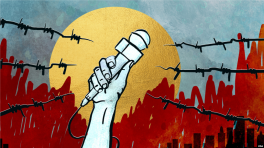
In Hasina's playbook, a free press was prohibited. Media had been muzzled in every possible way, vilifying independent journalism and dissenting voices. Censorship, cyber harassment, pressure from military intelligence services, judicial harassment, a series of draconian laws, police violence, and assaults by ruling party militias, according to Reporters without Border, were the hallmark of Hasina's regime in curbing press freedom. It was like a 'sword of Damocles' hanging over the press. In such an atmosphere, the media had struggled for survival in their own possible ways, compromising with independent journalism. What are the ultimate results of Hasina's zero-sum game? She faced a humiliating defeat and had to flee Bangladesh in the face of mass uprising and took refuge in India. She herself has become a big "zero" in Bangladesh politics. Her party's activities remain banned. Her authoritarian regime gave birth to an economic tsunami.
After the fall of the Hasina regime, the media expected freedom, but was again denied meticulously. It faced a new normal. Some news outlets and journalists were branded as "cohorts" of the "fascist" Hasina regime. Many were put behind the bars, many others lost jobs. Media industry discovered it in a new reality: "it jumped out of the frying pan into the fire."
The result?
Bangladesh falls three places to 152nd out of 180 countries in the 2026 World Press Freedom Index, released by Paris-based Reporters Without Borders (RSF) on 30 April, on the eve of World Press Freedom Day on Saturday.
The index assesses journalism conditions across five indicators—political context, legal framework, economic pressure, sociocultural environment and safety—classifying countries from "good" to "very serious." Bangladesh was ranked 149th in 2025 and is now placed in the "very serious" category.
The watchdog identified a sharp decline in the political context score as the main driver behind Bangladesh's drop, citing reduced tolerance for critical journalism, pressure from political actors and weak support for media accountability.
The impact of bad politics curbing press freedom on the economy is enormous.
Global Investigative Journalism Network in a study found evidence that "attacks on press freedom — such as jailing journalists, raiding their homes, shutting down printing presses, and using libel laws to thwart reporters — have measurable effects on economic growth.
"Our research team — spanning economics, journalism, and media — used rankings on press freedom from the US-based Freedom House and data on economic growth to examine 97 countries from 1972 to 2014. We found countries that recorded a decrease in press freedom also experienced a 1% – 2% drop in real gross domestic product (GDP) growth," says the network in an article "The Economic Costs of Curbing Press Freedom" published on 15 April, 2021.
It says, "Our findings affirm other economic studies showing the institutions that uphold a "rule of law" are strongly associated with stronger economic performance. Our work took into account education, labor force, and physical capital."
"Perhaps our most significant — and unexpected — finding is the long-term economic impost of undermining a free press," it concluded adding "Freedom House's own research suggests "press freedom can rebound from even lengthy stints of repression when given the opportunity."
Take the case of the poor health of our banking sector. Robbing of the banks during the fallen regime left the financial sector in ruin. Can a free press be an antidote to such a virus? Yes, it can. The Conversation, a network of nonprofit media outlets publishing news stories and research reports online, in their study found something noteworthy. Beyond its democratic role, press freedom is also a vital part of a stable economy. Research has shown that it acts as a kind of financial watchdog, ensuring balance and accuracy, the study asserts.
An independent press strengthens the resilience of financial institutions. "And our research suggests that higher levels of press freedom can also be linked to greater financial stability and lower "systemic risk" – where something bad happening at one company can trigger wider instability or even industry collapse – in the banking sector."
Using data from 47 countries, the study found that an independent press brings greater scrutiny of banking executives. Another benefit is a better flow of information around the financial markets, making the whole system more efficient.
"Countries with higher levels of press freedom are also more likely to foster corporate and political cultures that are free from the sort of corruption which could jeopardise the stability of the banking sector. All of these advantages are most pronounced during economic downturns or banking crises," it says in an article "Press freedom linked to greater financial stability, finds global study" published on 9 April, 2025.
Let us check what economists think about the importance of press freedom.
After the fall of the Hasina regime, the media expected freedom, but was again denied meticulously. It faced a new normal.
A High-Level Panel on Public Interest Media, consisting of 11 leading economists of the world including two Nobel Laureates Prof. Joseph Stiglitz and Prof. Daron Acemoğlu, was formed to assess the economic and social implications of the crisis confronting public interest media globally.
They concluded that healthy economies need good journalism, urging governments to recognize and uphold the economic value of public interest media in the age of AI.
"In 2024, as many as 90 countries were targeted by foreign state-sponsored efforts to manipulate information. The rise of Generative AI risks accelerating these tactics and heightens the challenges in thwarting the spread of false information online. Meanwhile, independent journalists and media organizations are coming under increasing political and economic pressures as autocracies and vested interests take hold," said the report published seven months ago.
"Our report, The Economic Imperative of Investing in Public Interest Media, shows why market forces alone are incapable of sustaining this vital public good: historically profitable business models are failing as revenues migrate to online platforms, allowing powerful interests to co-opt, intimidate or neutralize independent media."
The press freedom index offers food for thoughts. The countries such as Norway, Netherlands, Estonia, Denmark, Sweden and Finland always perform better on the press freedom index as they always grab top position on Corruption Index as least corrupt countries.
While Bangladesh and other countries with deplorable press freedom index perform poorly on the corruption index too. It proves a strong correlation between lack of press freedom and corruption. Higher levels of press freedom are significantly associated with lower levels of government corruption. Experts always say a free press acts as a watchdog, reducing the expected benefits of corruption by exposing abuses, acting as a deterrent against the misuse of power.
Bangladesh is now at a crossroads as it began a new journey led by a new government following the 12 February general election. It is facing a multidimensional crisis from economy to governance.
Experts are calling for extensive care—reforms, good practices and many more things for curing the ailing economy. An extraordinary situation deserves extraordinary measures. What will be the role of the press in this new journey?
Not alone for a thriving democracy, free press is equally important for an ailing and thriving economy. Time and again it has been proved. Either you take it or leave it. Your decision will shape your future.