At SB64, Bangladesh seeks to capitalise climate action
At SB64 in Bonn, Bangladesh is pushing for grant-based adaptation finance, faster access to loss and damage funds, and new opportunities in carbon markets, green jobs and climate investment

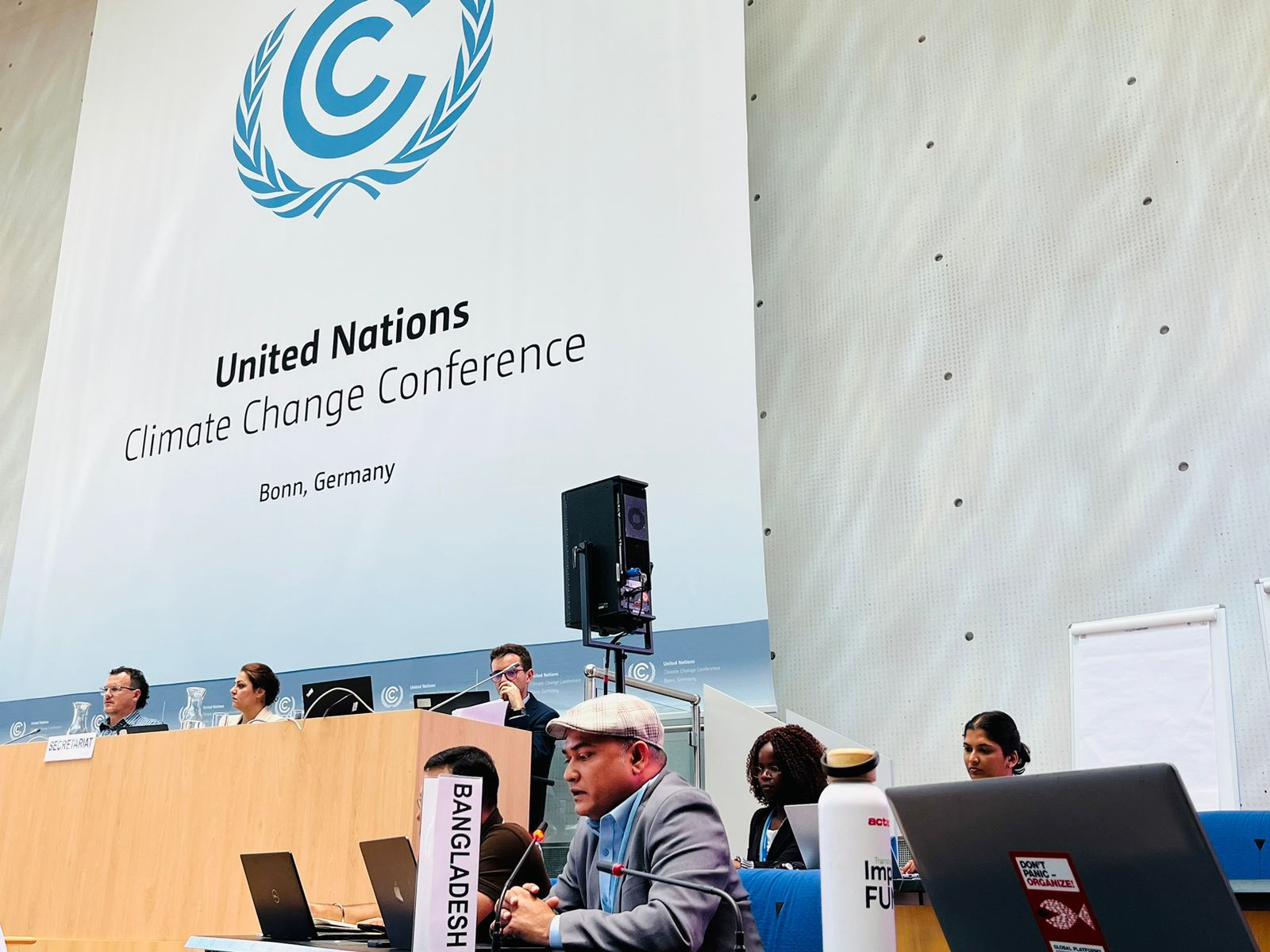
For Bangladesh, the Bonn climate talks are often treated as a technical stopover before the larger political theatre of COP. Delegations attend, officials negotiate text, and the real headlines usually wait until the end-of-year climate summit. But this year's SB64 appears to be different.
Bangladesh has sent a stronger and more high-profile delegation than usual. Dr Saimum Parvez, Special Assistant to the Prime Minister on Environment, Forestry and Climate Change, and Dr Sheikh Faridul Islam, State Minister for Environment, Forestry and Climate Change, are part of the delegation.
Alongside them are key stakeholders, including youth representatives, ensuring that the concerns of future generations can travel from consultation rooms in Dhaka to the negotiation tables in Bonn.
 Keep updated, follow The Business Standard's Google news channel

The message the government wants to convey is also sharper than before: Bangladesh does not want merely to attend climate negotiations; it wants to participate vocally, bargain strategically, and turn climate action into a development opportunity.
"We are seriously looking at carbon trading, loss and damage, and the role of LDC countries, G77 plus China, and developing countries negotiating together," Dr Saimum Parvez told TBS ahead of SB64. "Bangladesh is now participating vocally in negotiations. Earlier, we mostly attended. Now we are participating seriously."
At the centre of Bangladesh's SB64 position is a demand that climate-vulnerable countries have repeated for years but which has often remained underfunded: grant-based adaptation finance.
For Bangladesh, adaptation is not an abstract concept. It is the cost of living with damage that has already occurred. A river erodes a village, and the state must build an embankment.
A cyclone damages the coast, and shelters, roads, water systems and livelihoods must be rebuilt. Salinity intrudes into fields and drinking water sources, and communities need new infrastructure to survive.
Dr Saimum Parvez explained: "The damage has already happened. Suppose a river has broken its bank; now we build an embankment. These are adaptation measures. These are the most expensive. Adaptation costs more."
Mitigation, by contrast, is more technology-driven. "In electricity, we bring solar. Instead of oil-based vehicles, we bring EVs; these are mitigation," he said.
But for a country such as Bangladesh, where floods, cyclones, river erosion, salinity and coastal vulnerability are recurring realities, the greater burden is adaptation. That is why the government wants to push hard for funds that come as grants rather than loans.
The distinction matters. International climate funds and development partners often offer concessional loans with long repayment periods and low interest rates. But for vulnerable countries, that still creates debt.
"The purpose of climate funds was that developed countries, because of the damage they caused, would compensate for the losses faced by developing and least developed countries," he added. "But instead of compensation, if they create a loan mechanism, then even when they give the loan, they get it back. That means they are giving nothing."
This is why Bangladesh's position at SB64 is clear: adaptation finance must be grant-based. The demand covers floods, cyclones, river erosion, salinity, coastal resilience and other climate impacts that continue to drain public resources.
The second major priority is the Fund for Responding to Loss and Damage (FRLD). The fund was created after years of pressure from vulnerable countries, but it has yet to become fully effective in the way countries such as Bangladesh need it to be.
The government wants the fund to be operationalised quickly, with direct access, rapid disbursement, and coverage for slow-onset impacts such as salinity intrusion, sea-level rise and long-term livelihood loss.
"This is also something we are prioritising at the highest levels of government: that the FRLD should be operationalised as soon as possible," Dr Saimum Parvez said.
Beyond finance, Bangladesh also wants its priorities reflected in key global policy frameworks, including Global Goal on Adaptation indicators, Global Stocktake follow-up measures, NDC guidance, Article 13 transparency arrangements, the ocean-climate agenda, just transition policies and Action for Climate Empowerment.
Beyond finance, Bangladesh also wants its priorities reflected in key global policy frameworks, including Global Goal on Adaptation indicators, Global Stocktake follow-up measures, NDC guidance, Article 13 transparency arrangements, the ocean-climate agenda, just transition policies and Action for Climate Empowerment.
In simpler terms, Bangladesh wants the language of global climate policy to recognise the realities of countries facing repeated disasters, economic stress and development pressures simultaneously.
However, the government is not framing climate action solely as a burden. A third pillar of its SB64 message is opportunity.
"We want to capitalise climate action," Dr Saimum Parvez said, clarifying that a more precise phrase would be to build "a model or mechanism to capitalise climate action".
The idea is to convert adaptation, renewable energy, smart agriculture and carbon reduction into jobs, investment and new sources of revenue.
This is where carbon trading under Article 6 of the Paris Agreement comes in. Bangladesh wants to develop a national carbon market and a credible MRV (measurement, reporting and verification) system so that emission reductions can be transparently counted and traded.
World Bank officials have estimated that Bangladesh could potentially earn up to $1 billion annually from the global carbon market if it can establish the necessary policy and institutional framework.
He noted that this opportunity is also reflected in the BNP manifesto and is being pursued seriously by members of the SB64 delegation through bilateral discussions with governments, private-sector actors and partner organisations.
Dr Saimum Parvez confirmed that he is also holding sideline meetings with German companies and Germany-based partner organisations to explore climate partnerships and increase climate financing for Bangladesh.
"This is not only about SB," he said. "Alongside SB, I am trying to engage with German-based partner organisations and increase climate funding. Bangladesh, as a victim country, should receive proper compensation and adequate funding from the international community."
The green jobs agenda is another part of this effort to turn vulnerability into opportunity. Bangladesh is promoting a plan to plant 250 million trees, linked to nursery entrepreneurship, community participation and employment generation.
We are seriously looking at carbon trading, loss and damage, and the role of LDC countries, G77 plus China, and developing countries negotiating together.
According to figures under discussion, 350,000 green jobs could be created directly. Another 10,000 new nurseries could generate around 50,000 additional jobs. Overall, officials believe the programme could support between 500,000 and 600,000 jobs.
Yet experts warn that scale alone will not guarantee success.
Dr Haseeb Md. Irfanullah, an independent environment and climate change consultant and Visiting Research Fellow at ULAB, suggests that the plantation drive could be more effective if it prioritises locally appropriate and diverse tree species.
Instead of relying on one or two popular varieties, the programme could benefit from a mixed-species approach that reflects local ecology, community needs and long-term biodiversity goals.

One useful example, he notes, is the mangrove enrichment plantation programme carried out by UNDP and the Forest Department between 2015 and 2021. In that initiative, 12 mangrove species were used to restore degraded coastal green belts that had previously been dominated mainly by keora and baen. Such examples demonstrate how ecological diversity can make plantation efforts more resilient and meaningful.
According to him, Bangladesh can also draw lessons from international experience. In China's Ningxia Province, 80 million fast-growing poplar trees had to be cut down during the 1980s and 1990s following an Asian longhorned beetle infestation. The lesson, experts say, is not to avoid ambitious plantation programmes but to design them carefully, with the right species mix, scientific planning and a long-term ecological vision.
Bangladesh's SB64 agenda also includes scaling renewable energy to at least 30% of electricity generation by 2030, advancing climate-smart agriculture through water-saving rice cultivation and methane reduction, supporting a just transition for the RMG sector, women workers, green industries and cleaner production, and strengthening circular economy measures such as the 3Rs, e-waste recycling, waste-to-energy initiatives, climate education and public awareness.
These issues may appear scattered, but together they reveal the government's intended message: Bangladesh wants finance to survive damage it did not create, policy space to continue accessing funds after LDC graduation, and market mechanisms to convert climate action into jobs and revenue.
There is also a diplomatic ambition behind this approach. Bangladesh's recent success on the global stage, including Dr Khalil's rise to the presidency of the UN General Assembly, demonstrates that the country can exercise international leadership.
"Bangladesh can lead the global climate agenda. If it wants, Bangladesh can achieve more such international successes," Dr Saimum Parvez said.
SB64 will not resolve all these issues. Bonn is a negotiation platform, not a final destination. But this year, Bangladesh is arriving with a clearer narrative: it is a victim of climate change, but it does not want to remain merely a victim.