Decoding American militarism in the 21st century
Why does American military intervention persist even when presidents campaign on ending it?

During his November 2024 victory speech, Trump promised supporters, "I'm not going to start a war. I'm going to stop wars."
He doubled down on this peacemaker persona during his inauguration, declaring that true success would be measured not by military triumphs, but by the conflicts ended — and those avoided entirely.
He promised to end endless wars, yet, he has now dragged the country into a war with Iran with no end in sight.
 Keep updated, follow The Business Standard's Google news channel
But this should not come as a surprise, as he is just following in the footsteps of his predecessors: George W Bush, Barack Obama, Donald Trump and Joe Biden — all four US presidents in the 21st century — authorised military force abroad despite the rhetorical differences.
In the aftermath of the 28 February 2026 strikes on Tehran, which reportedly killed at least 787 Iranians, including at least 175 children in Minab, and the 3 January abduction of Venezuelan President Nicolás Maduro by US special forces, the question resurfaced with urgency: Why does American military intervention persist even when presidents campaign on ending it?
To decode this persistence, one must move beyond personality and examine institutions, incentives and law.
The campaign promise and the governing reality
Each president in the 21st century entered office pledging restraint.
George W Bush campaigned in 2000 on a "humble" foreign policy and skepticism toward nation-building. Within a year, the attacks of September 11, 2001 triggered wars in Afghanistan and later Iraq. By the mid-2000s, the US was engaged in large-scale counterinsurgency operations across multiple theatres.
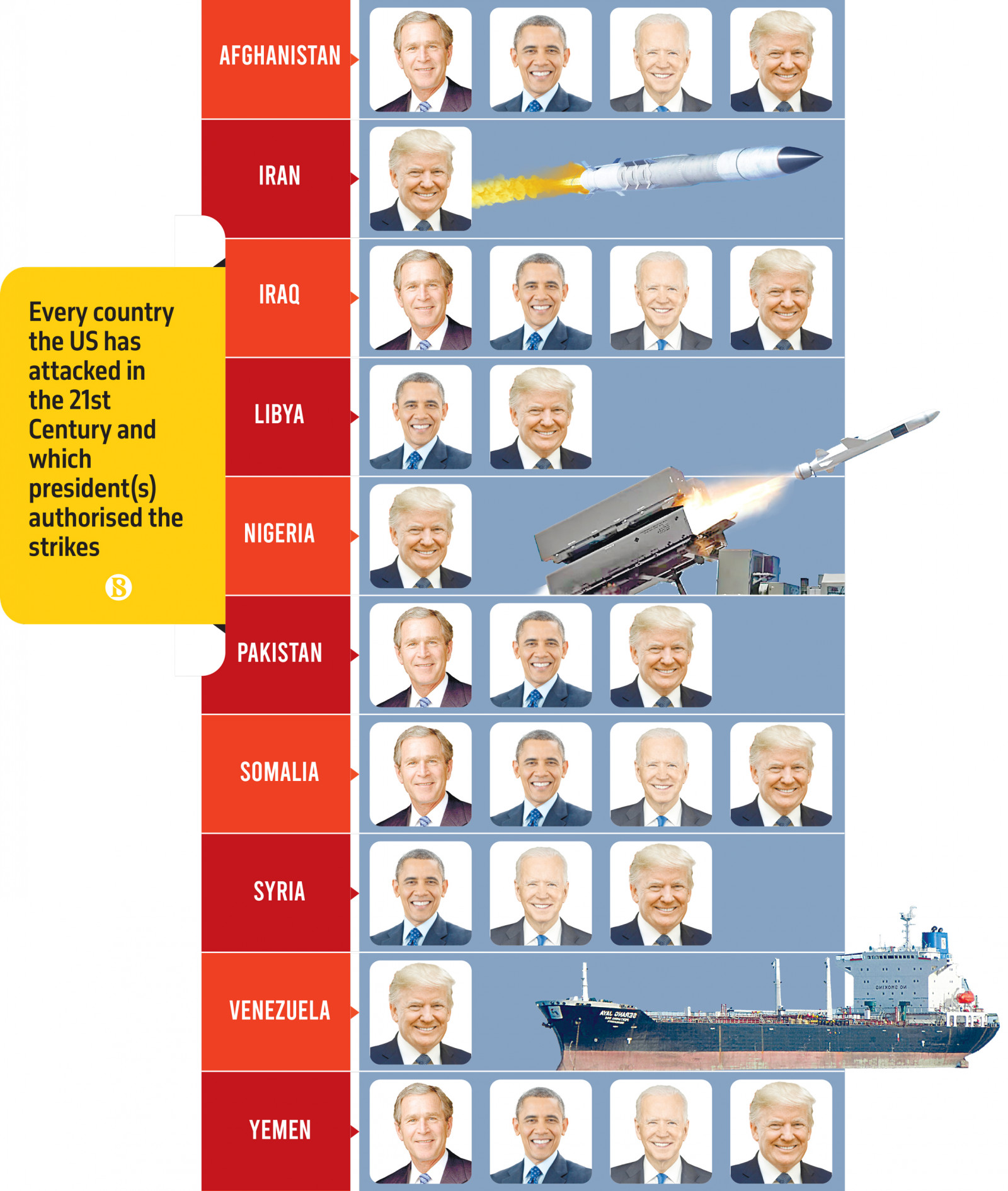
Barack Obama ran in 2008 on the promise of ending the Iraq War. While he did oversee a withdrawal from Iraq in 2011, his administration expanded drone campaigns in Pakistan, Yemen and Somalia, authorised intervention in Libya in 2011, and conducted sustained operations in Syria against ISIS.
Donald Trump campaigned in 2016 against "endless wars," criticising the Iraq invasion as a strategic error. Yet his administration increased airstrikes in Afghanistan, authorised the killing of Iranian General Qassem Soleimani in 2020, and maintained counterterrorism operations across Africa and the Middle East.
Joe Biden defended the 2021 withdrawal from Afghanistan by citing the $2.3 trillion cost and lack of strategic clarity. However, between 2021 and 2023, the US conducted counterterrorism operations in 78 countries under the residual "war on terror" architecture.
By 2026, overt interventions in Iran and Venezuela signalled a shift from covert continuity to visible escalation. The cycle persists: campaign restraint, operational expansion.
The institutional imbalance
The structural imbalance between military and diplomatic capacity is stark.
The United States spends roughly $12 on defense for every $1 on diplomacy and development — the so-called "12:1 ratio." The Pentagon's budget exceeds $800 billion annually, while the State Department's funding remains a fraction of that.
The Department of War, formerly the Department of Defense, employs more lawyers than the State Department employs career diplomats.
Even the Pentagon's ceremonial infrastructure outnumbers the entire diplomatic corps in staffing.
Economic architecture of the military industrial complex
The durability of American militarism is also embedded in economic design.
Since World War II, the US economy has incorporated defense production as a core industrial pillar. Major contractors — Lockheed Martin, Boeing, Raytheon, Northrop Grumman — operate facilities across nearly every congressional district. Defence supply chains are geographically dispersed, ensuring that reductions in military spending have local employment implications.
The US accounts for approximately 42% of global arms exports. Weapons sales are often framed as tools of influence, yet they also sustain domestic manufacturing ecosystems and trade balances. In regions such as the Middle East, arms transfers reinforce security dependencies that can later draw Washington into regional conflicts to protect partner regimes and supply chains.
This interlocking structure — federal contracts, district-level employment, export revenue — creates bipartisan incentives to maintain high levels of defense expenditure. Militarism becomes not merely a foreign policy posture but an economic stabiliser.
The post-9/11 Authorisations for the Use of Military Force (AUMFs), enacted in 2001 and 2002, provided the executive branch with broad authority to target entities associated with terrorism. Over time, these authorisations were interpreted expansively, justifying operations far beyond their original geographic or temporal scope.
Two competing doctrines define the legal debate. The Youngstown model envisions fluctuating presidential authority depending on congressional support. The Curtiss-Wright doctrine asserts plenary executive power in foreign affairs.
In practice, the latter vision has expanded. The 2026 strikes on Iran reportedly proceeded without a fresh congressional authorisation, relying on Article II interpretations and legacy AUMFs. Similarly, the 3 January operation in Venezuela was framed as a national security action under executive authority.
Iran and Venezuela as case studies
The 2026 interventions illustrate the convergence of these structural drivers.
In Venezuela, the abduction of President Maduro was publicly justified under narcotrafficking and national security arguments. Yet the operation also intersected with long-standing geopolitical and energy considerations.
The action was characterised by the Joint Chiefs as the culmination of two decades of special warfare refinement — effectively repurposing the institutional legacy of Iraq and Afghanistan.
In Iran, the February bombardment followed years of "maximum pressure" policies after the US withdrawal from the nuclear agreement. The strikes were framed domestically as decisive action rather than protracted war. Unlike earlier interventions that sought broad international coalitions, the 2026 operation appeared calibrated for rapid execution and media visibility.
In both cases, the underlying "war on terror" infrastructure — intelligence fusion centres, drone fleets, special operations command — provided ready capabilities. The system built for one conflict becomes available for the next.
Disregard for global institutions, international law and the rules-based order
The 2003 invasion of Iraq stands as a foundational case. Despite the lack of explicit Security Council authorisation, the United States — joined by a coalition of willing states — launched a full-scale invasion premised on contested claims about weapons of mass destruction and imminent threat.
Two competing doctrines define the legal debate. The Youngstown model envisions fluctuating presidential authority depending on congressional support. The Curtiss-Wright doctrine asserts plenary executive power in foreign affairs. In practice, the latter vision has expanded.
The UN Secretary-General at the time, along with several Security Council members, emphasised that a new resolution authorising force was absent.
Yet the intervention proceeded.
This episode marked a significant moment in the post-Cold War security order: a great power electing to act without the clear imprimatur of the world's principal multilateral security body.
In subsequent years, US use of force often operated in similar legal grey zones. Counterterrorism strikes in Pakistan, Yemen and Somalia were conducted under the broad umbrella of the 2001 AUMF, a domestic authorisation that has been read expansively to justify operations in states that were neither attacked nor engaged in armed conflict with the United States in the traditional sense.
While some operations were coordinated with host governments, many executed with limited transparency, accountability mechanisms or international legal debate.
The 2011 intervention in Libya, authorised by UN Security Council Resolution 1973 to protect civilians under the Responsibility to Protect (R2P) doctrine, initially operated within a collective security framework. However, the shift from a limited no-fly zone to a full campaign contributing to regime collapse strained the original mandate.
Russia and China later argued that the intervention exceeded its legal bounds. The ensuing instability in Libya contributed to broad skepticism in capitals about multilateral intervention mandates.
The pattern resurfaced in the 2026 strikes. The Iranian bombardment, undertaken without fresh Security Council deliberation, rested on executive authority and legacy AUMFs rather than a contemporary multilateral legal foundation. While proponents framed it in terms of self-defense and imminent threat, the absence of a unified global mandate reinforced perceptions of unilateralism.
Likewise, the Venezuela operation — an extraterritorial capture of a sitting head of state — defies conventional interpretations of the UN Charter's prohibition on the use of force except in self-defense or with explicit Security Council approval.
Across these cases, the United States often cited domestic constitutional authority or pre-existing authorisations rather than seeking fresh international consent or regulatory clarity. In practical terms, this approach has diminished the normative force of institutions designed to regulate interstate violence.
The International Court of Justice, the UN Security Council, treaty bodies and multilateral legal frameworks have had limited influence on the executive calculus when force is deemed politically or strategically imperative.
This evolution has normative and practical implications. Normatively, it challenges the authority of a rules-based order premised on shared constraints and adjudication. Practically, it creates precedent: if a great power can justify force without multilateral backing, other states may claim similar latitude in future crises.
In an increasingly multipolar world, the dilution of collective legal norms has consequences far beyond individual theatres of conflict.