Budget is only the first step of the larger plan
The budget must be read alongside the five-year strategic plan and monetary policy, says the applied macroeconomist

The Prime Minister told the people that he has a plan. And the budget is the first glimpse the people are going to have at his plan.
We need to assess the budget, Bangladesh Bank's monetary policy statement, and upcoming five-year plan. At the same time, there are a great many small measures here that have been taken for the very first time — genuinely micro-level work, I would say.
Even within the budget itself a great deal has been done for the first time — things that simply were not done before. Take one example. The traditional wisdom is that the moment a budget lands, the prices of everyday goods go up.
 Keep updated, follow The Business Standard's Google news channel
This time, a deliberate attempt has been made to tackle the high inflationary environment — an initiative, in other words, to bring the prices of goods down rather than let them climb. We have to appreciate that, surely.
Now, the obvious question that follows is: very well, but where will the money come from?
The answer is that, over the longer term, the revenue target depends on economic growth picking up. So I go back and look at what the monetary policy statement says and what the five-year plan says. On growth, they are projecting 6.5% — probably too optimistic.
Again, we have to see where that growth is supposed to come from, and that will not be in the budget speech. It will be in the five-year plan's strategy and in the macroeconomic framework. Without reading the whole of it, commenting would not be judicious. One has to look at the entire picture for oneself.
There is one more thing worth saying. At the very least, there is now a recognition that revenue has to be talked about — and I think that is a very important positive. Revenue will not rise on technocratic solutions alone. It is essential that the political culture, across the board, takes this up — that we say it as a political matter: we have to raise revenue.
One interesting thing is reading this budget, it felt to me like a stepping stone. A lot of the commentary carries the same sense: that this is step one, and we will see step two in the next budget, and so on and so forth.
And one more thing. Consider the state the economy is in right now and, at the same time, the amount that will go out in debt servicing. These are the challenges ahead.
And that is precisely why their baseline assumption — the 5.5% GDP growth that has been pencilled in — may well not materialise. In fact, there is a very real possibility that it will not. There is a risk that the 5.5% simply does not happen.
And if it does not — if we do not get 5.5% GDP growth — then the most likely outcome, which is what we have seen historically and which is, frankly, the practical reality, is that a large part of the development programme will simply not be implemented. That is a reality, an eventuality, for which we have to be prepared. The war in Iran has once more flared up. So, the uncertainty exists through no fault of the government's own — but it is a problem nonetheless. So, the government needs to tread carefully in the days ahead.
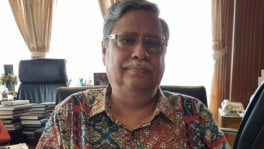
Jyoti Rahman spoke with TBS' Shadique Mahbub Islam.