



Nakshi Kantha turns couture
From naturally dyed sharis to vibrant salwar kameez, emerging labels are incorporating Nakshi Kantha in modern contemporary wardrobes — without losing its artisanal soul

Mashiyat Salam is a development professional whose work frequently takes her into the halls of government ministries and foreign embassies. In such settings, her go-to attire is her trusty Aarong Nakshi Kantha embroidered shari (with quilt motifs and patterns), crafted on balaka silk. An elegant choice, upholding tradition and offering elegance in a rather understated way.
Mashiyat is not alone. Ever since Aarong introduced Nakshi Kantha designs on sharis, they have garnered immense popularity as formal attire for women. Traditional hand embroidery, often contrasting with the shari's undertone, makes each piece distinct. Every embroidered piece feels like a work of art — something you instinctively want to touch, if only once.

These shari uphold their intricate craftsmanship while maintaining a restrained sense of sophistication. To preserve this intricacy, hand embroidery takes time — often a long time — before it is finally placed on a shari. Each piece reflects not only labour but also an intense level of craftsmanship. By the time these sharis reach retail outlets, they are, quite justifiably, high-end.
As much as Aarong's designs have dominated the market for decades, Aranya, Friendship Colours from the Chars, and several other organisations have also worked with Nakshi Kantha sharis. What is interesting now is how a new wave of Facebook-based entrepreneurs is working with Nakshi Kantha, bringing in diversity in design and interpretation.
 Keep updated, follow The Business Standard's Google news channel
Two such pages are worth looking at closely.
Rooted in the earth, reshaped by hand
Can you imagine grasshoppers fluttering all over your shari in Nakshi Kantha embroidery? Or lotuses floating side by side in contrasting threads on an earthy-toned fabric? Or perhaps run stitches in modular patterns on a grass-green shari that feels like you are draping a field across your body?
Most of Samia Khan's sharis hold onto earthy tones, paired with distinctive embroidery ideas rooted in Nakshi Kantha stitches. That philosophy is reflected in the owner's own words. "All the work on our sharis is done on naturally dyed fabrics. Even the threads used to create the stitches are dyed naturally," says Samia Khan.
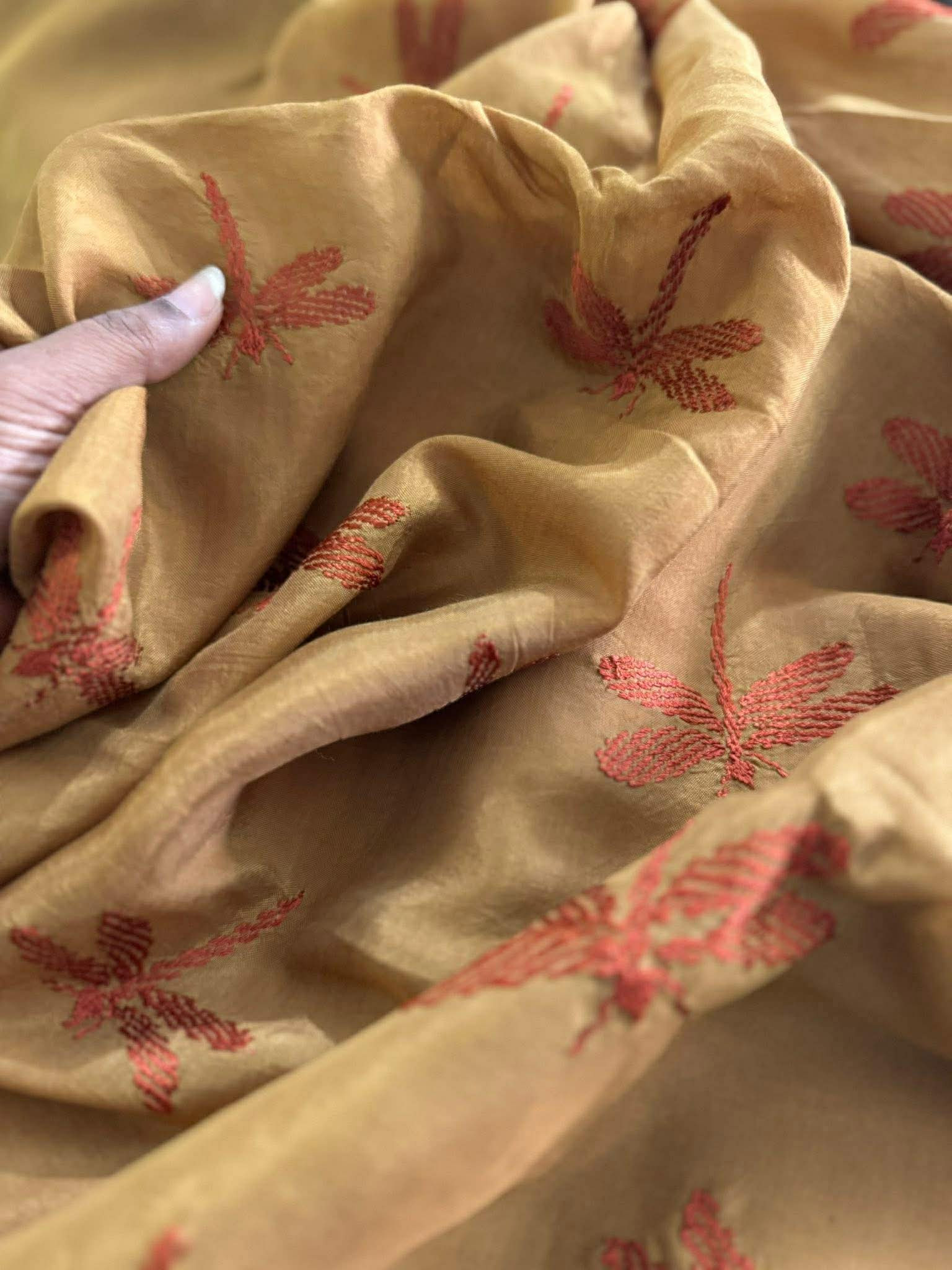
Kantha stitches are crafted on cotton, muslin, Joyosree and Balaka silk — each fabric dyed naturally beforehand. The designs sit somewhere between tradition and modernity, which sets the brand apart from more conventional ones.
"My initial idea was to further enhance the motifs. For instance, if I talk about a specific stitch — beki shelai (a popular stitch motif used in quilt borders) — my aim was to give it a rounder shape. I kept thinking about how I could reshape it to bring a sense of fusion into my sharis."
These new motifs did not come without effort. To build effective communication, Samia relocated to Jashore, where most of the artisans are based.
"I would go to every household working with Nakshi Kantha. When I started working closely with the artisans, I was fortunate that they accepted what I wanted to bring out of their work. Initially, they were a little apprehensive, but over time, they adapted."
Kantha sharis here are of two types. One is the naturally dyed printed shari. "First, we print the shari using natural wax dye. Then, kantha stitching is crafted on the printed shari. These are called Anokhi kantha sharis," she says. These range from Tk8,500 to more than Tk20,000.
The second type is the regular kantha shari, priced between Tk13,500 and Tk50,000.

For Samia, pricing is inseparable from fairness. "The time and work they put into this craft — this payment is not extra, it is what they deserve. I try to meet their rates. If we start bargaining, they will have to move to other professions, such as cattle farming, which offer better returns. Ultimately, we lose our heritage and an entire cottage industry."
She sees it as a responsibility. "We need to create new artisans. This sustainable, handmade work — if we do not support it now, it will disappear."One memory stays with her. "There was a girl in Class 6. When she moved up to Class 7, alongside her studies, she made an entire shari for me. The fact that she is becoming self-reliant while continuing her education was a huge inspiration for me."
Where celebration meets craftsmanship
Where Samia Khan's world is one of earthy restraint, Sitoka occupies a rather different space. Sitoka — a Bangla word meaning 'soil' — speaks directly to a deeper identity, yet its creations are mostly centred on salwar kameezes, often designed with festive occasions in mind. This is reflected in the burst of colours used in both fabric and embroidery.
The brand deliberately moves away from overused materials. Instead of focusing on cotton, it invests in muslin, silk and blended silk — fabrics associated with celebration and deeply tied to South Asian heritage. Stitches fall differently, textures respond in their own ways, and the final pieces carry a more fluid, refined presence.
Behind each garment lies a layered process. A single piece passes through 10 to 12 stages — from sourcing fabric to layout mapping, embroidery and finishing. This explains both the time and value embedded in each product.

Sitoka's pricing reflects this complexity. Pieces begin at around Tk6,250 and can reach Tk25,000–30,000, depending on design, fabric and handwork.
Sitoka's growth has been structured. From a single artisan to more than 200 craftspeople, it has expanded through small clusters of 20–25 artisans across Jamalpur and nearby districts. This decentralised system allows flexibility while maintaining quality.
Each new artisan undergoes four to six months of training, which includes not just stitching, but also interpreting and executing specific design instructions.
Samia Khan and Sitoka stand at two ends of the same spectrum. One leans into earthy, naturally dyed tones and experimental yet restrained motifs on sharis. The other embraces vibrant colours, festive fabrics, and salwar kameezes that command attention.
And in their own unique ways, they are not just creating garments — they are ensuring that this centuries-old art continues to live, evolve and be worn.


