How football carried war, empire and power over the last century
Football has never been sealed off from power. On the contrary, history shows how the world’s game became a tool of recruitment, propaganda, morale, and political pressure

On 8 September 1939, five days after Neville Chamberlain told Britain that war with Germany had begun, the Football Association made its own declaration: all football, except that organised by the armed forces, was suspended "until official notice to the contrary".
It was a short statement with big implications. Football, by then the people's game, could no longer pretend to be outside history.
In 1914, professional football had carried on through the first year of World War I, drawing criticism from those who believed fit young footballers should be in uniform rather than on the pitch. In 1939, there was no such delay. Conscription, the threat of air raids and the reality of "total war" meant the old league season could not continue.
 Keep updated, follow The Business Standard's Google news channel
The 1939-40 campaign had begun on 26 August; by early September, its results were scrubbed from official records, players were effectively out of work, and clubs were reduced to paying signed-on professionals a small weekly allowance.
Chelsea manager Billy Birrell aptly captured the uncertainty, "Chelsea have closed down, but we are still marking time, hoping and believing that football in some form or other will be allowed soon."
That "some form" mattered. The Home Office soon allowed a revised programme, provided football did not interfere with national service or industry. Crowds were capped at 8,000 in evacuation areas and 15,000 elsewhere.
Regional leagues, war cups, home internationals, and inter-service matches replaced normality. The game had been rationed, but not extinguished. For a country under bombardment, football became a safety-valve, a reminder that ordinary life had not entirely surrendered.
It also became a recruiting ground. On Easter Saturday 1939, Bolton Wanderers captain Harry Goslin addressed the crowd and urged men to join up. The following Monday, he and Bolton's entire first team joined the 53rd Field Regiment, Royal Artillery.
Goslin was later killed in action in Italy. He became one of the clearest examples of how the footballer's body — fit, visible, admired — could be converted into a military symbol.

The numbers show how deeply the game was pulled into war. The Football Association's (FA's) post-war account recorded that, between September 1939 and the end of the conflict, 91 men joined the armed forces from Wolves, 76 from Liverpool, 65 from Huddersfield Town, 63 from Leicester City, 62 from Charlton, 55 from Preston, 52 from Burnley, 50 from Sheffield Wednesday and 44 from Chelsea.
The Imperial War Museums notes that more than half of Britain's army — around 1.5 million troops — spent most of the war in Britain, where playing and watching sport helped keep them fit, occupied and entertained. In May 1943, 55,000 people attended a match at Chelsea that raised £8,000 for the Navy Welfare League.
The pitch followed the war wherever it went. Arsenal's Highbury became an Air Raid Precautions centre, forcing the club to share Tottenham's White Hart Lane. Stamford Bridge survived incendiaries, near misses and the Blitz.
At one point, Birrell was told an unexploded fire bomb lay on the terrace. With bomb disposal busy, he reportedly made it safe himself, pipe in mouth, because postponing a match was unthinkable. Football was not merely entertainment; it was morale, money, routine and defiance.
For soldiers, it was also discipline. Inter-service and inter-unit matches were encouraged to maintain fitness and build links across units. Gunners played near their artillery in Anzio in January 1944.
Ted Drake, the Arsenal forward serving as a flight lieutenant, appeared for FA Services XI in Paris after liberation, beating a French side 5-0 before travelling to Brussels, where a match against Belgium required the terraces to be cleared of mines before spectators could enter. Football had become part of the Allied performance of liberation.
Mussolini used football to glorify a regime. Hitler's Europe showed how football could be swallowed by conquest and racial ideology. Wartime Britain used it to recruit, fundraise, discipline and console. Trump's case is smaller in scale but sharper in method: a head of state of a host nation personally entering a disciplinary process in real time.
The home front had its own football economy.
Factories formed women's teams, echoing the First World War. In 1944, goalkeeper Betty Stanhope played for Fairey Aviation against A V Roe; Fairey won 6-0. Prisoners of war organised leagues in camps, with Red Cross and YMCA supplies.
One British POW team at Stalag XXID in Nazi-occupied Poland called itself "Aston Villa". Bert Trautmann, later Manchester City's famous goalkeeper, arrived in Britain as a German POW in 1945. Football, in these spaces, was not propaganda in the crude sense. It was survival: a structure of time, identity and fellowship.
Yet governments understood its propaganda value.
The Ministry of War Transport used a football-themed cartoon to encourage workers to unload vehicles more efficiently. The message was obvious: the habits of the game — speed, teamwork, finishing the job — could be transferred to the war machine. Football was a language everyone understood.
Dictators understood it too.
Benito Mussolini's Italy treated football as proof of fascist vitality. Italy hosted and won the 1934 World Cup under his regime; the team gave fascist salutes, including at the final. In 1938, Italy retained the trophy in France, and in the quarter-final against the hosts wore black shirts, an unmistakable tribute to Mussolini's paramilitary unit of the same name. Football became theatre, the nation disciplined, muscular, obedient.
Adolf Hitler's Germany used the game differently but no less politically.
Austria had qualified for the 1938 World Cup as an independent country; after the Anschluss, its place disappeared into Germany's imperial project. Sweden advanced automatically because Austria no longer existed as a footballing nation.
The episode remains one of the starkest examples of geopolitics erasing a team from the draw. The Nazi regime's brutality also reached footballers themselves. Julius Hirsch, a German Jewish international, was murdered at Auschwitz. In that fact lies the limit of sporting romance: football could offer belonging, but fascism decided who was allowed to belong.
The British Empire and wartime Britain used football less as spectacle of superiority than as mobilisation. Recruitment speeches, charity matches, military fitness, BBC rebroadcasts to troops, regional cups and guest-player systems all kept the game inside the national project.
The controversy was subtler: Should football continue while cities burned and men died? Was it a necessary relief, or an indulgence? The answer, in practice, was both. Football gave the public a way to "keep calm and carry on", but it also helped the state organise bodies, morale and money.
After 1945, football returned bigger than before. When Moscow Dynamo visited Stamford Bridge in November, the crowd was so vast that the match became, technically, a riot. The ordinary league resumed in 1946/47 to huge attendances. People had not forgotten football during the war; they had used it to get through the war.
The post-war World Cup inherited this tension between sport and power. The tournament's controversies form a shadow history of politics, pressure and authority. In 1930, Argentina's Luis Monti reportedly received death threats before the final against Uruguay.
In 1950, withdrawals by India, France, Turkey and Scotland showed how finance, logistics and national pride could shape a supposedly global event. In 1954, Spain missed out after lots were drawn by a blindfolded boy, sending Turkey instead.
Then came the matches that made controversy part of World Cup folklore. The 1962 "Battle of Santiago" between Chile and Italy descended into violence, two sendings-off and police intervention; a BBC presenter called it the most "disgusting and disgraceful exhibition of football in the history of the game".
In 1966, England's "ghost goal" against West Germany and Antonio Rattín's dismissal for "violence of the tongue" showed how refereeing could become national mythology. In 1974, Zaire's Mwepu Ilunga blasted away Brazil's free kick before it was taken; years later, he said the team had been threatened by Mobutu Sese Seko if they lost by four or more. They lost 3-0.
Argentina 1978 remains darker. The hosts, ruled by a military junta, needed to beat Peru by four goals to reach the final. They won 6-0, and allegations of political pressure and fixing have never fully disappeared. In 1982, the "Disgrace of Gijón" — West Germany's 1-0 win over Austria, which sent both teams through and eliminated Algeria — forced FIFA to schedule final group matches simultaneously. Football changed its rules because distrust had become impossible to ignore.
The modern controversies are more familiar: Maradona's "Hand of God" in 1986; Beckham's red card in 1998; South Korea's disputed run in 2002; Rivaldo's simulation; Graham Poll showing Josip Šimunić three yellow cards in 2006; the "Battle of Nuremberg"; Zidane's headbutt; Lampard's disallowed goal in 2010; Suárez's handball against Ghana and later bite on Giorgio Chiellini; Robben's "No era penal" moment in 2014; Japan advancing over Senegal by fair-play points in 2018; and the 2022 "Battle of Lusail", with 18 yellow cards and one red.
What makes Donald Trump's intervention different in this day and age is not that politics entered football. Politics was always there. The difference is the directness, visibility and institutional pressure.
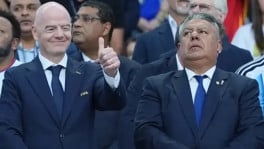
In July 2026, Trump acknowledged that he personally asked FIFA president Gianni Infantino to review the red card shown to USA striker Folarin Balogun before the last-16 tie against Belgium.
"All I did was ask for a review," he said, insisting, "I didn't tell him what to do." FIFA then suspended the automatic one-match ban, while Infantino maintained that "Fifa's judicial bodies are independent." UEFA called the decision "incomprehensible and unjustifiable", and the US lost 4-1 to Belgium anyway.
The White House's World Cup taskforce head, Andrew Giuliani, later defended the lobbying, calling the refereeing situation "very, very highly suspicious". FIFA defended referee Raphael Claus, saying he had "consistently demonstrated the highest standards of professionalism and integrity".
That is the modern form of an old story. Mussolini used football to glorify a regime. Hitler's Europe showed how football could be swallowed by conquest and racial ideology. Wartime Britain used it to recruit, fundraise, discipline and console. Trump's case is smaller in scale but sharper in method: a head of state of a host nation personally entering a disciplinary process in real time.
Football has always sold itself as a game of rules. Its history says something more complicated. In war, empire, dictatorship and democracy, the ball has never rolled across neutral grass. It has carried flags, fear, money, morale, grievance and power.
That is why football's controversies endure. They are rarely just about whether the ball crossed the line, whether a tackle was a red card, or whether a striker should play the next match. They are about who gets to decide — and what power is doing just outside the touchline.