



Climate change-linked warming triggers jellyfish surge in Bay, hurting deep-sea fishing
Industry insiders say the shift has intensified since late January and became more pronounced in February, after minimal rainfall between November and January

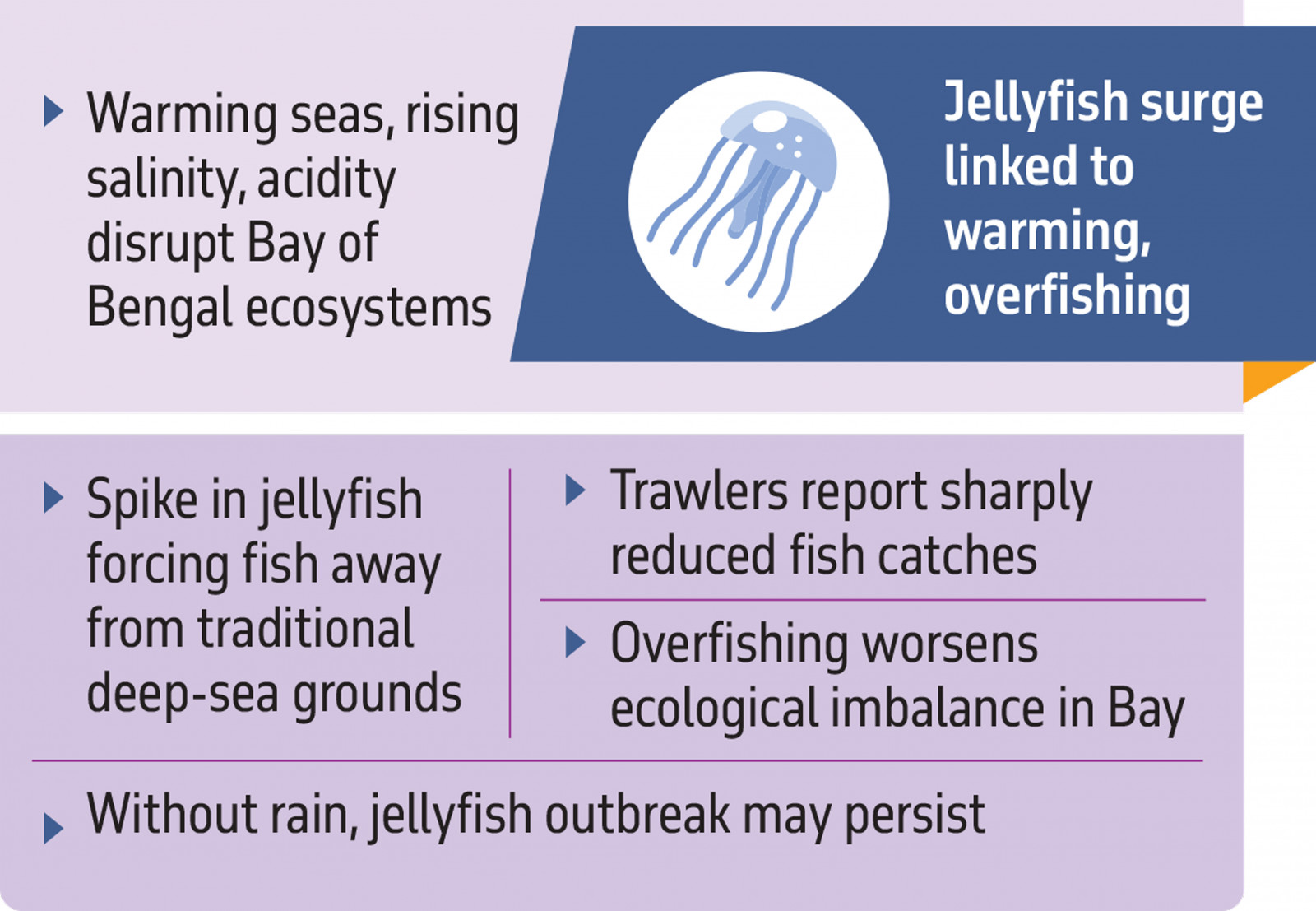
A prolonged dry spell coupled with climate change-driven ocean warming is disrupting marine ecosystems in the Bay of Bengal, triggering a spike in jellyfish and forcing fish away from Bangladesh's traditional deep-sea fishing grounds.
Industry insiders say the shift has intensified since late January and became more pronounced in February, after minimal rainfall between November and January. With no significant rain to cool surface waters, sea temperatures have stayed elevated. Salinity has risen, and acidification has accelerated – a combination experts say is unsettling marine habitats across the Bay.
Many fish species struggle to survive in their usual habitats when temperature, acidity and salinity increase and they begin moving towards cooler, more stable waters.
Jellyfish, by contrast, adapt easily.
 Keep updated, follow The Business Standard's Google news channel
"The higher the temperature and acidity, the more favourable it becomes for jellyfish," said Tanvir Shahriar Rimon, chief executive officer of Rancon Sea Fishing. "Once jellyfish dominate an area, fish cannot sustain there. They move elsewhere."
The consequences are now visible in authorised deep-sea zones, particularly beyond 40 metres in depth, where operators report dense jellyfish concentrations. Trawlers returning from those waters are bringing back sharply reduced catches.
"With lower fish hauls, many trawler owners are struggling to recover fuel costs, let alone make a profit," Rimon said.
The situation is unlikely to improve without rain.
"If there is rain, the sea may cool and the jellyfish could disperse," said Enam Chowdhury, president of the Bangladesh Marine Fisheries Association. "But without rain, the outbreak of jellyfish may not subside quickly."
The pattern is not new. Similar surges have occurred in recent years. In 2024, a severe outbreak left many vessels unable to even cover fuel expenses.
Scientists have long cautioned that climate variability – including phenomena such as El Niño – can intensify ocean warming and acidification in the Bay of Bengal, reshaping fish distribution and threatening marine livelihoods.
A study published in Marine Environmental Research in March shows that warming of +1.5–3°C significantly accelerates jellyfish proliferation.
Marine researcher Dr Mazharul Islam said that increasing sea surface temperature and salinity – partly due to oceans absorbing large amounts of heat-trapping carbon dioxide – directly contribute to higher jellyfish density.
He added that overfishing further exacerbates the problem by reducing natural predators and competitors, creating favourable conditions for jellyfish blooms.
"When large fish populations decline due to overfishing, jellyfish increase and the food chain gets disrupted," he said.
In a balanced ecosystem, large fish feed on medium-sized fish, which in turn consume smaller species. Larger fish also prey on jellyfish. When top predators decline, jellyfish populations can expand unchecked, further reducing smaller fish stocks and deepening the imbalance.
Bangladesh's deep-sea fishing industry operates primarily in the Bay of Bengal, targeting tuna, mackerel, sardine and various demersal species beyond coastal waters. The sector gained momentum after maritime boundary verdicts in 2012 and 2014 expanded the country's exclusive economic zone, opening wider offshore areas for commercial fishing.
Over the past decade, private operators and state-backed initiatives have led to a rise in the number of longliners and trawlers, driven by expectations of tapping underexploited offshore resources.
However, high fuel costs, limited cold storage, ageing vessels and dependence on a handful of landing centres leave operators vulnerable even in favourable seasons. A sudden ecological shift, such as a jellyfish surge, can quickly turn voyages unviable.
As ocean temperatures begin rising earlier in the year, operators fear disruptions may prolong and become more frequent. Until sustained rainfall cools and stabilises sea conditions, the sector remains exposed to a warming Bay, contending not just with market volatility, but with a marine ecosystem under mounting strain.


