Low-cost health initiatives, digital tools can boost RMG productivity and worker wellbeing: Experts
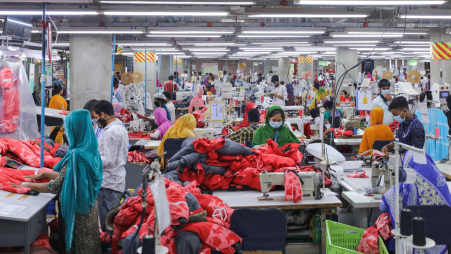
The garment industry contributes about 16% of Bangladesh’s GDP and 80% of its export earnings, employing around four million workers—about 57% of them women. Yet long-standing health problems among workers have been affecting productivity and competitiveness

Combining low-cost health initiatives with digital tools can safeguard the wellbeing of Bangladesh's readymade garment (RMG) workers while also increasing productivity, speakers said at an event held on 28 September at The Westin Dhaka.
They highlighted the need to expand these activities, ensure their sustainability and strengthen policy support, noting that healthier workers ultimately mean a stronger industry and economy.

Organised under the title "Ensuring Health and Wellbeing of RMG Workers," the programme was jointly arranged by Ayat Education, the Bangladesh Garment Manufacturers and Exporters Association (BGMEA), Integral Global (IG), the JCM Foundation and several leading factories. It brought together industry owners, policymakers, buyers and development partners.
 Keep updated, follow The Business Standard's Google news channel
The garment industry contributes about 16% of Bangladesh's GDP and 80% of its export earnings, employing around four million workers—about 57% of them women. Yet long-standing health problems among workers have been affecting productivity and competitiveness.
To tackle these challenges, the initiative has introduced several measures: providing health information to workers and managers, organising awareness workshops for mid-level managers, offering training for workers on health and hygiene, holding a four-day health camp, and launching the country's first digital health toolkit.

Chief guest Md Sanwar Jahan Bhuiyan, secretary of the Ministry of Labour and Employment, said, "RMG workers are the lifeline of our economy. BGMEA and the government are taking various steps to amend labour laws and to ensure workers' welfare, safety and health."
"We aim to improve digital systems, information management and self-regulated monitoring. Investment in risk reduction is crucial. If all stakeholders work together, both productivity and workers' welfare can be enhanced," he added.
Special guest Inamul Haq Khan, senior vice-president of BGMEA, noted: "The industry defines the economic framework of Bangladesh. With our four million workers—57% of them women—it is vital to ensure their health and welfare."
"BGMEA and its partners have shown that the right initiatives can improve both workers' quality of life and productivity. Our goal is to scale up and sustain these good practices across more factories. Healthy workers mean a stronger industry, a stronger economy and a stronger Bangladesh," he added.
Other speakers included Nusrat Aman, CEO of Ayat Education; Jenna Buttolph, senior public health analyst at Integral Global; and Mased Abdullah, managing director of Dressmen Ltd.
Participants in the panel discussion included Sharif Zahir, managing director of Ananta Group of Companies and chairman of United Commercial Bank; Kazi Faisal Bin Seraj, Bangladesh country representative of The Asia Foundation; Ron Johnson among others.