



Outpaced by costs: Rising feed prices, tax hikes push poultry farmers to shutter sheds
Industry insiders say production costs have more than doubled over the past five years: what once cost Tk100 now costs Tk210 or more.

At dawn in a small village in Bhuapur, Tangail, Alamgir Hossain used to open his poultry sheds to the clamor of thousands of chickens; now the silence inside now says more than the noise ever did.
Alamgir, who once oversaw a thriving operation producing 10,000 eggs daily, has been forced to shutter half of his sheds – the quiet has come to reflect a business he can no longer sustain. After more than two decades in poultry farming, he says the numbers no longer add up.
"It costs me around Tk10 to produce an egg, but I often have to sell it at Tk8. I can't survive with losses month after month. Many around me have already quit. I may have to shut down too."
 Keep updated, follow The Business Standard's Google news channel
His experience mirrors a broader strain across Bangladesh's poultry sector, where small and medium farmers are struggling to stay afloat amid rising costs and limited returns.
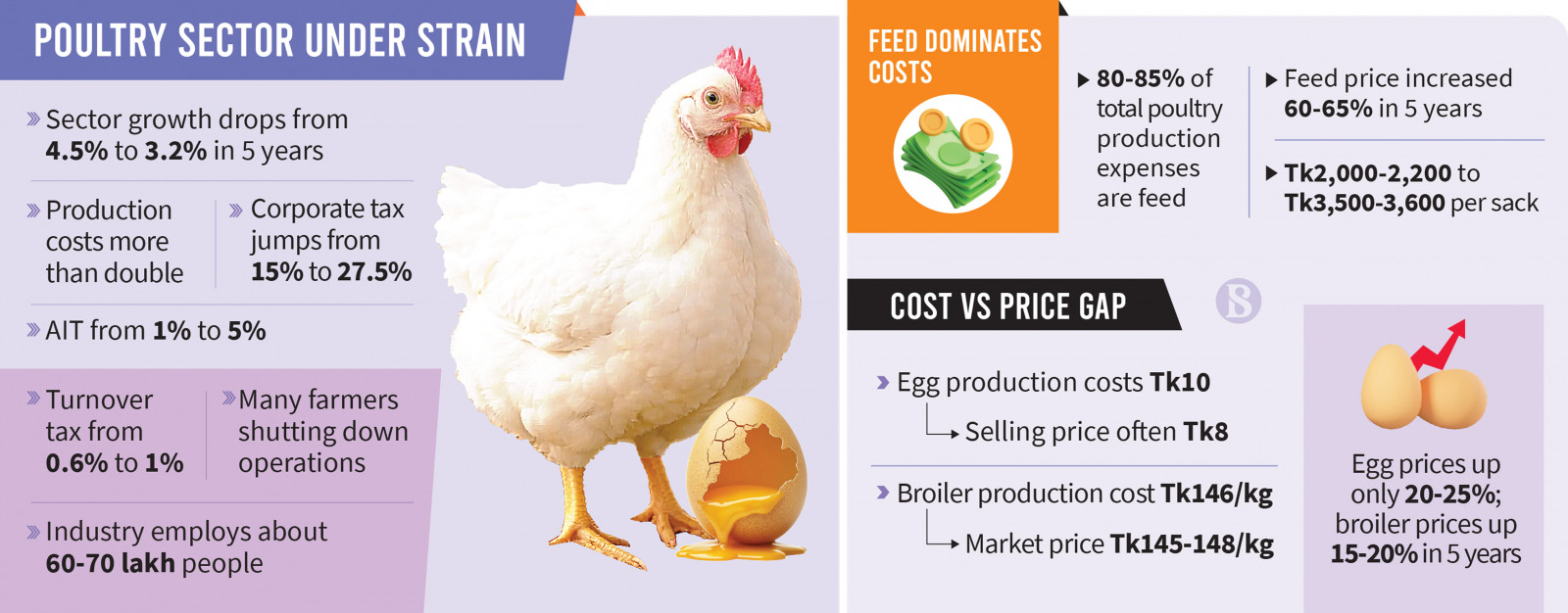
Industry insiders say production costs have more than doubled over the past five years: what once cost Tk100 now costs Tk210 or more. Meanwhile, Bangladesh Poultry Industries Association (BPIA) data states that growth in the sector has slowed from 4.5% to about 3.2% during the same period.
Feed has become the dominant expense, accounting for 80–85% of total production costs, according to farmers. At the same time, higher corporate taxes, advance income tax (AIT), and turnover tax have added further pressure in the current fiscal year.
Shafiqul Islam, a farmer from Bhaluka in Mymensingh, closed his 15,000-bird farm last year. "I used to buy a sack of feed for Tk2,100. Now it costs over Tk3,500. With loan instalments and electricity bills, I couldn't continue," he said. "I had to sell land to repay debts."
Rubina Akter from Monohardi in Narsingdi described a similar struggle. "I started this farm to support my daughters' education. Now I can barely run the household," she said.
Feed prices outpace market returns
Farmers say the sharp rise in feed prices has not been matched by increases in egg and chicken prices, leaving them squeezed between input costs and market rates.
Feed prices have risen by 60-65% over five years, from around Tk2,000-2,200 per sack in 2020 to Tk3,500-3,600 in 2025. In contrast, wholesale egg prices have increased by only 20-25%, from Tk6-7 to Tk8-9 per piece.
Broiler prices show a similar pattern. Wholesale prices rose from Tk120-130 per kg in 2020 to Tk140-150 in 2025 – an increase of just 15-20%, far below the rise in production costs.
"This gap is killing us," said Abdul Kader, a farmer from Chandina in Cumilla. "Feed costs have nearly doubled, but chicken prices haven't. Sometimes we can't even recover costs. Small farmers will disappear if this continues."
Tax changes deepen the strain
Farmers and industry leaders say recent tax hikes have worsened the situation.
According to the National Board of Revenue (NBR), corporate tax for poultry-related companies has been raised from 15% to 27.5% this fiscal year. AIT has increased from 1% to 5%, while turnover tax has gone up from 0.6% to 1%.
Mosharraf Hossain Chowdhury, president of the BPIA, said the effects of the tax changes have been immediate. "The tax hike has a chain effect. Feed companies have increased prices, pushing up production costs," he said.
Farmers estimate that producing one kilogram of broiler now costs around Tk146, while wholesale prices hover between Tk145 and Tk148, leaving little or no margin.
The concerns were raised before NBR Chairman Abdur Rahman Khan last month at a pre-budget meeting at the revenue board. Responding to the industry's claims, he said the tax adjustments were part of broader reform measures.
"Our goal was to rationalise the tax structure and increase revenue collection. Many sectors had long enjoyed tax benefits, which needed review," he said.
He added that the government is aware of the sector's difficulties and may consider adjustments in the next budget.
Higher taxes than regional peers
Industry leaders argue that Bangladesh's poultry sector faces a heavier tax burden than competitors in the region.
BPIA President Mosharraf said Thailand offers five to eight years of full tax exemption for feed industries, Malaysia waives sales tax on feed raw materials, India imposes no advance income tax on imports, and Nepal provides tax relief on key feed inputs.
Dr Ripon Kumar Mondal, a professor of agricultural economics at Sher-e-Bangla Agricultural University, stressed the urgency of reducing feed costs. "Without reducing feed prices, the poultry sector cannot survive. Taxes and duties on imported raw materials must be lowered," he said.
Experts have also suggested cutting corporate tax to 10% and aligning turnover tax with actual profits to help revive the sector.
According to industry leaders, an estimated 60-70 lakh people are directly and indirectly employed in the poultry sector, underlining the wider economic stakes.
Safir Rahman, secretary general of the BPIA, warned of deeper consequences if policy support does not follow. "Without policy support in the next budget, new investment will stop. Existing farmers will leave. Eggs and chicken will become unaffordable for ordinary people," he said.
For Alamgir, the crisis has already moved beyond statistics. "If we cannot survive, there will be no eggs in the market," he said. "Then what will people eat?"


