



Finance Bill passed with tax-free income threshold set at Tk4 lakh
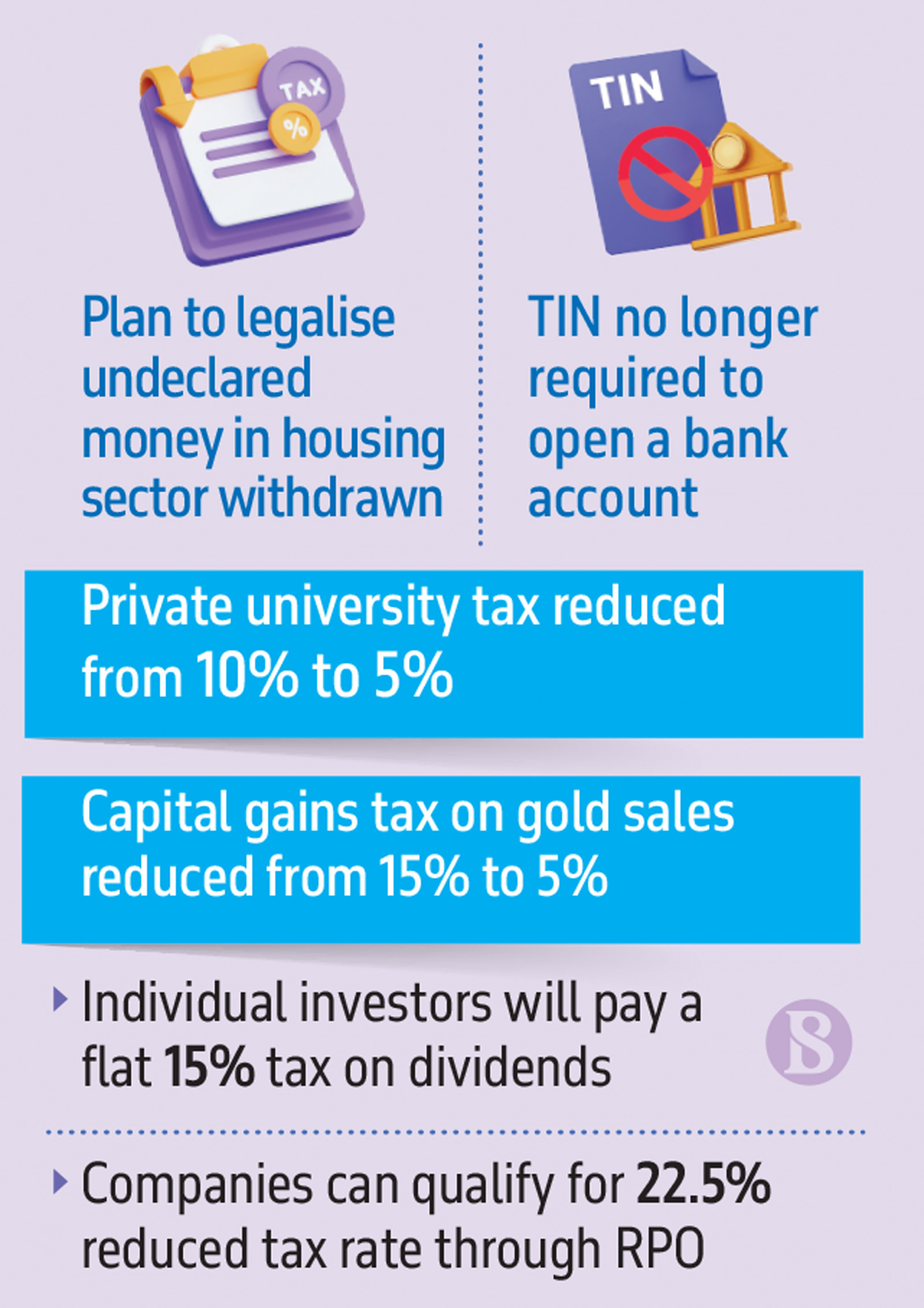
The government has scrapped both the proposed TIN requirement for opening bank accounts and a controversial provision that would have allowed unaccounted money to be invested in real estate without source scrutiny.

Highlights
- Finance Bill 2026 passed in parliament with key tax revisions
- Tax-free income threshold set at Tk4 lakh, rising to Tk5 lakh by FY31
- Govt withdraws provision allowing unexplained real estate investments without scrutiny
- Requirement for TIN to open bank accounts scrapped
- Tax rate for private universities cut to 5% with new sectoral exemptions introduced
Parliament today (29 June) passed the Finance Bill 2026 with several significant changes including raising the income tax-free threshold for individual taxpayers and withdrawing the proposed provision on the disclosure of investments.
Finance Minister Amir Khosru Mahmud Chowdhury moved the bill which was passed by voice vote.
Responding to requests made by the prime minister during his budget discussion speech, the finance minister revised several proposals in the national budget including increasing the income tax-free threshold for individual taxpayers over the next five fiscal years.
Under the revised proposal, the tax-free threshold has been set at Tk4,00,000 for FY2026-27 and FY2027-28, Tk4,50,000 for FY2028-29 and FY2029-30, and Tk5,00,000 for FY2030-31.
The proposed budget earlier proposed the thresholds at Tk3,75,000, Tk4,00,000 and Tk4,50,000 respectively for those periods.
 Keep updated, follow The Business Standard's Google news channel
Two other proposed measures that had created confusion among the public – making the submission of Taxpayer Identification Number (TIN) certificates mandatory for opening most bank accounts and requiring TIN certificates for the registration of partition deeds and property mutations – have been scrapped.
The government has also withdrawn a provision that would have allowed taxpayers investing unaccounted money in the real estate sector to do so without scrutiny over its source, following widespread criticism.
The income tax rate for private universities has been reduced from the existing 10% to 5%.
The government also expanded tax exemptions for indigenous communities in both the three hill districts and the plains by proposing that salary income, in addition to income from business, agriculture and other economic activities.
To support the shrimp sector, customs duty, regulatory duty, supplementary duty and VAT on imported shrimp feed, probiotics, vitamins, minerals, other essential inputs and related machinery will be withdrawn.
The government has reduced import duty on PVC and PET resin, widely used as industrial raw materials, from the proposed 10% to 5%.


