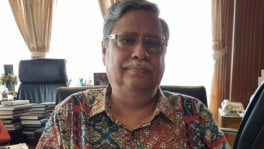
Temporary markets planned in 6 fields for hawkers: Dhaka North administrator
He expressed hope that this measure would keep the footpaths clear for pedestrians.

Dhaka North City Corporation Administrator Md Shafiqul Islam Khan has announced plans to establish temporary markets in six open fields to relocate hawkers and free up city footpaths.
Hawkers will be allowed to sit in these designated locations through a registration process, and a specific fee will be collected for the maintenance of these areas, the administrator said this morning (25 April) during a discussion organised by the Urban Development Journalists Forum Bangladesh (UDJFB) in Dhaka.
Shafiqul noted that where there were previously 200 hawkers on a sidewalk, the number has now surged to nearly 2,000, causing extreme public suffering.
 Keep updated, follow The Business Standard's Google news channel
He highlighted that even ambulance movement in front of hospitals is being obstructed.
"Because of 2% of the people, 98% are suffering," he remarked.
He further said no permanent structures will be permitted in the designated zones and that hawkers must conduct business using benches or trolleys, which must be removed at the end of each day.
He expressed hope that this measure would keep the footpaths clear for pedestrians.
Highlighting the lack of long-term planning in urban management, he said, "Most of what we do is temporary. Sustainable solutions are not possible without long-term planning."
He also stressed the need to bring the city corporation, Dhaka Water Supply and Sewerage Authority, gas and electricity agencies under a single coordinating authority.
Speaking as a special guest, Rajuk Chairman Md Riazul Islam said bringing urban services under one umbrella would reduce coordination gaps and improve service quality.
He noted that the lack of data often hinders effective planning.
He added that efforts are underway to recover parking spaces to ease traffic congestion and emphasised improving public transport.
Plans are also in place to revitalise the Purbachal project, he said.
Architect Sujaul Islam Khan commented that plans should not exist merely on paper; they must be implemented.
He pointed out that most of the capital's facilities are limited to the 5% elite living in areas like Gulshan and Banani, while those benefits have not reached areas like the Korail slum.
Dhaka Wasa Additional Chief Engineer Alamgir Hasin Ahmed said several water treatment plants are under construction, but administrative complications are delaying progress.
Speakers at the event emphasised the need for coordinated planning, data-driven decision-making and inclusive urban development.