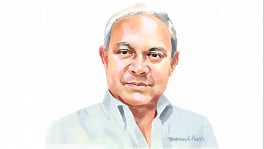
No secret that NCP is a 'king's party': TIB Executive Director Iftekharuzzaman
The TIB executive director further said efforts for institutional reform are being obstructed from within, and warned that a change in political power without a change in political practices is undermining the broader goals of the reform movement.

The National Citizen Party (NCP), formed in the aftermath of last year's mass uprising, is a "king's party" backed by the state and it is no secret, said Dr Iftekharuzzaman, executive director of Transparency International Bangladesh.
He made the remark in response to a question at a press conference held today at TIB's office in Dhanmondi, Dhaka. He also expressed grave concerns over widespread political violence, indiscriminate lawsuits, and stalled reforms under the interim government.
The briefing was organised to release a TIB research report titled "One Year After the Fall of an Authoritarian Government: Expectations and Realities", which paints a sobering picture of the post-uprising political landscape.
 Keep updated, follow The Business Standard's Google news channel
At the conference, Iftekharuzzaman, also a member of the National Consensus Commission, said the TIB research report noted that a political party – referred to as a "king's party" – has been formed under government patronage.
When a journalist asked which party this referred to, he replied, "There is nothing to hide. It is the NCP. This is because two of its key allies or associates are currently part of the government. In that sense, it fits the definition of a king's party."
Dr Iftekharuzzaman further described the political trajectory after 5 August as "unfortunate."
Explaining his remark, he said, "From that very afternoon, sections of top leaders from existing political parties resumed practices such as favouritism, extortion, and business of filing and withdrawing cases – activities that have only intensified over the past year."
"Even interventions from the highest levels of party leadership have failed to curb these practices. As a result, newly formed political parties have followed the same model from the very beginning, immersing themselves in land grabbing and extortion, and moving down a self-destructive path," he said.
What TIB's report say
According to TIB, the country has witnessed 471 incidents of political violence in the 11 months from August 2024 to June 2025, resulting in 121 deaths and over 5,000 injuries. Of these, 92% were linked to the BNP, 22% to the Awami League, 5% to Jamaat-e-Islami, and 1% to the NCP.
TIB also noted that after the fall of the previous government, political groups quickly moved to seize control of public resources. In Dhaka alone, around Tk2.21 crore is being extorted daily from 53 transport terminals once under Awami League control. Elsewhere, quarries, rivers, bridges, markets, and sandbanks have been forcibly taken over, often through violent or illegal means. Politically motivated cases have also been filed with specific intent.
Mobs have been formed, roads have been blocked, and police stations have been besieged in the name of protests – all of which have led to a worsening of the law and order situation, the report said. The watchdog said such actions, often politically motivated, are creating instability and threatening public safety across the country.
The TIB report further stated that indiscriminate lawsuits are undermining the integrity of the justice system. As of June 2025, there were around 150,000 pending cases related to the political upheaval, with over 4,100 people arrested.
Citing police headquarters data, TIB revealed that as of 29 July 2025, 351 cases – including 214 murder charges – had been filed against former prime minister Sheikh Hasina. Many of these were based on flimsy grounds, used to harass political opponents under what has been labelled "arrest business."
About 30% of these cases have made no progress due to vague charges and poorly conducted investigations, the report said. In some cases, the same person has been arrested multiple times in different locations, a serious violation of legal norms.
TIB's findings also raise concerns about enforced disappearances, with security forces allegedly destroying evidence and misidentifying innocent individuals. The lack of representation of women, religious minorities, and non-bureaucratic experts in reform commissions has further weakened public confidence.
The report also highlights systematic irregularities in key institutions such as the police, judiciary, and public administration. Issues include partisan appointments, lack of coordination, and weak leadership, all of which have contributed to a growing sense of disillusionment with the reform process.
TIB documented 496 cases of harassment against journalists between August 2024 and July 2025.
Of these, 266 were charged in cases linked to the July uprising, while three were killed in the line of duty.
Additionally, eight newspaper editors and 11 TV news chiefs were dismissed, with at least 150 journalists losing their jobs.
Mobs have been used to intimidate media offices, and fear continues to cloud the environment for free expression, the report said.
Reforms derailed, old politics resurfacing
Despite the interim government's initial promises, efforts to bring about meaningful reform have largely stalled, while old political practices have continued under new leadership, said Dr Iftekharuzzaman.
"Although the interim government began reforms with immense potential, many shortcomings and stagnation have emerged in reflecting the anti-discrimination spirit," he said.
The anti-corruption watchdog's report also expressed concern over the lack of constitutional and legal progress on reforms outlined in the July Charter. It further warned that delays in implementing key reforms, despite political consensus, could undermine the country's democratic transition and trigger renewed political unrest.
Noting that no fundamental change is visible in the country's political culture, Iftekharuzzaman said, "Those who feel overly empowered by the anti-discrimination movement, assuming they will form the next government, have continued the culture of partisanship, extortion, land grabbing, and dominance, which is a major challenge in achieving the goal of state reform."
The TIB executive director further said efforts for institutional reform are being obstructed from within, and warned that a change in political power without a change in political practices is undermining the broader goals of the reform movement.
"Those who were long outside the circles of power have simply replaced one party's influence with another. They are thinking, 'now it's our turn' – and that mindset is blocking the realisation of meaningful reform," he said.
He also criticised the growing influence of religion-based politics, which he said threatens efforts to build a non-communal, equal-rights-based and discrimination-free society.
Dr Iftekharuzzaman also expressed concern about the absence of key oversight bodies.
"Another alarming issue is the absence of the Information Commission and Human Rights Commission in Bangladesh in the past year. It is incomprehensible why this important issue did not receive priority from the interim government," he said.
He also noted that the failure to reform cybersecurity laws has allowed repressive provisions to remain in place, reflecting what he described as "a visible lack of government sincerity in eradicating the culture of fear."
He said intelligence agencies have also remained untouched, although their reform was "indispensable to change the authoritarian practices established over the last 16 years."
Addressing the broader administrative situation, he said, "It cannot be said that the law and order situation is completely under the control of the interim government."
According to him, instability within state institutions remains unresolved.
"The instability within various state institutions, including the police and administration, the attempt to create spheres of influence through a 'King's Party' even before ensuring justice, reform, and elections, and the government's indifference in addressing these issues are disappointing," he said.
Dr Iftekharuzzaman warned that the rare opportunity for reform following the fall of the previous regime is at risk of being wasted.
"If we fail to achieve the desired level of positive change by utilising this incredible opportunity, the responsibility lies with all of us," he said.