



How some budget proposals may fuel business costs, add pressure on consumers
Among the proposals is a new advance tax collection mechanism under which dealers would collect Tk2 in advance tax for every Tk1,000 worth of goods purchased by retailers.

Although most measures proposed in this year's budget have been welcomed as business- and taxpayer-friendly, economists and business leaders say some provisions could increase compliance burdens for businesses and ultimately place additional pressure on consumers.
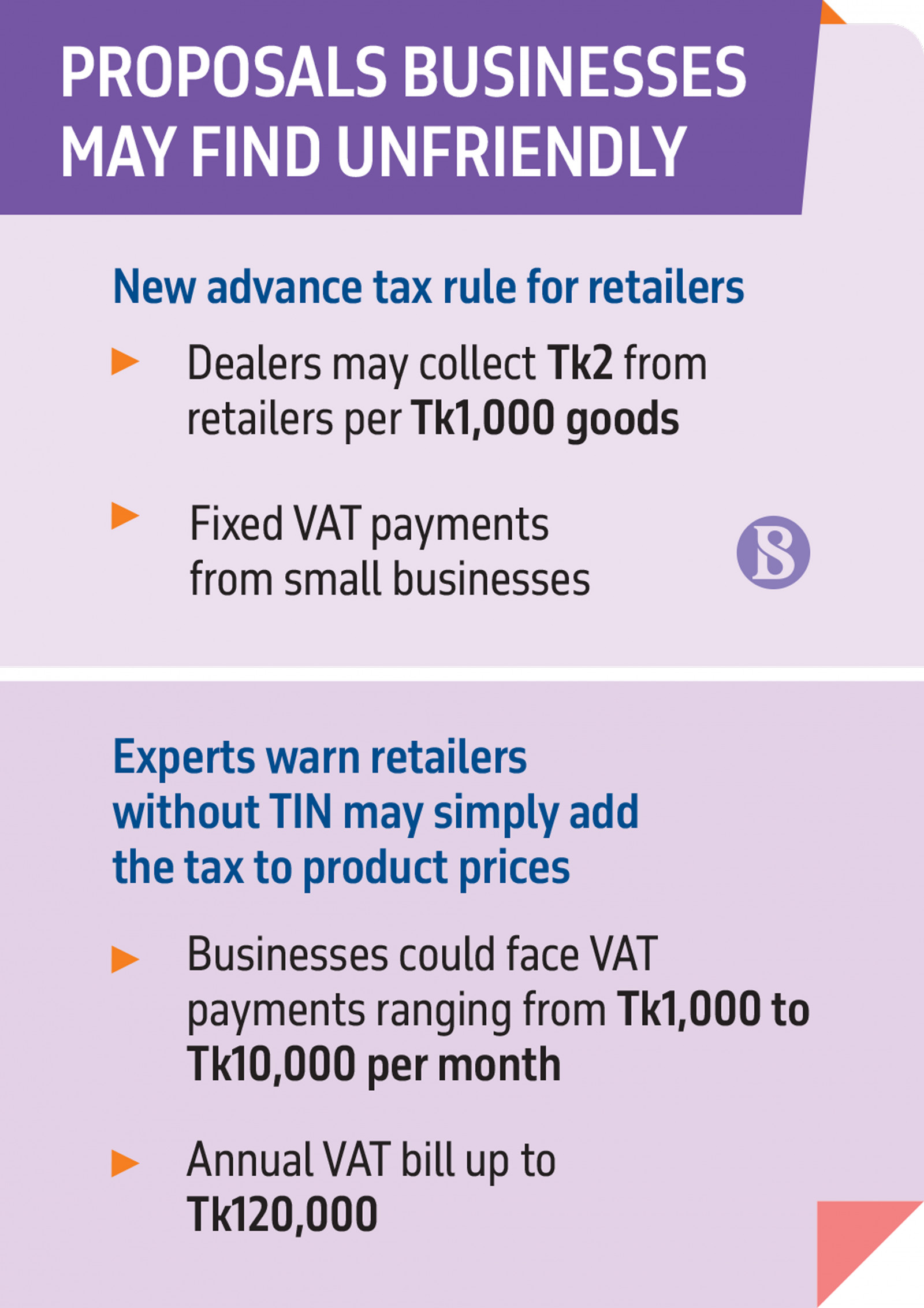
Among the proposals is a new advance tax collection mechanism under which dealers would collect Tk2 in advance tax for every Tk1,000 worth of goods purchased by retailers.
The government's objective is to bring more small businesses under the tax net. Under the proposed system, a portion of a retailer's annual earnings would effectively be collected in advance.
At the end of the financial year, retailers would be able to adjust the amount against their income tax liability when filing tax returns or seek a refund if they have no taxable income.
 Keep updated, follow The Business Standard's Google news channel
However, experts argue that the policy may not work as intended.
They point out that, with a few exceptions, most small retailers do not have Taxpayer Identification Numbers (TINs). As a result, many are unlikely to file tax returns or go through the process of claiming adjustments or refunds for the advance tax deducted from them.
Instead, they may simply add the extra cost to the prices of goods sold to consumers.
For example, if a retailer purchases goods worth Tk5,000 from a dealer, the dealer would collect Tk10 in advance tax under the proposed rate. Although the value of the goods remains Tk5,000, the retailer may effectively treat the purchase cost as Tk5,010 and incorporate that additional expense into the final selling price.
If a business pays Tk1,000 in advance tax over the course of a year, experts believe that amount could ultimately be recovered through higher prices charged to consumers.
The government is also planning to broaden the VAT net by introducing a specific tax regime for relatively small businesses, similar to the previous package VAT system. Details of the collection mechanism will be outlined in a separate regulation after the budget is announced.
According to officials at the National Board of Revenue, businesses under each VAT zone would initially be divided into five categories based on their size and estimated profitability. Monthly VAT payments ranging from Tk1,000 to Tk10,000 would then be imposed.
Business leaders fear that this measure could also lead to higher prices for goods and services.
For example, a business required to pay Tk10,000 in VAT each month would face an annual VAT bill of Tk120,000. To maintain profit margins, businesses may seek to recover at least part of that cost through higher prices, they argue.
A business leader, speaking to The Business Standard on condition of anonymity, said, "If tax is collected from retailers at the dealer level, they may simply add that amount to their purchase costs and pass it on through higher prices. Although the government intends to impose the tax on business income, in reality the burden will fall on consumers."
The same concern applies to the proposed VAT collection system, he said, arguing that it could add both costs and compliance burdens for businesses.
Abdul Wahed, president of the Chapai Nawabganj Chamber of Commerce and Industry, told TBS, "If VAT is collected in this way, it could increase both complications for businesses and opportunities for corruption. Instead of reaching the government treasury, some of the money could end up in the pockets of officials.
"However, we will be able to comment in more detail after seeing the final budget proposals."
Consumer advocates have also expressed concern about the potential impact on households.
AHM Shafiquzzaman, chairman of the Consumer Association of Bangladesh, said any tax or VAT collected from businesses would eventually be passed on to consumers.
"The amount recovered from consumers could be many times higher than the amount collected by the government," he said.
He noted that some traders earn substantial daily incomes and therefore should be brought into the tax net.
"A trader selling eggs at Karwan Bazar can earn Tk10,000 in a single day. So it is reasonable that such businesses pay tax, and that may be why the government is trying to expand the tax base," he said. "But businesses will ultimately pass those costs on to consumers."


