Oil extends gains after latest US strikes, tech suffers more losses
Oil prices surged more than 9% yesterday amid fears of renewed conflict and the possibility that another spike in inflation could force the Federal Reserve and other central banks to raise interest rates sooner than expected.

Highlights
- Fresh US strikes on Iran escalated regional tensions
- Iran attacked Hormuz shipping, then announced strait closure
- Oil prices rose as inflation fears intensified
- Trump proposed 20% Hormuz cargo fee, hinted at deal
- Global stocks, especially technology shares, extended broad declines
- Fed officials warned persistent inflation could require interest rate hikes
Oil prices jumped and stocks fell again today (14 July) after fresh US strikes against Iran marked a new escalation in hostilities, fuelling fears over an already fragile truce and raising concerns about another spike in inflation.
Technology firms were once again in the crosshairs, with South Korea's Kospi extending its painful sell-off as chip giant SK hynix continued to tumble amid growing fears that the AI boom may be losing momentum.
 Keep updated, follow The Business Standard's Google news channel
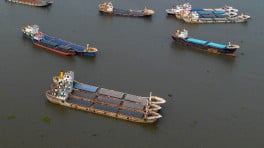
The latest attacks came after Iranian forces struck a commercial ship in the Strait of Hormuz- through which about one-fifth of global oil supplies pass- early on Sunday, before announcing the closure of the waterway.
That prompted a series of US strikes on sites in the Islamic republic, to which Iran responded by hitting targets in Bahrain, Jordan, Kuwait and Oman.
Before the latest US attacks, President Donald Trump told conservative radio host Hugh Hewitt on Monday: "We're going to hit them very hard tonight, and we're going to hit them hard tomorrow."
He later declared on Truth Social that the United States would be known as "THE GUARDIAN OF THE HORMUZ STRAIT" and would impose a 20% fee on all cargo shipped through the waterway.
While Iran's ports would again be blockaded, Trump said "all other countries will have fair and open use of the strait."
However, he also said a deal with Tehran to end the crisis remained possible.
"Yeah, I think a deal is possible. Sure, I do," he told reporters in the Oval Office. "We had a deal with them two days ago, and then they said, 'Oh, we can't make that deal. We have to negotiate it further.'"
Oil prices surged more than 9% yesterday amid fears of renewed conflict and the possibility that another spike in inflation could force the Federal Reserve and other central banks to raise interest rates sooner than expected.
Prices continued to rise on Tuesday, gaining more than 1%.
"With Trump, one never quite knows how seriously to take such pronouncements, but Gulf allies would not be pleased with this plan, and it almost certainly violates international law," said BNZ's Jason Wong.
"The 20% levy would add about $16 to the cost of every barrel of oil passing through the strait on a typical supertanker.
"It remains to be seen whether the plan will stick—probably not—and whether it is merely a negotiating tactic aimed at getting Iran to pause its military strikes on shipping in the area."
The renewed hostilities once again weighed on equities, compounding the sell-off in technology stocks that has characterised markets in recent weeks as investors worry the sector's AI-driven rally has gone too far.
Seoul again saw heavy selling, with SK hynix shedding more than 3%, following a 15% plunge the previous day. Its New York-listed shares—which had soared more than 13% on their debut on Friday—fell more than 9% on Monday.
Tokyo, Hong Kong, Sydney, Singapore, Taipei, Wellington, Manila and Jakarta also traded sharply lower.
The losses came at the start of a crucial week for investors, with the earnings season about to begin, Fed Chair Kevin Warsh scheduled to testify before Congress, and US inflation data due for release.
Meanwhile, Federal Reserve Governor Christopher Waller heightened concerns over a possible interest rate hike as inflation remained elevated.
"If we get another hot reading on core inflation this week, then the (rate-setting committee) will need to consider tightening monetary policy in the near term," he said on Monday.
Key figures at around 0230 GMT
- West Texas Intermediate: Up 1.3% at $79.15 a barrel
- Brent North Sea Crude: Up 0.7% at $83.91 a barrel
- Tokyo – Nikkei 225: Down 0.8% at 66,678.36 (break)
- Seoul – Kospi: Down 2.6% at 6,631.83
- Hong Kong – Hang Seng Index: Down 0.2% at 24,166.38
- Shanghai – Composite: Flat at 3,912.31
- Euro/dollar: Up at $1.1394 from $1.1384 on Monday
- Pound/dollar: Up at $1.3358 from $1.3353
- Dollar/yen: Down at ¥162.35 from ¥162.43
- Euro/pound: Up at 85.30 pence from 85.25 pence
- New York – Dow: Down 0.3% at 52,498.64 (close)
- London – FTSE 100: Flat at 10,498.29 (close)