Café de Volte cooks up a new flavour for Dhaka Theatre

There is a moment in Café de Volte when the audience gasps. Not because of something they see — there is no blood on stage, no theatrical gore — but because of what the lights and sound convince them they are witnessing. That gap between the real and the perceived is exactly where Hunt Production lives, and their debut show understands it with a confidence rare for any theatre group, let alone a new one.
The production, now in its eighth staging at the Studio Theatre Hall of Bangladesh Shilpakala Academy, centres on Max de Rosario — a Bangali Christian restaurateur who, at the inauguration of his establishment Café de Volte, quietly assumes control over the fates of four prominent citizens of Calicut. Max is not after revenge. He is not after justice in any conventional sense. What drives him is harder to name, and the play is wise enough not to name it for you.
On the surface, it sounds familiar — a wronged man, a reckoning, a room full of people who once had power over him. But Café de Volte cooks with familiar ingredients and presents an entirely new dish. The tale of an individual systematically stripped of his rights by society could easily collapse under its own weight, becoming a sermon. It never does.
 Keep updated, follow The Business Standard's Google news channel
With Café de Volte, she makes a credible first argument. Bangladeshi theatre has often asked its audiences to come to it on its own terms. Hunt Production does the opposite — it meets the audience where they are, speaks the way they speak, and then implicates them in something genuinely unsettling.
The dialogue, written by Abid Hasan, is startlingly modern — slangs slip in without announcement, conversations feel lived-in rather than scripted, and not a single line feels placed there to make a point. The point arrives anyway, which is the mark of good writing.
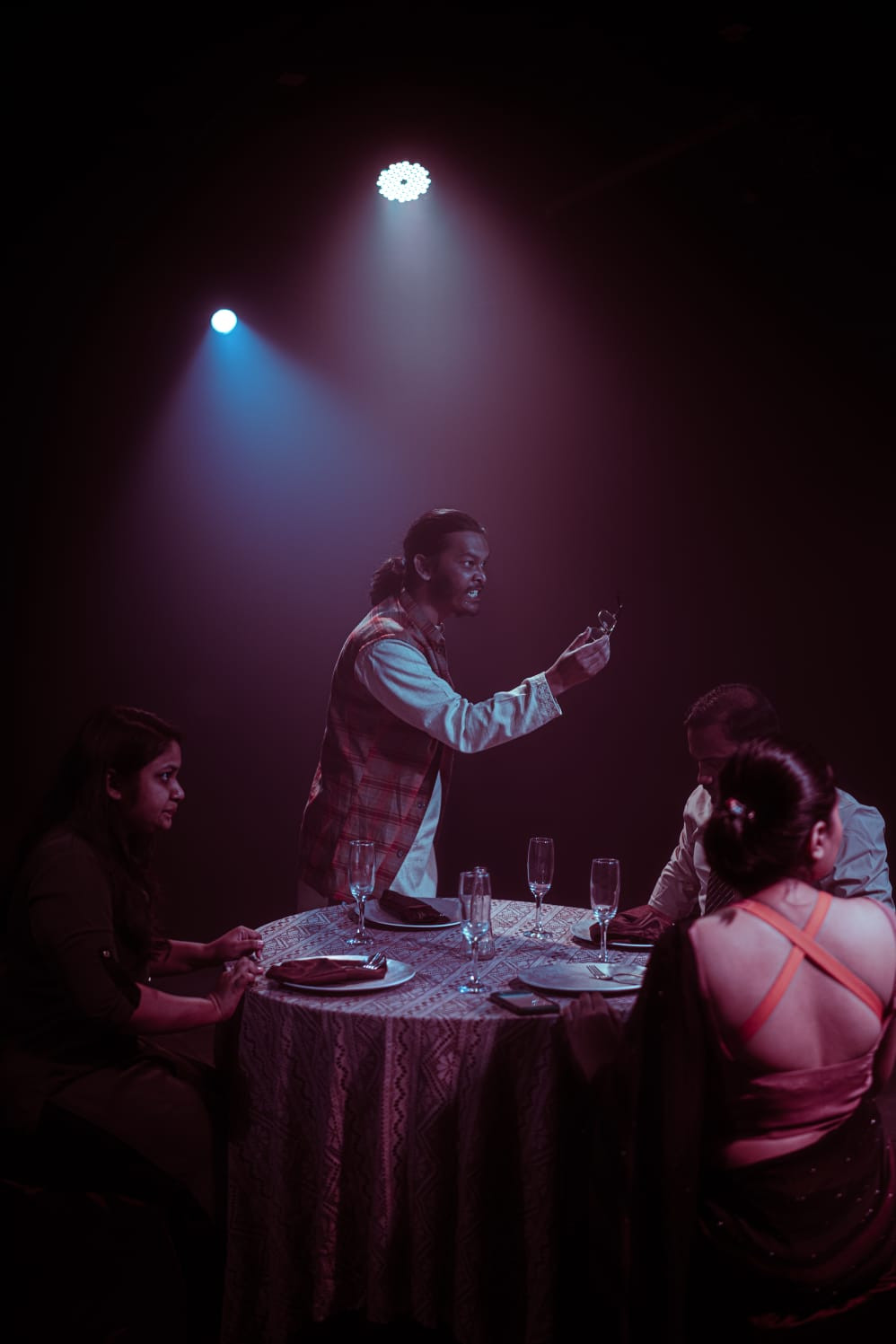
Much of that weight falls on Shahzada Samrat Chowdhury, who plays Max as a psychotic, deeply disturbed individual — and yet the audience ends up feeling for him most. It is a difficult tonal balance, sustaining sympathy for a man staging something close to a trial by terror, and Chowdhury holds it without overplaying a single beat.
Diana Marilyn, who also directs the production, delivers its most mesmerising performance. She makes the audience love her, then pulls back into something opaque and unsettling, and by the end earns their hostility too. That kind of range — charming, mysterious, and finally hateable — is not easy to sustain on a small studio stage where every face is visible.
The mise en scène, shaped by Mokhlesur Rahman's lighting and Charles Chowdhury's sound and music, does the heavy lifting in the production's most intense passages. Violence is suggested rather than shown, and the effect is more disturbing than spectacle would have been. The audience smiled, gasped, and leaned in — and crucially, they were never allowed to simply watch.
The show's interactive structure pulled every person in the room into the action; no one sat untouched, no one felt like a bystander. The premise made that impossible: your decisions, the show insists, are part of the story.

Marilyn has said she wants to change how theatre is perceived in Bangladesh. It is a bold ambition in a scene that has long defaulted to the pretentiously classical and the safely dated. With Café de Volte, she makes a credible first argument. Bangladeshi theatre has often asked its audiences to come to it on its own terms. Hunt Production does the opposite — it meets the audience where they are, speaks the way they speak, and then implicates them in something genuinely unsettling.
That is harder to pull off than it looks. The fact that it works, on the eighth show of a debut production, suggests Hunt Production is not a group to watch cautiously. They are one to take seriously now.