



Chasing dawn at Parbatipur, Bangladesh’s legendary railway crossroads
From brick kiln workers to university students, Parbatipur Junction Railway Station comes alive with diverse travellers after midnight. Spending a sleepless winter night at the historic station, the author documents the stories of some of the strangers he encounters

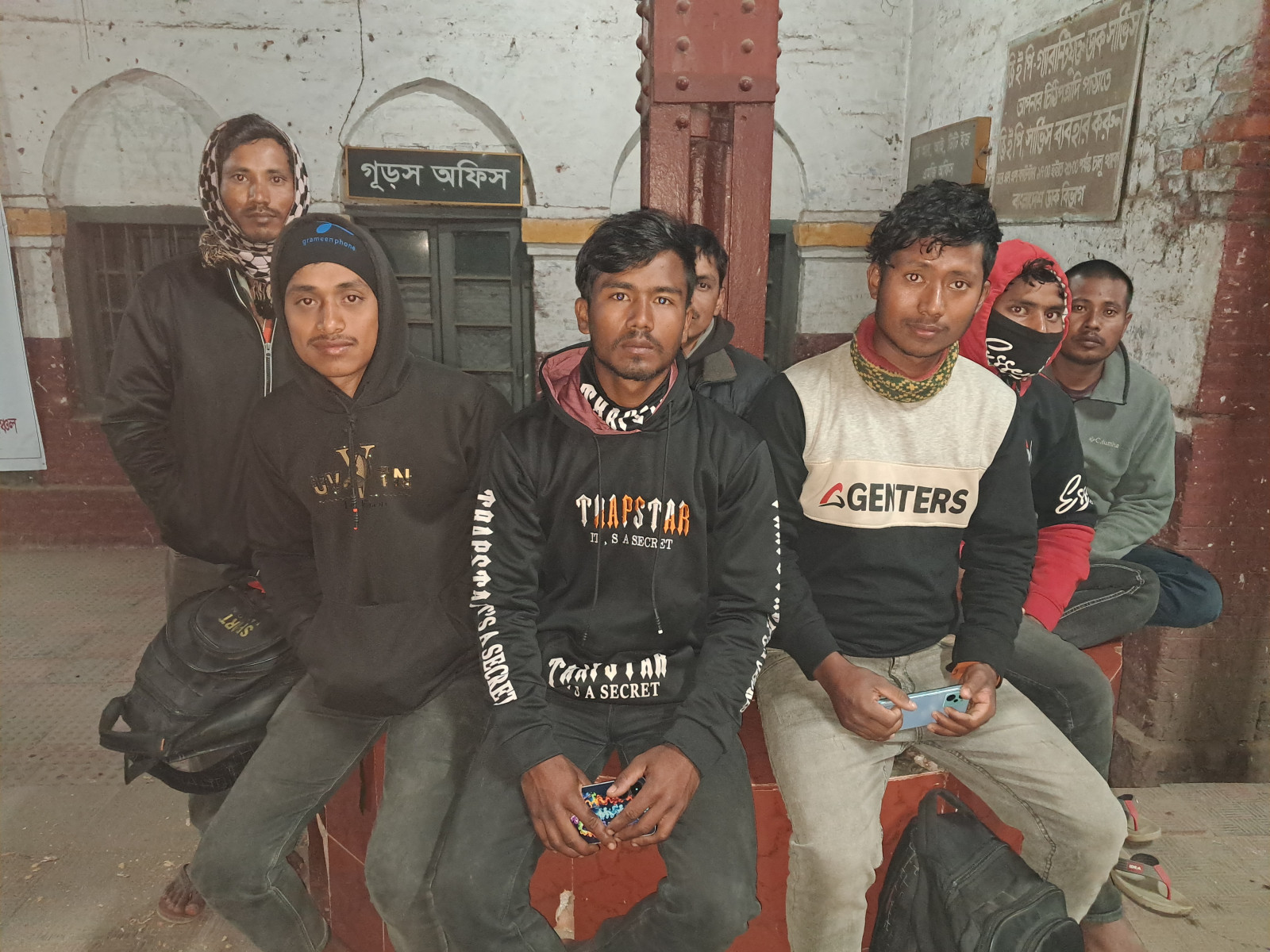
It is 10 minutes to midnight when three men and a woman arrive at Parbatipur Junction Railway Station in a rickshaw van. They are bundled up in sweaters, jackets and cardigans, and two of them have mufflers wrapped around their ears for extra protection against the late-January cold. As the men jump down, one of them takes the woman's hand to help her descend, and they all stride towards the platform with their luggage.
I wonder whether they will board the Dhaka-bound Ekota Express, which arrived at Platform 1 a few minutes ago from its northernmost terminus in Panchagarh. Not everyone in the station forecourt is in a hurry to catch a train, though. A few men amble around, while several others chat over steaming cups of tea in a corner where lights from multiple sources have thinned the darkness.
This corner houses a row of snack shops and an unassuming restaurant named Kutumbari, where a handful of customers are still dining. I sat there about two hours ago, having chicken khichuri for dinner. The food was decent and cheaper than in Dhaka, and I ordered a second serving after devouring the first to satisfy my intense hunger.
Tonight, I will stay awake to witness the station's nocturnal ambience, strike up conversations with strangers and keep an eye out for any sign of paranormal activity. I have never attempted anything like this before, and the idea initially sent a chill down my spine because of concerns about safety and the biting northern cold. But I finally mustered the courage to take the risk and boarded a train from Dhaka for the nine-hour journey to this historic junction.
 Keep updated, follow The Business Standard's Google news channel
Parbatipur, located in the north-western district of Dinajpur, emerged as a prominent railway town during the British Raj. The station, built in the 1870s on the old Kolkata–Siliguri route, became a key junction as lines branched eastwards to Kaunia in Rangpur and westwards to Dinajpur. Even after the 1947 Partition, the legendary Darjeeling Mail reportedly used this route to transport passengers until the 1965 India–Pakistan War.

Wrapped in blankets and quilts, men of various ages are scattered across the tiled floor of the entrance hall, lying on rugs as they sleep. The three ticket counters on the right, separated by metal barriers, are empty. Several vertical boards displaying train schedules, fare charts and other information are mounted on the wall.
"Are you looking for something?" a man sitting on the floor in a dimly lit corner asks in an ambivalent tone as I linger, taking photographs.
His hometown is in Dinajpur, but the station has been his home since 2010. He rents rugs to travellers, especially those who arrive at night and need something to sit or sleep on while waiting for their trains.
Sagor bought the rugs himself to start the business. He charges Tk20–30 per night. Some customers give him a tip out of appreciation.
This is not his main source of income. During the day, he works as an assistant at Kutumbari, although he has been off work for a while. He earns Tk400–500 a day there, along with three meals.
Built in the 1870s, Parbatipur Junction remains one of the country's most important railway crossroads.
Faisal, a young man sitting nearby, comes over when Sagor calls him. They share a common history—the same hometown, the same year of moving to Parbatipur and the same workplace. Faisal, who is single, enjoys working at Kutumbari, which is unofficially known as Muktijoddha Hotel.
For him, sleeping at the station during summer is more comfortable than in winter. In the hot season, he uses mosquito coils, while the ceiling fans help keep the insects away. Overall, he has no major complaints about life at the station.
He volunteers to show me around and leads me onto Platform 1, which stretches beneath rows of fluorescent lights and motionless ceiling fans. Red signal lights gleam in the distance. The long station building runs alongside the platform, its wall on this side painted in bands of red, white and yellow.
Cobwebs cling to the upper walls, where brooms may not have reached for days. Most of the rooms are locked, their grey doors and windows guarding the interiors until morning. Second-class male and female passengers have separate waiting rooms, and there is a bhojonaloy, a dining facility found at only a few British-era stations.
It is 2:00am. We pass the running room for train guards, a mosque, Railway Nirapatta Bahini (RNB) offices and other facilities lining the unshaded section of Platform 1. Faisal briefs me on the functions of each unit as we stroll towards the end of the long platform.
What I see ahead looks like the gateway to a dark and hazy world into which the parallel railway tracks disappear. White overhead lamps on both sides outnumber the red signals, but the latter stand closer to the tracks like watchful eyes. Passenger carriages lie idle on the sidings.
None of the five platforms is deserted yet. Dogs wander around, their occasional barks punctuating the incessant chirping of crickets. But what overwhelms all other sounds is the distant rumble of locomotives deployed for shunting and other operations.
We cross the tracks to Platform 2, walking up its inclined edge to find two puppies sitting outside a room without a door. Partly filled with sand, the room is housed in a white-walled building. The next room looks abandoned, with litter strewn across the floor and paint peeling from the walls, while the stench of urine lingers in the air.
Curled beneath blankets, several men sleep on the platform, which adjoins Platform 3. The walls of some of the small railway offices are covered with graffiti bearing slogans from the July 2024 uprising that ousted former Prime Minister Sheikh Hasina. Large mixing bowls and other street-food equipment, covered with plastic sheets, are tucked against a red wall on movable wooden stools, ready to be collected by vendors when they begin their morning trade.
Three teenage boys bantering in front of the area operating manager's office catch my attention. One of them is Md Sadman Sayeed Mohon, a first-year economics student at the renowned Carmichael College in Rangpur. He was born and raised in Rangpur and now lives in the city's Munshipara neighbourhood.
The three friends are waiting for the Banglabandha Express to travel to Panchagarh. They planned the trip impulsively the previous evening and took a train to Parbatipur. This will be their first visit to the country's northernmost district, where many travellers head in autumn to enjoy views of Kanchenjunga, the world's third-highest mountain.
"What do you like most about Rangpur?" I ask Mohon.
"The people and their behaviour. People are very friendly and lead simple lives. Overall, it is a peaceful place to live."
A loud whistle suddenly pierces the stillness of the night. Turning my head, I see the faint beam of a distant train's headlight. The light grows brighter as the train approaches Platform 2, the headlamp becoming a blazing orb.
"Banglabandha Express," Faisal asserts. After a 20-minute halt, its predominantly white carriages will roll onwards, carrying Mohon and his friends, along with hundreds of others, to Panchagarh. The train is named after a union in Tetulia Upazila, where winters are bitterly cold and temperatures frequently fall to the lowest levels recorded in the country.

Here in Parbatipur, it does not feel as cold as I expected. Although I have not zipped up my jacket, its thick padding provides enough warmth. It is not a windy night, and I am managing fine without my balaclava, which I normally never forget to bring on winter trips to the north.
I lie down on a bench beneath the weathered red trusses of the grey platform canopy, exhausted and sleepy. Before parting, Faisal assures me that I can find him in and around the ticket-counter area if I run into trouble. I thank him for his company and for the unsolicited assistance that made my job easier.
The clock is about to strike 4:00am. My feet are growing cold, and a slight chill bites at the tips of my ears. As more travellers arrive, their footsteps, muffled conversations and the cacophony of videos playing on mobile phones break the quiet of the platforms.
I follow some travellers into a gloomy waiting room, where rows of plastic chairs along the walls are occupied at random. With my legs stretched out and my bag resting on my lap, I sit down and try to sleep, but it remains elusive. I drift in and out of a light doze, waiting for dawn.
The night eventually surrenders to daybreak. As I step outside, the station suddenly looks unfamiliar, with a cool breeze brushing against my face and thick mist hanging over the horizon. The tracks I watched and the platforms I wandered throughout the night now make me feel like a traveller who has just arrived in Parbatipur.


